
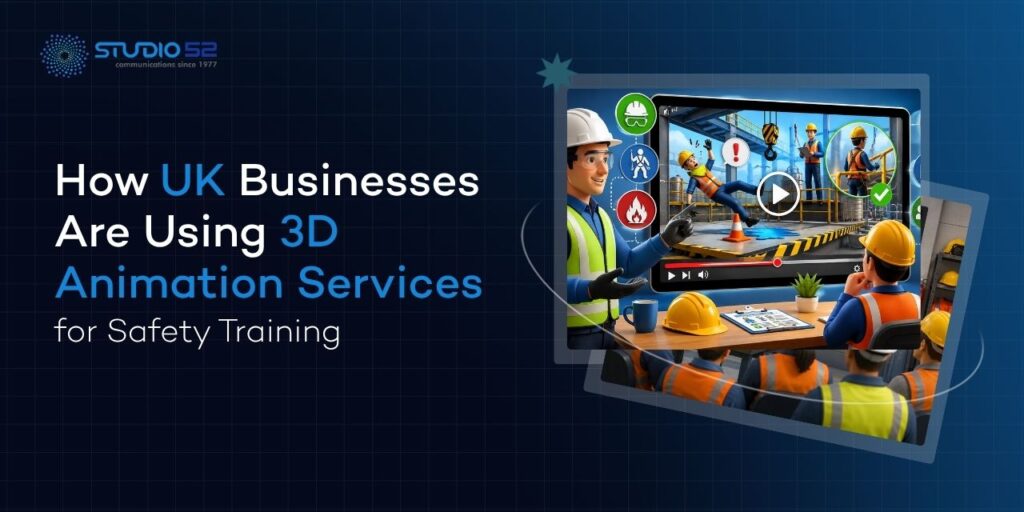

Workplace safety training in the UK is going through a real shift. Businesses are ditching outdated manuals and dull classroom sessions in favor of something employees actually pay attention to. 3D animation services are helping organizations across construction, manufacturing, logistics, and energy create training that sticks. This blog breaks down why UK companies are making the switch, the real benefits they’re seeing on the ground, and how the right 3D animation agency can change how your workforce learns safety.
Table of Content
Introduction
Ask any safety manager in the UK what their biggest training challenge is and most will say the same thing: getting people to actually engage with the content. A laminated poster on a break room wall. A forty-minute presentation nobody remembers by Friday. A printed induction booklet that gets skimmed in the car park.
None of it is working well enough. The numbers back that up. Workplace injuries and ill health still cost the UK economy an estimated £20.7 billion every year. That figure has not shifted enough despite decades of awareness campaigns and mandatory training requirements.
What is changing, though, is the approach. UK businesses are increasingly turning to safety training animation to replace or supplement traditional methods, and the difference in employee engagement is hard to argue with.
Understanding 3D Animation for Safety Training
At its core, 3D animation for safety training uses computer-generated environments to recreate real workplaces, machinery, and hazardous scenarios. The important distinction from live-action video is flexibility. You can show what is happening inside a pressurized gas line. You can put an employee inside a confined space scenario without any actual risk. You can slow down a split-second mechanical failure so a viewer understands exactly what went wrong and why.
A professional 3D animation studio builds these environments with accuracy, giving employers precise control over every detail an employee sees and hears. That level of control is difficult to achieve any other way.
Why Safety Training Is a Priority for UK Businesses
The Health and Safety at Work Act 1974 does not give employers much wiggle room. Adequate training is a legal requirement, not a recommendation. HSE enforcement notices land on businesses every year where training records are weak or absent, and the financial penalties are not insignificant.
Improve workplace safety communication with engaging HSE Animation Videos for oil & gas. Studio52 creates impactful safety animations that simplify complex procedures and help employees understand safety practices better.
Health and safety animation has moved from being a nice-to-have production investment to a genuine compliance tool. When your workforce operates in high-risk environments, demonstrable and documented training is the difference between regulatory confidence and serious liability.
Key Benefits of Using 3D Animation Services for Safety Training
Improved Employee Engagement
Workplace safety animation holds attention in a way that a PowerPoint deck simply does not. Real environments, realistic human characters, and cause-and-effect scenarios keep people watching and thinking.
Better Knowledge Retention
People remember what they visualize. Employees who go through 3D explainer animation UK training consistently outperform those trained through traditional written or verbal methods when assessed weeks later.
Safe Demonstration of High-Risk Scenarios
This is perhaps the most practical benefit. 3D industrial animation lets businesses walk employees through a chemical exposure, an electrical arc flash, or a vehicle collision in a training context, without anyone getting hurt.
Consistency Across Training Programs
One version of the truth, delivered identically across every site, every shift, every new starter. A 3D animation video maker removes the inconsistency that comes when five different trainers deliver the same topic in five different ways.
Cost Savings Over Time
The upfront cost of professional 3d animation is an investment, but the module does not need rebuilding every year. Update it when legislation changes, redistribute it digitally, and the per-employee training cost drops significantly over time.
Multilingual Training Capabilities
A 3D animation agency can add subtitles or voiceover tracks in multiple languages without remaking the visual content. For UK businesses employing diverse workforces, this matters practically.
Industries in the UK Benefiting from 3D Safety Animation Training
Construction
Falls from height remain the single biggest cause of fatal injuries in UK construction. Scaffold safety, edge protection, and site induction content translate particularly well into workplace safety animation because the visual element reinforces what workers need to picture before they step on site.
Oil and Gas
Few environments demand more rigorous preparation than offshore and onshore oil and gas operations. 3D industrial animation allows operators to simulate blowout scenarios, fire suppression responses, and emergency evacuations in accurate technical detail.
Manufacturing and Industrial
Press machinery, robotic systems, and chemical storage hazards cannot always be demonstrated safely on a live shop floor. A 3D animation company can recreate those environments without ever putting a trainee near real danger.
Logistics and Warehousing
Forklift collisions, manual handling injuries, and pedestrian segregation failures are consistent problems in UK warehouses. Animated content reaches large, distributed workforces without requiring everyone in the same room.
Energy and Utilities
High-voltage switching, confined space entry, and live cable procedures sit at the more dangerous end of any risk register. Health and safety animation gives utility workers thorough preparation before physical exposure.
Retail and Hospitality
High staff turnover makes consistent training difficult. Animated modules covering fire evacuation, lone working, and food safety deliver the same message to every new employee regardless of when or where they join.
How 3D Animation Improves Safety Compliance
Simplifying Regulatory Requirements
COSHH, PUWER, and working at height regulations. These frameworks are dense when read from a document. When visualized through animation, the same regulations become genuinely understandable to someone without a legal background.
Supporting HSE Standards
Content developed with HSE guidance embedded into the script gives employers confidence that what they’re delivering to employees actually reflects current regulatory expectations.
Documented Training Records
Digital delivery through a learning management system captures completion automatically. When an HSE inspector asks for evidence of training, those records are there without a paper chase.
Reducing Compliance Risks
Consistent training, properly recorded and visually engaging, does two things. It reduces incident likelihood, and it demonstrates due diligence if something does go wrong.
Real-World Applications of 3D Safety Training Videos
New Employee Safety Induction
Every new starter gets the same thorough onboarding experience, regardless of which site they join or which manager happens to be available that morning.
Machinery Operation Training
3D walkthroughs of equipment operation show employees exactly how to interact with machinery before they touch it, reducing both misuse and injury rates.
Emergency Preparedness Training
Evacuation routes, assembly points, and fire response procedures are far clearer when employees have already watched them play out in a realistic animated environment.
Hazard Identification Programs
Spotting risks in a simulated environment first means recognizing them faster in a real one.
Behavioral Safety Campaigns
Animation communicates the consequences of unsafe behaviors without pointing fingers at individuals, making it an effective tool for cultural safety messaging.
Features of Effective 3D Safety Training Videos
Good safety animation does not try to do too much in one sitting. The strongest modules run between three and seven minutes, focus on one scenario or procedure, include a clear voiceover, and end with an assessment that reinforces the key points. Multilingual options, realistic workplace environments, and identifiable characters all contribute to content that employees connect with rather than switch off from.
Choosing the Right 3D Animation Services Provider in the UK
Production quality matters, but it is not the only thing to look for. A provider’s familiarity with HSE requirements, their track record in safety-specific content, and their ability to manage a brief from concept to delivery without losing accuracy along the way are equally important.
Studio52 is a well-regarded 3D animation agency with substantial experience producing professional 3D animation for safety training across UK and international industries. Their team understands both the creative side of engaging animation and the regulatory side of workplace compliance, which is a combination that makes a genuine difference to the finished product.
Future Trends in 3D Animation for Safety Training
Virtual reality environments, AI-driven personalization, and branching scenario modules are all starting to appear in UK workplace training programs. These tools build directly on the 3D animation services infrastructure that businesses are already investing in, making early adoption a smart long-term position.
Conclusion
The businesses in the UK seeing the best safety outcomes are not necessarily those with the biggest budgets. They are the ones delivering training that employees actually engage with and remember. 3D animation achieves that in a way that traditional methods have consistently failed to. Whether your workforce is in construction, manufacturing, logistics, or retail, working with an experienced 3D animation company gives your safety training program a foundation worth building on.
If your current safety training is not landing the way it should, it might be time to look at what animation can do differently. Studio 52 works with UK businesses to develop professional 3D animation that meets compliance requirements and actually changes how employees think about safety.
Get in touch and start a conversation about what that could look like for your organization.
FAQs
What is 3D animation safety training?
Why is 3D animation effective for workplace safety training?
How do UK businesses use 3D animation for employee training?
How much do 3D animation services cost for safety training in the UK?
Can 3D safety training videos be customized for specific industries?
Why are UK companies investing in 3D animation services for safety training?
How can businesses choose the right 3D animation services provider?