
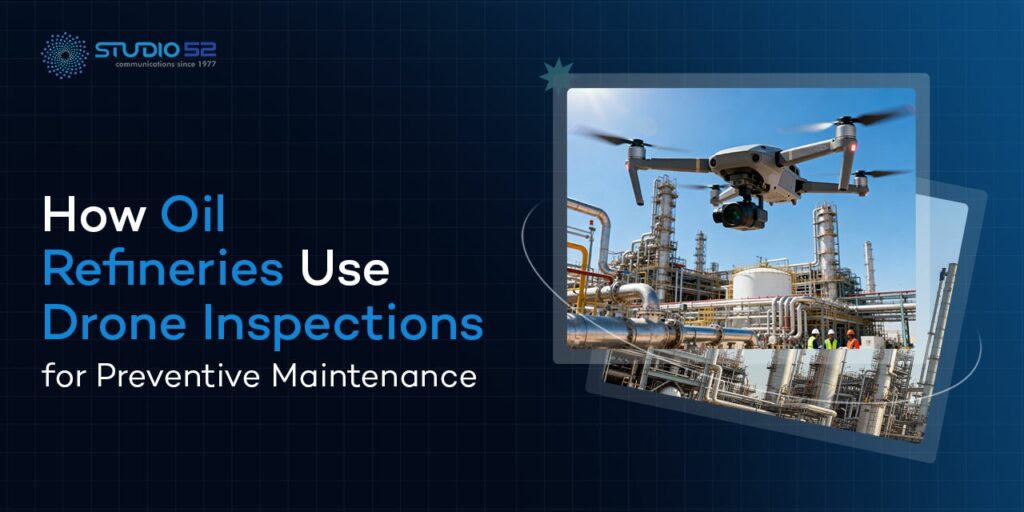

Oil refineries in Saudi Arabia are turning to drone inspections to strengthen their preventive maintenance programs. From scanning towering flare stacks to monitoring vast pipeline networks, drones deliver faster, safer, and more cost-effective inspection data than conventional methods. This blog explores how refinery drone inspection services work, which assets they cover, the role of thermal and AI technology, and why industrial drone inspection services are becoming essential across the oil and gas sector.
Saudi Arabia operates some of the most complex and high-capacity refining infrastructure in the world. With facilities running continuously under enormous pressure, the margin for undetected asset failure is almost zero. Maintenance teams carry the responsibility of keeping every component in working order, and the quality of that work depends directly on the inspection data they have access to.
For decades, getting that data meant rope access crews, scaffolding erection, and planned shutdowns just to get inspectors close enough to equipment for a meaningful assessment. The process was slow, costly, and regularly placed workers in genuinely hazardous positions. Drone inspections for oil refineries have changed that dynamic in a fundamental way, bringing faster access, richer data, and significantly reduced risk to an inspection process that had not evolved much in years.
Across the Kingdom, refinery drone inspection services are transitioning from pilot programs to standard operational practice. This blog covers the practical dimensions of that shift: what drone inspections involve, where they are applied, how they support maintenance strategy, and what refineries should look for when selecting a service partner.
Table of Content
Understanding Preventive Maintenance in Oil Refineries
Preventive maintenance in oil refineries refers to scheduled, condition-based work carried out before equipment fails rather than in response to a breakdown. The goal is to extend asset life, control unplanned downtime, and manage safety and environmental risks through systematic, data-driven intervention.
In Saudi Arabia, refineries operating under ARAMCO standards, SABIC guidelines, or international frameworks such as API and ISO carry detailed inspection and maintenance obligations. Compliance is non-negotiable, and the consequences of missing a developing fault range from emergency repair costs to serious safety incidents and regulatory exposure.
The effectiveness of any preventive program depends entirely on the quality of inspection data feeding into it. Infrequent, incomplete, or access-limited inspections create gaps in the maintenance plan that can allow deterioration to go undetected. That is where aerial inspection services for refineries have begun to close a longstanding problem, delivering faster and more complete condition data without the access barriers that limited traditional inspection approaches.
What Are Drone Inspections in Oil Refineries?
Drone inspections in oil refineries use unmanned aerial vehicles (UAVs) equipped with high-resolution cameras, thermal imaging sensors, gas detection payloads, and, in some cases, LiDAR scanning to assess asset condition from the air.
These are structured technical operations with defined flight paths, data collection protocols, and reporting outputs. Pilots or automated systems follow pre-planned routes designed to capture specific asset features at the angles and distances required for accurate analysis. Data gathered during the flight is processed to produce georeferenced inspection reports that identify anomalies by exact location on the asset.
The drone inspection in the oil and gas industry has grown substantially because this technology works across scenarios that challenge every conventional inspection method. It operates on live equipment under pressure, reaches elevated or confined areas without scaffolding, and covers large asset footprints efficiently. For a Saudi refinery spread across several square kilometers, that combination of access, speed, and safety is transformative.
Key Areas Where Oil Refineries Use Drone Inspections
Flare stacks and tall structures: Vertical assets present some of the greatest access challenges in a refinery. Industrial drone inspections allow close assessment of weld integrity, external coating condition, and structural deterioration at heights that would otherwise require specialist rope access teams or crane-assisted platforms.
Storage tanks: Drone surveys capture roof integrity, floating roof seal condition, shell corrosion, and venting system status. Aerial inspection services for refineries cover the full tank exterior in a single deployment, producing detailed visual records that support both maintenance planning and compliance documentation.
Above-ground pipelines: Pipeline inspection drones traverse long elevated pipe runs quickly, identifying coating breakdown, joint anomalies, and corrosion development across distances that ground crews would take considerably longer to cover manually.
Heat exchangers and cooling systems: Thermal payloads map temperature differentials across exchanger banks, identifying fouled or underperforming sections without requiring an equipment shutdown.
Structural steel and pipe racks: Visual inspection of pipe rack steelwork, support structures, and connections for corrosion, paint failure, and mechanical damage across the wide footprint of a Saudi refinery is significantly faster and less disruptive with drones.
Perimeter and fence-line monitoring: Drone monitoring for oil and gas facilities includes regular boundary checks that support both physical security and environmental compliance requirements in one operation.
Enhance safety and efficiency with Drone-Based Flare Stack Monitoring. Get real-time insights, reduce risks, and ensure compliance. Contact us today for reliable, high-quality drone inspection solutions tailored to your needs.
How Drone Inspections Support Preventive Maintenance
The relationship between drone inspections and preventive maintenance in oil refineries is direct. Each flight generates inspection data that enters the maintenance planning cycle at a point where intervention is still cost-effective.
Early in the program, drones establish a condition baseline for each asset. Surface coating quality, early-stage corrosion, insulation integrity, and structural condition are recorded and catalogued before any deterioration becomes critical. That baseline becomes the reference against which every future inspection is compared, allowing maintenance teams to track deterioration rates rather than simply discovering problems at an advanced stage.
Because deploying a UAV is far less disruptive and costly than traditional inspection methods, refineries can increase inspection frequency without a proportional rise in cost. More frequent data means deterioration is identified earlier, and maintenance can be timed precisely rather than scheduled conservatively to account for uncertainty. Industrial drone inspection services produce structured, georeferenced reports that integrate into asset management systems, shortening the gap between inspection completion and work order generation.
Perhaps most significantly for Saudi facilities where throughput is a priority, drones reduce reliance on shutdown-dependent inspections. Drone monitoring for oil and gas facilities allows many condition checks to be completed on live, operating equipment, preserving production continuity while maintaining full inspection compliance.
Major Benefits of Drone Inspections in Oil Refineries
Worker safety: Keeping inspection personnel on the ground and away from elevated, confined, or chemically hazardous areas is the most immediate benefit of drone inspections for oil refineries. Falls, heat exposure, and chemical contact incidents associated with conventional access methods are substantially reduced.
Inspection speed: What a ground crew might take several days to inspect, a drone team can often complete in hours. This speed advantage is particularly valuable during tight maintenance windows when every hour of equipment availability counts.
Cost reduction: Eliminating scaffolding, rope access mobilisation, and extended shutdown time produces significant savings per inspection cycle. Refinery drone inspection services consistently deliver lower per-inspection costs than the conventional methods they replace.
Data quality: High-resolution imagery, thermal mapping, and sensor data collected by industrial drone inspection services exceed what human inspectors can consistently capture under field conditions, particularly on elevated or difficult-to-access assets.
Compliance documentation: Timestamped, georeferenced inspection reports satisfy the documentation requirements of Saudi regulators and international inspection standards, supporting audit readiness without additional administrative burden.
Role of Thermal and AI Technology in Drone Inspections
Two technological developments have substantially raised the value of drone inspection in the oil and gas industry: thermal imaging and AI-assisted data analysis.
Thermal imaging detects heat signatures that are invisible to standard cameras. Overloaded electrical components appear as hot spots. Blocked heat exchanger tubes show uneven temperature distribution. Insulation failures on pipelines register as thermal anomalies against the ambient environment. In Saudi Arabia, where summer surface temperatures routinely exceed 60 degrees Celsius, thermal drones provide inspection data that would be impractical to collect through any other means.
AI-assisted image processing automates the identification of anomalies across the data captured during aerial inspection services for refineries. Machine learning models trained on refinery inspection datasets can detect corrosion patches, coating failures, surface cracks, and structural deformations faster and more consistently than manual image review. This compresses the time between flight completion and actionable maintenance recommendations.
Together, these technologies are pushing industrial drone inspections from condition documentation toward predictive capability. When flight data is combined with historical maintenance records and operational parameters, it becomes possible to model asset failure probability and schedule interventions at the most cost-effective point.
Choosing the Right Drone Inspection Service Provider
Selecting the right partner for refinery drone inspection services requires evaluation across several areas beyond equipment specifications.
Industry experience is the most important factor. Operating UAVs in a working refinery demands teams who understand permit-to-work systems, hazardous area classifications, and the specific risks of flying near pressurised or flammable systems. Providers without genuine refinery operational experience represent a safety risk regardless of their hardware quality.
Data deliverables are equally critical. The value of any drone inspection program lies in what is done with the data after the flight. Look for providers who deliver structured, georeferenced reports in formats compatible with your asset management system, not simply raw video footage.
Multi-sensor capability is now essential for refinery applications. Confirm that any provider operates platforms capable of visual, thermal, and gas detection payloads.
Studio52 has built a strong operational track record in this space across the GCC. With extensive experience delivering industrial drone inspection services to refinery and energy sector clients in Saudi Arabia, Studio52 combines certified UAV operations with professional-grade data analysis and structured maintenance reporting. Their teams work within the strict safety frameworks of Gulf-region energy facilities, and their deliverables are designed to feed directly into maintenance planning systems.
If your refinery is evaluating drone monitoring for oil and gas facilities, contact Studio52 to discuss a structured inspection pilot tailored to your asset profile and maintenance objectives.
Conclusion
Drone inspections for oil refineries address three of the most persistent challenges in refinery maintenance simultaneously: access, speed, and data quality. For Saudi facilities operating under continuous production pressure and stringent compliance requirements, that combination delivers genuine operational value.
As pipeline inspection drones, thermal platforms, and AI analysis tools continue to develop, the gap between drone-based and conventional inspection capabilities will widen further. Refineries that build drone inspection programs now are establishing the data foundation that will support increasingly sophisticated predictive maintenance strategies over the coming years.
The practical starting point is a structured pilot program. Select a representative set of high-priority assets, partner with an experienced provider such as Studio52, and measure outcomes against your current inspection baseline. The results will make the case for broader adoption.
Reach out to Studio52 today to learn how their refinery drone inspection services can support your preventive maintenance program in Saudi Arabia.