You have probably watched a dubbed video and felt something was off. The voice did not match the emotion on screen. The words were technically correct but somehow hollow. You moved on within seconds.
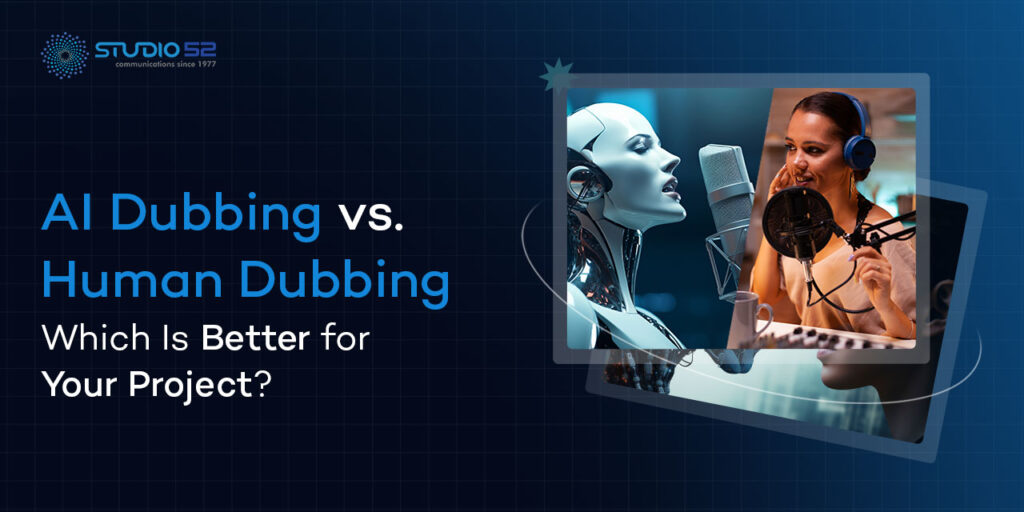
That is not a small problem. In a world where content competes for every second of attention, dubbing services play an important role in determining how naturally and effectively your message reaches its audience. And today, with AI voice dubbing entering the mainstream, content teams everywhere are asking the same question: do we go with AI or stick with human talent?
There is no one-size-fits-all answer. But by the end of this blog, you will know exactly which option fits your project, your budget, and your audience. Before making that choice, it helps to understand the dubbing process and the professionals involved at each stage.
Table of Content
The State of Dubbing in 2025
The dubbing industry has changed more in the last three years than in the previous two decades. AI voice over tools can now clone voices, sync lip movements, and deliver multilingual output in a fraction of the time it used to take. For businesses producing content at scale, that is genuinely exciting.
But human dubbing professionals have not stood still either. Studios like Studio 52 have evolved their workflows, integrating new tools while keeping creative and cultural expertise at the core of every project.
So the real conversation is not AI versus human. It is about understanding what each brings to the table and why dubbing matters for your brand.
Where AI Voice Dubbing Excels
Let us give credit where it is due. AI voice dubbing has earned its place in the content production world, and here is why.
Speed at scale. If you need 30 training videos dubbed into 8 languages by next Friday, AI can handle that volume without studio bookings, scheduling conflicts, or re-recording sessions. It removes production bottlenecks in a way that human workflows simply cannot match at the same pace.
Lower upfront cost. For startups, small businesses, or internal content that does not need broadcast-level polish, AI voice dubbing is a cost-effective entry point into multilingual content.
Consistency across large volumes. When you need hundreds of pieces of content to sound uniform, such as e-learning modules or product tutorials, AI delivers consistent output without the natural variability that comes with human performance.
Quick revisions. Swap a line, update a number, change a product name. AI tools make small edits fast without the need to rebook studio time or reschedule a voice artist.
For informational, high-volume, or internally focused content, AI voice dubbing is a smart and practical tool.
Where Human Dubbing Services Win
Now, here is what AI still cannot replicate, no matter how advanced the models get.
Emotional depth and performance. They know when to slow down for impact, when a line carries grief or irony or humor, and why the human voice still matters when emotional connection is central to the message. They understand the subtext. That level of nuance is what separates content that connects from content that just informs.
When you look at AI voice-over vs human voice-over comparisons in brand campaigns or entertainment content, the emotional gap is consistent and significant. Audiences feel it even if they cannot name it.
Cultural intelligence. Language is not just vocabulary. It is rhythm, reference, and context. A phrase that resonates deeply in one culture may land awkwardly in another, even when translated correctly. Human dubbing professionals understand these layers. They adapt tone, phrasing, and delivery to fit the cultural reality of the target audience.
This is especially critical in markets across the Middle East, South Asia, and other regions where Studio 52 has deep expertise. Getting the cultural register right is not optional. It is what determines whether your content feels local or foreign.
Brand voice and consistency. For companies with a defined brand identity, the voice carrying their message needs to feel human, recognizable, and intentional. AI can approximate a voice, but it cannot own one the way a trained professional can. If your brand voice is a core asset, protecting it matters.
Complex creative content. Films, documentaries, branded storytelling, character-driven advertising. These formats demand performance, not just pronunciation. Human dubbing services are built for this kind of work.
The Cost Conversation Nobody Has Honestly
Yes, AI dubbing costs less upfront. That is a real fact and not one to dismiss.
But here is what the cost comparison often leaves out.
Poorly dubbed content costs you audience trust. A robotic voice on a client-facing video, an awkward pronunciation in a regional market, a tone that feels off in an emotional brand film. These things have a measurable impact on how your audience perceives you.
Fixing substandard AI dubbing still takes time and money. And re-dubbing content that missed the mark the first time around is never cheap.
Professional dubbing services from Studio 52 are priced to be competitive, with clear packages designed for different project scales. You are not paying for luxury. You are paying for content that does its job properly the first time.
Matching the Tool to the Project
This is the practical framework every content team should be using.
Choose AI voice dubbing when:
You are producing internal training content where informational clarity matters more than emotional delivery. You need rapid multilingual rollout for e-learning or product documentation. You are creating draft versions for review before final human production. Your content is short, neutral in tone, and high in volume.
Choose human dubbing services when:
Your content will be seen by external audiences, clients, or consumers. Emotion, trust, or brand identity is part of what you are communicating. You are working in culturally specific markets where local nuance is non-negotiable. Your project involves storytelling, character performance, or advertising with creative depth. You cannot afford a second chance to make a first impression.
Consider a hybrid approach when:
You need the speed and scale of AI with the quality assurance of human oversight. Many studios, including Studio 52, now offer production models that combine both, using AI tools to accelerate timelines while keeping experienced professionals in the loop for review, cultural adaptation, and emotionally critical content.
A Quick Reality Check
Here is a scenario worth thinking through.
Imagine a global brand launching a campaign across the Gulf region. They use AI dubbing to save budget. The voice output is technically accurate but culturally flat. Regional audiences notice. Engagement drops. The campaign underperforms.
Now compare that to the same brand working with Studio 52’s professional dubbing team, who adapt not just the language but the tone, pacing, and cultural references to feel genuinely local. The campaign connects. The numbers reflect it.
The difference in production cost between the two scenarios is real but finite. The difference in campaign outcome is compounding.
Why Studio 52 Belongs in This Conversation
Studio 52 has been delivering voice dubbing services and professional dubbing services across industries for years. With a roster of trained voice artists, linguists, and audio production specialists, the team brings together creative craft and technical precision on every project.
Whether you need Arabic dubbing for a regional audience, multilingual dubbing for a global rollout, or a hybrid production model that blends AI efficiency with human quality, Studio 52 has built the infrastructure to deliver it.
The studio works with brands, agencies, broadcasters, e-learning platforms, and corporate teams, and has earned its reputation by treating every project as a communication challenge, not just a production task.
If your content needs to connect, perform, and represent your brand well, Studio 52 is the partner to call.
Ready to figure out the right dubbing approach for your next project? Reach out to Studio 52 and get expert guidance tailored to your goals, timeline, and audience.
Final Thoughts
The AI dubbing vs human dubbing debate is not really about which technology is better in the abstract. It is about what your content needs to do, who it needs to reach, and what is at stake if it misses.
AI voice dubbing is a genuine tool with real advantages in the right context. Human dubbing services are irreplaceable when performance, culture, and connection are on the line.
Stop guessing what your content needs. Talk to the experts at Studio 52 and get dubbing that actually performs.