
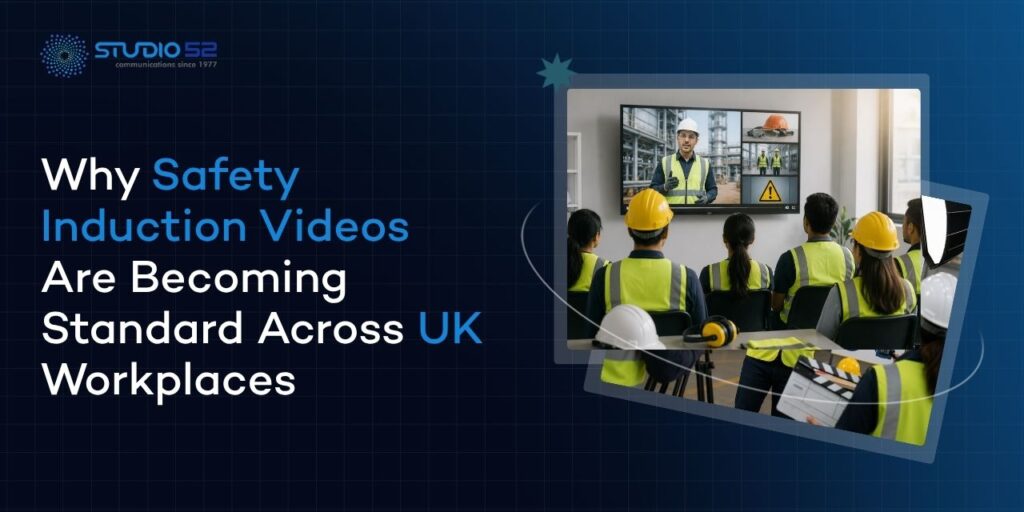

Across UK industries, safety induction videos have become the go-to approach for getting workers trained, compliant, and site-ready from day one. From consistent messaging to multilingual accessibility, video simply outperforms everything that came before it. This blog breaks down why organizations are making the switch, what separates a good induction video from a forgettable one, and why professional safety induction video production is worth every penny.
Walk onto any major UK construction site, manufacturing plant, or logistics hub today and you will likely find the same thing happening before work begins. Workers are watching a screen. Not sitting through a talk, not flipping through a laminated sheet, but watching a proper safety video production that covers everything they need to know before they touch a single piece of equipment. This shift has not happened by accident. It has happened because employers got tired of incidents that should never have occurred and because video works in ways that older induction methods simply cannot match.
Table of Content
The Growing Importance of Workplace Safety in the UK
The numbers from the Health and Safety Executive make uncomfortable reading. Over 135 workers lost their lives at work in 2022/23, and hundreds of thousands more suffered injuries that ranged from minor to life-changing. UK employers carry real legal weight under the Health and Safety at Work Act 1974, and regulators are watching more closely than ever. A well-produced HSE induction video gives organisations a way to meet those obligations properly. not just tick a box. It also sets the tone from the start, which matters more than most employers realize.
Why Traditional Safety Inductions Are No Longer Enough
There is nothing wrong with the intention behind a verbal briefing or a printed safety booklet. The problem is what actually happens in practice. Workers zone out. Pages get skimmed or skipped entirely. On sites where English is not everyone’s first language, critical information gets lost completely. A site induction video removes all of that uncertainty. The message is the same every single time; it is easy to track who has completed it, and it presents safety information in a format that people genuinely pay attention to. It is not a complicated argument.
Why UK Workplace Is Switching to Safety Induction Videos
Consistent Delivery of Safety Information
A site safety induction video does not have good days and bad days. It does not rush through the fire evacuation section because lunch is running late. Every worker, on every shift, at every location, gets the same complete and accurate safety briefing. That consistency alone makes it worth doing.
Better Employee Engagement
Nobody gets excited about a slideshow. Safety induction training videos that combine real scenarios, clear visuals, and professional narration are a different thing entirely. Workers actually watch them. And workers who are paying attention are the ones who remember what to do when something goes wrong.
Improved Knowledge Retention
Research has consistently shown that people hold onto information far better when it comes through video than when they read it off a page. An HSE induction video that shows the correct use of PPE, the location of emergency exits, and the procedure for reporting a hazard is not just informative. It is memorable. That is the whole point.
Time and Cost Efficiency
Running a live induction every time a new contractor arrives on site costs time, and time costs money. A single safety induction video can be used across multiple sites, multiple teams, and multiple years.
Supports Diverse Workforces
UK job sites are genuinely diverse, and that is a good thing. But it does create a communication challenge when safety information needs to reach everyone equally. Animated site safety induction videos with multilingual voiceovers or subtitles make sure that language is never a barrier to understanding something that could save a life.
Enhanced Safety Culture
Workers notice when a company has put real effort into its safety training. A professionally produced safety induction training video tells people that safety is taken seriously here before they have even met their line manager. Enhance workplace safety with expert safety training video production that simplifies complex safety guidelines and improves employee knowledge retention.
Key Features of an Effective Safety Induction Video
Clear and Simple Messaging — Speak plainly. Workers need to understand the rules immediately and act on them without having to decode complicated language.
Site-Specific Content — Generic site safety induction videos only go so far. The most effective ones reflect the actual hazards, layout, and working conditions of the specific location.
High-Quality Visual Demonstrations — Showing someone putting on a hard hat correctly is worth more than a paragraph of text describing it.
Engaging Storytelling and Animation — A narrative thread keeps viewers engaged. Animation makes complex or dangerous scenarios easy to demonstrate without staging anything risky.
Multilingual Support — Subtitles and translated voiceovers make sure that every single worker leaves the induction fully informed, regardless of background.
The Role of Professional Safety Video Production in Effective Training
A poorly produced video does real damage. Bad audio, clunky visuals, and weak scripting do not just fail to engage workers; they actively undermine the message. Workers see it as an afterthought, and they treat it like one. Professional safety induction video changes that entirely. At Studio 52, we build safety training content from the ground up, tailored to your site, your workforce, and your specific compliance requirements. The result is a video people actually watch, with content they actually retain.
Future Trends in Workplace Safety Training
The direction things are heading is clear. VR site walkthroughs, interactive assessments, and AI-personalized training are already being used by the more forward-thinking UK organizations. Animation is increasingly the format of choice for anything involving complex hazards or high-risk demonstrations, which is making animated site safety induction videos a genuinely smart long-term investment. The tools are evolving, but the goal stays constant: safety information that reaches every worker, without exception, every time.
Conclusion
The days of handing someone a leaflet and calling it an induction are behind us, and they are not coming back. A professionally made health and safety induction video protects workers, satisfies the HSE, and builds a safety culture that holds up under pressure. If your current induction process would not stand up to scrutiny, that is not a small problem. It is the kind of thing that ends careers and costs lives. Sorting it out should be at the top of the list.
Studio52 creates professional safety induction videos built around your site, your people, and your compliance requirements. If your current inductions are not doing the job, we can fix that. Get in touch with the Studio 52 team today and find out what a properly produced safety training video can do for your workplace.
UK: +44-2030-965422
UAE: +971 44541054
Saudi: +966 12 4220506
Email: askus@studio52.tv
FAQs
What is a safety induction video?
Why are safety induction videos important in UK workplaces?
Which industries benefit most from safety induction videos?
What should be included in a workplace safety induction video?
How do safety videos reduce workplace accidents?
How much does a professional safety induction video cost in the UK?
What are the benefits of animated safety induction videos?