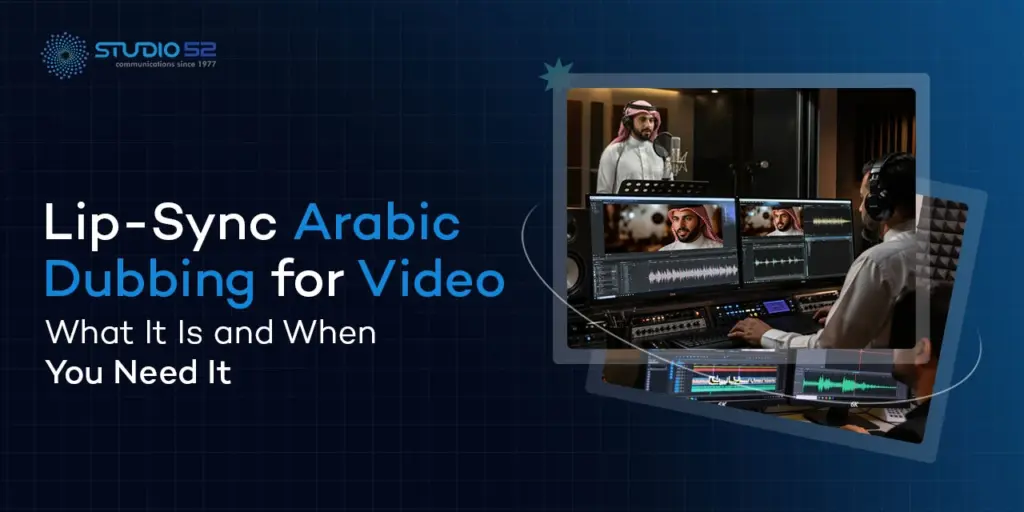

Lip-sync Arabic dubbing replaces a video’s original dialogue with Arabic audio timed to match the speaker’s lip movements, creating an experience that feels native rather than translated. This guide covers how it differs from standard voice over, the studio process from script adaptation to final mixing, and when businesses in the UAE and GCC should invest in it, from product ads to entertainment and e-learning. It also outlines what to look for in a dubbing partner and why Studio52 is a trusted choice.
Anyone who has tried to localize video content for the Arab world has run into this fork in the road: do you go with voice over, or do you go all in on lip-sync dubbing? They sound similar on paper. In practice, they produce two very different viewer experiences, and picking the wrong one can quietly undercut a video that otherwise took weeks to produce.
Lip-sync Arabic dubbing is the more demanding of the two. It replaces the original dialogue with Arabic audio that is timed to match the actor’s mouth movements, so the video feels like it was shot in Arabic rather than translated into it. Below, we will walk through what that actually involves, how studios pull it off, and when it is worth the extra time and budget over a standard voice over.
Table of Content
What Is Lip-Sync Arabic Dubbing?
Definition and How It Works
At its core, lip-sync Arabic dubbing means re-recording the entire dialogue track in Arabic and syncing it to the speaker’s lips on screen. Not layering a translation over the top. Replacing it entirely, and timing every line so it lands when the mouth opens, closes, and shapes each syllable.
That is harder than it sounds. Translators cannot just translate; they have to adapt sentence length so the Arabic dialogue fits the same window of time as the original speech. Then the voice actor has to deliver those lines with pacing that actually lines up with what is happening on screen. Get either piece wrong and viewers notice immediately, even if they cannot quite say why something feels off.
Lip-Sync Dubbing vs. Standard Voice Over Dubbing
Standard voice over, sometimes called UN style dubbing, leaves a faint trace of the original audio playing under the translated narration. You have probably seen this in documentaries. It is quicker to produce, costs less, and works fine when the goal is simply getting information across.
Lip-sync dubbing strips the original audio out completely. Every line is re-recorded and timed to match the visuals, which takes more script work, more direction, and more studio time. The payoff is a video that does not feel dubbed at all. It just feels like the person on screen speaks Arabic.
The Process Behind Arabic Dubbing Services Dubai
Script Translation and Adaptation
This is where most projects are won or lost, honestly. The script gets translated, then reworked so the phrasing fits the same rhythm and timing as the source footage. A translation can be perfectly accurate and still wreck the lip-sync if it runs too long or too short for the scene.
Casting Native Arabic Voice Talent
Casting comes next, and dialect is the decision that matters most here. Gulf Arabic, Modern Standard Arabic, and Egyptian Arabic each land differently depending on who you are talking to, so this should be driven by your actual target market rather than habit.
Recording and Lip-Sync Timing
During recording, voice actors work through the footage scene by scene, adjusting delivery until it matches the timing on screen. Directors and sound engineers keep fine tuning the pacing and pauses so nothing drifts ahead of or behind the visuals.
Audio Mixing and Final Quality Check
Once the dialogue is recorded, it gets mixed against the sound effects and music, then checked scene by scene for lip-sync accuracy before anything gets signed off.
When You Need Lip-Sync Arabic Dubbing
Corporate and training videos for Arabic speaking teams. Employees pick up training material faster when the presenter sounds natural instead of dubbed over.
Need Broadcast-Quality Arabic Dubbing Services?
From commercials to corporate videos, we provide studio-quality Arabic dubbing with precise lip synchronization.
Product videos and ads for GCC markets. First impressions matter in marketing, and an ad that sounds obviously translated rarely lands the way it should.
Film, documentary, and entertainment content. Immersion is the whole point here. Lip-sync dubbing keeps people watching the story instead of noticing the audio.
E-learning and educational content. Learners retain more when the instructor feels natural on screen, which is exactly what lip-sync dubbing is built to deliver.
Benefits of Video Dubbing Services UAE with Lip-Sync Accuracy
Higher engagement is the most obvious win. Viewers stick around longer when the dialogue feels natural rather than layered on top of the original audio, and that extra polish tends to show up directly in watch time.
There is also a credibility angle that is easy to underestimate. Brands entering the GCC are often judged on how much effort they put into localization, and accurate lip-sync work signals that Arabic was not treated as an afterthought.
And then there is trust, which is harder to measure but just as real. When the audio and the lips match, viewers stop noticing the dubbing altogether, and that small bit of friction disappearing does a lot for how credible the content feels. For businesses looking to understand the full scope of what professional localization involves, Arabic Dubbing Services For UAE Businesses covers the wider range of options available across the region.
Lip-Sync Dubbing vs. Arabic Voice Over Dubai: Which Should You Choose?
| Factor | Lip-Sync Dubbing | Standard Voice Over |
| Cost | Higher | Lower |
| Turnaround Time | Longer | Shorter |
| Best For | Ads, films, product videos, entertainment | Interviews, documentaries, internal corporate content |
| Viewer Experience | Fully immersive | Informative but noticeably translated |
If the video is meant to sell, entertain, or represent your brand publicly, lip-sync dubbing is usually the better investment. If it is mainly for internal use or a documentary style piece, standard Arabic voice over does the job without the added cost.
Industries That Rely on Arabic Dubbing Services Dubai
Media and entertainment lean on this the most, but they are far from alone. Corporate and B2B teams use it for internal communications, e-learning providers use it to keep training content engaging, retail and FMCG brands use it in advertising, and government bodies use it for public sector messaging. Each of these has a different tolerance for translation friction, which is exactly why the dubbing approach should not be a one-size-fits-all decision.
What to Look for in a Professional Dubbing Studio
Native voice talent matters more than people expect going in. Non-native speakers can get the words right and still miss the rhythm and cultural nuance that make dialogue feel real.
Lip-sync experience is its own skill, separate from general voice over work. Ask to see past lip-sync projects specifically, not just a general demo reel.
And full service facilities, meaning translation, casting, recording, and mixing all handled in one place, tend to produce cleaner results simply because there are fewer handoffs where quality can slip.
Why Studio52 Is a Trusted Choice for Arabic Dubbing Services Dubai
Studio52 has been doing Arabic voice over and dubbing work for years, with native talent covering Gulf, Modern Standard, and Egyptian dialects. Everything happens in house, from recording through lip-sync timing to final mixing, which keeps quality consistent without the usual back and forth between vendors. It is a big reason businesses across the UAE and the wider GCC keep coming back to them.
Conclusion: Choosing the Right Dubbing Approach for Your Video
Lip-sync Arabic dubbing earns its cost when the video needs to feel fully native to Arabic speaking viewers, whether that is a product ad, a film, or anything where immersion drives the outcome. For internal or purely informational content, standard voice over will usually do just fine at a lower price. The real question is not which option is better. It is which one fits what the video is actually trying to do.
Need precise, professional lip-sync Arabic dubbing for your next video? Partner with Studio52 to bring your content to Arabic speaking audiences with natural, high quality dubbing.