Video podcasts are quickly becoming the default for brands and businesses in Sharjah — but getting one to actually look professional takes more than a webcam and good intentions. This guide breaks down what a real production company should offer, seven things worth checking before you hire one, and how DIY stacks up against going professional.
Table of Content
How to Choose a Video Podcast Production Company in Sharjah
Not long ago, if you said “podcast,” people pictured audio only — two people on a Zoom call, cleaned up and dropped onto Spotify. That’s over now, basically. Today if there’s no video, half the audience assumes the show doesn’t exist. Creators cut clips and post them before the full episode even goes live. Guests expect cameras. It’s just where the format went.
Here’s the thing nobody tells you going in: video is way less forgiving than audio ever was. You can get away with a slightly muffled phone call. You cannot get away with bad lighting — it’s the first thing anyone notices, even people who couldn’t tell you why a shot looks off, just that it does. So in Sharjah, where a lot of businesses are now starting podcasts of their own, the shows that actually go somewhere are almost always the ones where someone brought in a real crew instead of trying to make a ring light and a laptop camera work.
So — what should you actually look for when hiring a video podcast production company in Sharjah? What’s worth asking about, what’s a red flag, and where does a studio like Studio52 fit into all this? That’s what this covers.
What Does a Video Podcast Production Company Actually Do?
“We’ll film your podcast” undersells it, honestly. A production partner worth paying gets involved well before you hit record and keeps working long after the episode airs.
Before You Record
Someone plans the episode first — mapping out the run of show, briefing the guest, sorting the logistics — so recording day doesn’t turn into three people staring at each other going “wait, who’s asking the first question?”
During the Shoot
The filming itself sounds obvious, but there’s a right way to do it: synced audio and video, not “we’ll figure out the sync in post and hope for the best.” That means real gear — cameras that aren’t phones on a tripod, microphones that aren’t the ones built into a laptop — and a space that’s actually lit and designed for this. There’s a real difference between a guest who looks credible on camera and one who looks like he’s sitting under an interrogation lamp, and 90% of that difference comes down to lighting alone.
After the Shoot
This is where editing takes over: cutting dead air, fixing pacing, cutting between angles so it doesn’t feel like you’re watching a static security camera for forty minutes. Then post-production adds the finishing layer — color grading, leveling the audio, adding graphics — the small stuff that makes an episode feel finished instead of raw.
Finally, a good team turns one session into several short clips for Instagram, YouTube, and LinkedIn, instead of leaving you with just the long-form upload.
Some podcast recording services in Sharjah stop after step two — they’ll film it and hand you the file. The ones actually worth hiring treat the whole chain — plan, record, edit, repurpose — as one connected job, and that connectedness is honestly what makes the final product feel put-together instead of stitched from parts.
Discover the top benefits of starting a podcast for companies in Sharjah — from brand authority to audience growth, find out why smart businesses are turning to podcasting.
Why Not Just Do It Yourself?
You can, obviously. Loads of people start that way, and there’s nothing wrong with it for a casual side project.
But quality is quality — sound and picture that hold up episode after episode, not just on the days the lighting happened to cooperate. There’s a brand angle too, whether people admit it out loud or not: a rough-looking video reflects on the company behind it. If the podcast is meant to make your leadership sound credible, it needs to look credible too.
Consistency matters more than people give it credit for. Viewers notice — maybe not consciously — when episode 12 looks nothing like episode 3. A production team keeps that visual thread steady across the whole run, which matters more for growing an audience than most people assume walking in.
And it’s just faster, frankly. An experienced crew doesn’t lose an afternoon fighting with a mic that isn’t picking anything up. They’ve already solved that problem. You haven’t, yet.
What to Actually Check Before You Hire Someone
If you’re comparing a couple of companies, here’s where your attention should go — not the sales deck, the actual details.
Track record. Ask to see real past work, ideally corporate or brand podcasts specifically, not just a wedding reel with a podcast clip tacked on the end. A portfolio tells you more in thirty seconds than any pitch will in thirty minutes.
The equipment they use. Multi-camera setups, 4K capability, decent microphones. If someone gets vague when you ask about their gear, take note.
How seriously they take audio. People overlook this constantly, and they shouldn’t. Viewers will sit through mediocre video without complaint. Give them bad audio, and they’ll close the tab in ten seconds. Ask about the mics, whether the room has any acoustic treatment, and whether someone masters the audio afterward or just leaves it raw.
The studio and the lighting. Is there an actual set, or are you booking a meeting room with a backdrop taped to the wall? Lighting design and camera angles matter more than you’d think until you compare two episodes side by side.
What the editing actually covers. Color correction, captions, graphics — some companies bundle all of this in, others charge extra for each piece. Get specifics in writing.
Whether they repurpose the footage. A single episode should reasonably produce five or six clips without you lifting a finger. If all you get back is one long file, you’ve just inherited a second job.
Pricing structure and turnaround. How many revisions come with the package? What’s the real delivery date, not the optimistic one? Vague answers now usually mean vague answers later, once you’ve already signed.
Questions Worth Asking Directly
Before you commit to anything, ask:
- What equipment do you record with?
- Do you shoot multi-camera, or single?
- Does the package include professional audio, or is that extra?
- Does editing come included?
- Can you cut the episode into social clips?
- What exactly does the production package include?
- When will we receive the final files?
- How many rounds of revisions do we get?
A production company worth hiring answers these without flinching. If you keep getting hedges and “it depends,” that tells you something too.
DIY versus Hiring It Out
Nothing wrong with starting DIY. But it’s worth being honest about what changes once you bring in a professional team.
| DIY | Professional | |
|---|---|---|
| Equipment | Whatever you already own | Broadcast-grade cameras and mics |
| Consistency | Varies day to day | Same standard, every episode |
| Your time | Hours per episode, easily | You show up, talk, leave |
| Editing | You, or someone with no experience | People who edit professionally |
| Extra content | Rarely happens | Clips come as part of the process |
| End result | Reflects the effort you put in | Reflects the brand |
DIY works fine for a side project nobody’s judging too hard. For something meant to represent an actual business, the gaps tend to show — one way or another, eventually.
What a Real Production Package Should Cover
Run any quote you get against this rough checklist:
- Pre-production planning
- An actual studio setup
- Multi-camera recording
- Real audio capture, not built-in laptop mics
- Lighting the team designs for the shoot
- Full video editing
- Audio post-production, mixed and mastered
- Graphics and branding elements
- Short clips cut for social platforms
- Final files ready to post, with nothing left for you to fix
Miss more than a couple of these, and you’ll probably end up hiring a second vendor to cover the gap — which defeats the point of outsourcing in the first place.
Where Studio52 Fits Into This
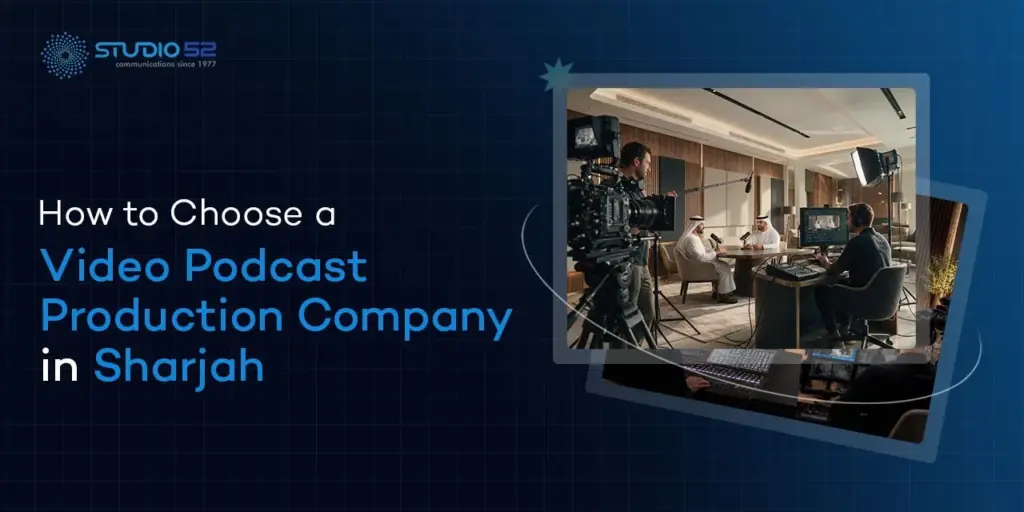
Studio52 runs video podcast production in Sharjah start to finish — planning, multi-camera filming, professional audio, a real studio and lighting setup, full editing, and social clips cut from every episode. The idea is simple: you show up and have the conversation, and the team handles everything downstream — editing, clips, delivery. No hunting for a separate editor afterward, no piecing together your own social content from a raw file.
If you’re weighing options for a business podcast in Sharjah, it’s worth a conversation. Get in touch with Studio52 about what you need.
Wrapping Up
Choosing a video podcast production company in Sharjah really comes down to a short list: can you actually see their past work, does their equipment meet a real standard, do they treat audio as seriously as video, do they run an actual studio, and do they lay out pricing and timelines clearly before you commit.
Get those right, and the rest mostly sorts itself out — a podcast that actually looks like the brand behind it, handled start to finish by people who’ve done this before.