
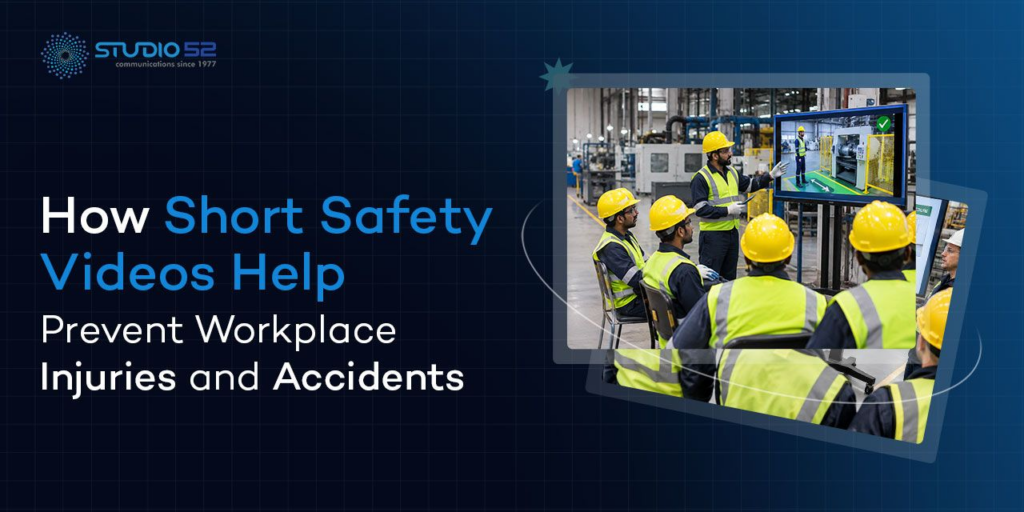

Workplace accidents occur very quickly. One slip on the ground, one hazard not noticed, and all of a sudden, the whole business is in big trouble. This is a situation that occurs in most companies in the UAE, Saudi Arabia, and the rest of the Middle East.
Workplace safety videos provide an effective solution for these organisations. These videos provide specific information to employees in advance of work.
People spend hours reading training manuals. Classroom training bores learners within minutes. A focused three to five minute workplace safety video delivers the message in a concise and efficient way.
The organisations that have invested in workplace safety videos experience some benefits from them. There is a reduced number of injuries, improved compliance, and increased confidence in employees.
Table of Content
What Are Short Safety Videos and Why Do They Matter?
Short safety videos are training videos on the topic of safety that are short and cover only one topic at a time. The length of such videos is from two to seven minutes. Each short video covers only one type of risk or procedure.
Short safety videos convey the message using visual demonstrations and actual situations. Employees learn the information quickly and retain it longer than through text-based training.
GCC construction sites, oil refineries and factories use workplace safety videos daily. Teams easily include these videos in daily briefings shifts and onboarding.
The companies operating in the Middle East region have a number of compliance rules related to HSE. Short safety videos allow compliance with them without affecting the daily routine.
How Short Safety Videos Help Prevent Workplace Injuries and Accidents
Improve Hazard Awareness
Employees cannot avoid hazards they cannot identify. Short accident prevention videos show real workplace risks in a clear visual format.
Reducing workplace accidents requires more than safety policies; employees need clear, engaging, and relatable training. Lessons learned videos that cut workplace accidents in GCC industries can help communicate real-life risks and encourage safer working practices. Discover professional safety video solutions designed to make safety communication more effective.
Workers see exactly where danger exists. They learn to spot unsafe conditions before an incident occurs. A video showing a wet floor near heavy machinery registers far stronger than a written warning.
Across UAE construction sites and Saudi industrial facilities hazard recognition is a core training need. Targeted workplace safety videos address that need directly and consistently.
Encourage Safe Working Practices
Workers cannot avoid the dangers they do not recognize. Brief workplace accident prevention shows actual dangers at the workplace in a visual manner.
Workers know precisely where the potential hazards lie. They get trained to detect dangerous situations even before something happens. It makes more impact when they see a wet floor close to heavy machinery rather than just reading about it.
In the UAE construction sites and Saudi Arabian industries, recognizing the hazards is one of the key needs for training workers. Workplace safety videos meet these needs on a consistent basis.
Reduce Human Errors
Safe practices get established through repetition. Short HSE Induction videos help workers remember the correct procedures every time they watch them.
A video with safe ways of lifting materials, using PPE, or operating equipment provides workers with the correct visual reference. They always repeat the correct procedures, having watched them.
Organisations in the Middle East use employee safety training videos. They establish standard practices among different workforces. All workers follow the same procedures no matter what.
Strengthen Emergency Preparedness
It is important to know how to handle yourself in an emergency situation. Short safety awareness videos train employees in emergency procedures such as evacuation routes and first aid steps.
The employees who have been trained through video on emergency procedures respond quickly and calmly in any emergency situation. They know exactly what they have to do in that situation.
Visual emergency training becomes very useful in the case of facilities located in the GCC due to the high number of languages spoken at those places.
Key Benefits of Using Short Safety Videos in the Workplace
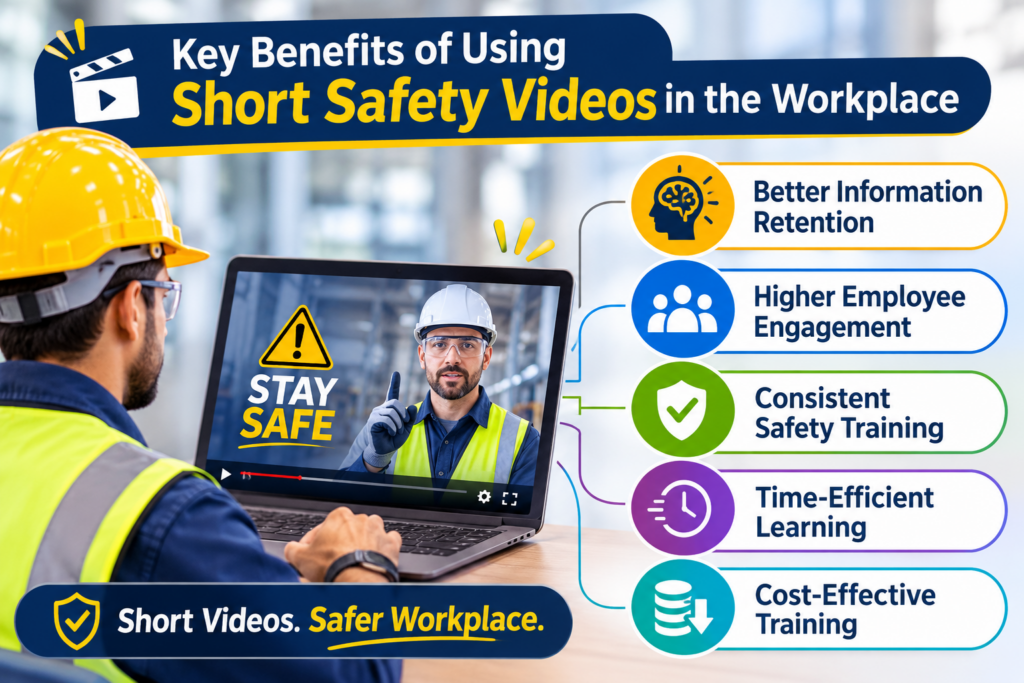
Better Information Retention
Numerous studies have proven that people memorize visuals better than written text. A combination of visuals, motion, and audio present in short workplace safety videos creates a much stronger memory impression.
Employees would remember the visual illustration of proper machine operation much better than a text description of the same thing. Such better memory directly translates into reduced chances for injuries in the work environment.
Higher Employee Engagement
Long safety discussions lose interest fast. In a short video, viewers remain attentive throughout its duration.
Visuals, realistic illustrations, and narration ensure that employees watch attentively. Employees who are interested in learning about safety at the workplace behave more safely.
In worksites in the UAE and Saudi Arabia, short training videos help improve participation of employees in morning briefings and inductions.
Consistent Safety Training
For bigger organisations, the issue of providing training consistently across several sites arises.
It is possible that the same trainer provides training for the same procedures in a different way in other areas.
Short videos help solve this problem. Everyone working in any of these sites is shown the same content and gets the same message.
This is particularly relevant for companies that operate in more than one country in the Middle East region with a multinational workforce.
Time-Efficient Learning
Work-related teams can never afford to suspend operations during a training session. Short videos are the solution.
You can easily show five-minute safety videos during morning briefings or lunchtime. Managers can also play these clips during pre-work shifts. Workers do not have to stop their jobs for hours.
Time efficiency is one of the prime factors mentioned by many logistics managers in the UAE who use video-based training.
Cost-Effective Training
Training safety experts to conduct classes at each location and at each time becomes expensive very quickly. Making safety videos costs money only once.
You can show this HSE training video at every site for many years. The video saves money by cutting out travel costs. Your team also avoids any scheduling conflicts with trainer availability
It becomes very practical to use videos for training in companies with big and widespread workforces in the Middle East area.
Why Short Safety Videos Are Essential for High-Risk Industries
In high-risk industries in the UAE, Saudi Arabia, and the wider Middle East region, there are many compliance issues involved.
The table below shows that short safety videos help meet specific industry training requirements.
| Industry | Key safety risk | How short safety video help |
| Construction | Falls from height
Equipment hazards Excavation risks |
Deliver quick site-specific hazard briefings and PPE training before each shift |
| Oil and gas | Fire explosion
Chemical exposure Confined space hazards |
Train workers on emergency response permit-to-work procedures and chemical handling |
| Manufacturing | Machine entanglement
Noise exposure Chemical spills |
Demonstrate lockout-tagout procedures safe machine operation and spill response |
| Warehousing and logistics | Machine entanglement
Noise exposure Chemical spills |
Cover forklift safety load limits proper lifting techniques and aisle awareness |
All these sectors have very stringent HSE regulations in the GCC countries. Short safety video production will keep the team fully aware, trained, and in compliance at all times.
Short safety videos form an integral part of an organisation’s training program and achieve quicker results than classroom training alone.
How to Measure the Effectiveness of Workplace Safety Videos
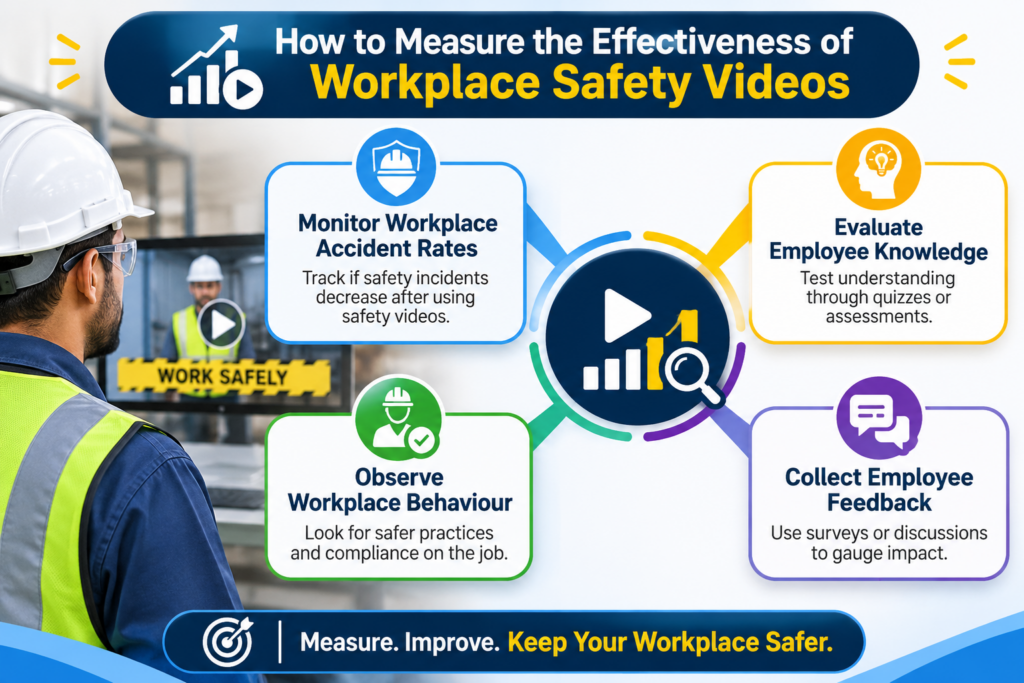
Making the videos is only half of the story. Monitoring their effect will ensure that the money spent on safety training has been well spent. Here are ways to monitor their effectiveness –
Monitor Workplace Accident Rates
Record the number of monthly injuries and near misses both prior to and following the release of the videos. Note how often accidents occur in locations where workers have received video-based training, versus those locations that do not provide video training. Be aware of declining numbers of repeated accidents to indicate that the messages contained within the videos are being understood.
Evaluate Employee Knowledge
Immediately following each viewing session, take a quiz. See how much of the safety procedure was retained by the employee. You can also compare team score results to find areas where further education is required.
Observe Workplace Behaviour
Managers must conduct on-site walk-throughs to check if employees follow the steps shown in the training videos. Observe the level of conformity to PPE requirements and proper equipment operation techniques.
Collect Employee Feedback
The employer should survey the staff once the training ends. This step checks how well workers understood the safety awareness videos. Employees will also provide a rating of the degree to which the videos were able to address site-specific situations. The employer can then use this employee feedback to improve the development of future video content.
Conclusion
Short health and safety training videos prevent workplace injuries. They deliver quick daily lessons. Middle Eastern businesses use these videos for HSE compliance.
Want to protect your employees? Reach out to Studio52 now for your safety videos.
UAE: +971 44541054
Saudi Arabia: +966 12 4220506
Email: askus@studio52.tv
FAQs
How do short safety videos help prevent workplace accidents?
What is the ideal length of a workplace safety video?
What topics should workplace safety videos cover?
How often should employees watch safety training videos?
Are animated safety videos effective for industrial training?
Can short safety videos replace traditional safety training?