
Think about the last safety induction you sat through. Was it a PowerPoint from 2017? A laminated handout? A trainer reading off a script while half the room checked their phones?
That is not a criticism of the people running it. It is just the reality of how workplace safety training has worked for a long time and why it often does not land the way it should. People zone out. And then something goes wrong.
Safety Video Production helps organizations create engaging training content that improves knowledge retention and workplace safety. This guide explains what safety animated videos are, why they are effective, and what you should know before investing in professional Safety Video Production.
Table of Content
What Are Animated Safety Training Videos?
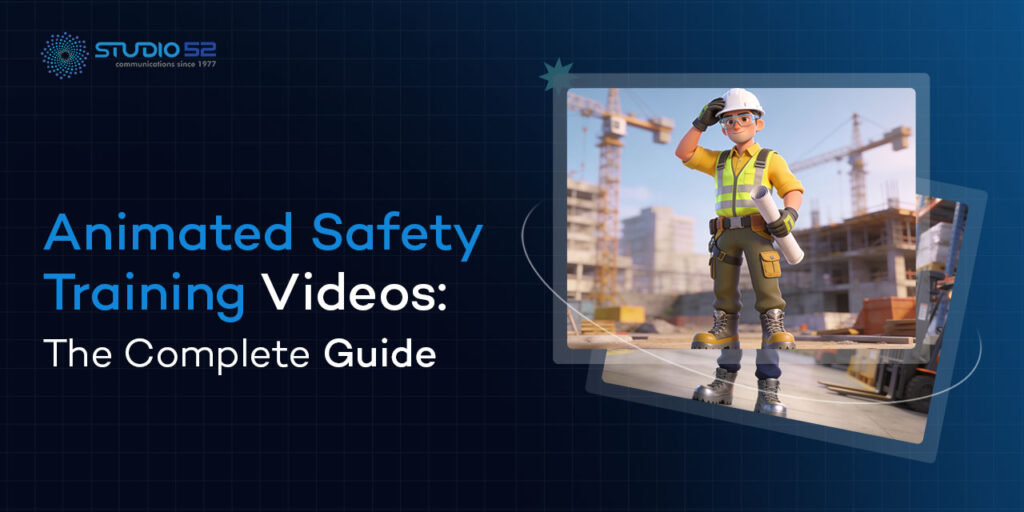
At their most basic, these are videos that use animation rather than live footage to teach safety procedures and workplace rules. But that description undersells them a bit.
A well-produced animated safety video can show a chemical plant explosion in full detail without any real-world risk. It can walk a new employee through an emergency evacuation step by step, with a character making the right decisions and the wrong ones, so the viewer understands both. It can do all of this in Arabic, English, Hindi, or whichever language your workforce speaks.
They are used for employee onboarding, contractor induction, visitor safety briefings, and ongoing HSE awareness. They can be produced in 2D animation, 3D animation, motion graphics, or character-based formats depending on what the content actually needs.
Why Are Animated Safety Training Videos Important?
Because traditional training has a consistency problem. The same safety induction video content delivered by three different trainers across three different sites is effectively three different inductions. One trainer is thorough. One is rushed. One skips the chemical spills section because they always run out of time.
Animated safety training videos remove that variable entirely. Every employee sees the same content, in the same sequence, with the same emphasis. That matters for compliance, and it matters even more for actually keeping people safe.
There is also the comprehension side of things. A lot of safety procedures are genuinely complex. Trying to explain lockout/tagout through a written document is harder than it needs to be. Show someone the exact sequence through animation, and the learning curve drops significantly.
For companies operating across multiple locations or managing a multilingual workforce, these videos are close to essential. You can add subtitles or swap in a different voiceover without rebuilding anything from scratch.
Key Benefits of Animated Safety Training Videos
Easy to Understand
Technical safety content becomes a lot more digestible when it is shown rather than described. Step-by-step visuals guide employees through procedures in a way that written instructions rarely manage.
More Engaging Than Traditional Training
Engagement is not just about making training enjoyable. It directly affects how much people retain. Story-based animated safety videos hold attention in a way that a static presentation or a manual simply does not.
Safe Demonstration of Dangerous Situations
You cannot film a real forklift accident for training purposes. You can animate one in full detail. Fires, falls, chemical exposures, and machinery failures: all of these can be shown clearly and safely through a 2D safety animation video or 3D safety animation video without putting anyone at risk.
Consistent Training Message
Every worker gets the same information regardless of where they are, who their manager is, or what day it happens to be.
Cost-Effective and Reusable
A good employee safety training video is a long-term asset. You produce it once, and it serves your training programme for years.
That tends to work out far cheaper than recurring trainer-led sessions across large or distributed teams.
Multilingual Training Support
Voiceover and subtitle options make HSE training videos adaptable for international or multicultural workforces without needing to produce entirely separate content.
Types of Animated Safety Training Videos
2D Animated Safety Videos work well for general awareness content and straightforward instructional topics. Clean, quick to produce, and easy to follow.
3D Animated Safety Videos come into their own for machinery, industrial equipment, and technical processes where depth and spatial detail matter. If you need to show the inside of a pressure vessel or the movement path of a crane arm, 3D is the right tool.
Motion Graphics Safety Videos suit data-heavy content, regulatory updates, and campaign-style messaging.
Character-Based Safety Videos put animated people into realistic workplace settings and show both correct and incorrect behaviour. These tend to be highly relatable.
Scenario-Based Safety Videos walk employees through real-life incident situations and show them how to respond correctly under pressure.
Microlearning Safety Videos are short, focused, and built around one topic. Ideal for toolbox talks and LMS platforms where time is tight.
Common Topics Covered
Fire safety training, PPE guidelines, working at height, electrical safety, confined space entry, forklift and machinery safety, chemical handling, emergency evacuation, first aid awareness, slips and falls prevention, lockout/tagout procedures, road and vehicle safety, construction site safety, oil and gas safety training, and warehouse safety training all fall comfortably within the scope of these videos.
Industries That Use Animated Safety Training Videos
Oil and gas, construction, manufacturing, logistics and warehousing, marine and offshore, mining, power and utilities, healthcare, aviation, and corporate offices all use workplace safety training videos as a core part of their HSE and compliance programmes. Any industry where workers face physical risk and consistent training delivery matters has a genuine use case here.
Animated vs Traditional Safety Training
The honest comparison looks like this. Animated safety training videos are reusable, visually clear, capable of demonstrating genuinely dangerous scenarios without risk, and suitable for multilingual delivery at scale. Traditional safety training depends heavily on the individual trainer, can vary in quality, and is difficult to standardise across large organisations.
Neither is completely without merit. But for companies that need consistent, scalable, measurable safety training across multiple sites, animation is the more practical solution.
How Animated Safety Videos Improve Employee Learning
Visuals improve retention. When training is grounded in recognisable real-world scenarios rather than abstract rules, employees apply it more readily. Short, focused videos reduce the information overload that comes with long induction sessions. Repetition through refresher content reinforces understanding over time. And when videos are integrated into an LMS, you can track who completed what and measure real outcomes rather than assuming the training worked.
The Production Process, Briefly
It starts with the objective. Who is the audience, what is the safety topic, and what should the viewer be able to do differently after watching? That shapes everything.
A script is written, clear, and accurate. A storyboard maps out how the visuals, text, and voiceover will work together before animation begins. Characters and environments are designed to reflect the client’s actual workplace. Voiceover is recorded, subtitles are added where needed, and the content goes through a safety accuracy review before final delivery for LMS, internal screens, or induction sessions.
How to Choose the Right Production Company
Industry experience matters more here than general production quality. A company that makes commercial ads is not necessarily equipped to handle HSE content with the accuracy it requires.
Look for a partner that understands safety standards, can handle both 2D and 3D formats, and has a clear process for accuracy review built into how they work.
Studio52 has been producing safety training videos for clients across the GCC and beyond for decades, covering oil and gas, construction, manufacturing, and corporate sectors. Every project is built around the client’s specific training objective, workplace environment, and compliance needs. If your safety training content is overdue for an update, or you are building an induction programme from scratch, the Studio 52 team is worth speaking to. Choose an industrial safety video production company to create impactful training videos that improve safety awareness, reduce risks, and support compliance.
Conclusion
The gap between safety training that ticks a compliance box and training that actually changes behaviour is significant. Animated safety training videos close that gap more reliably than most alternatives. They engage people, explain things clearly, and deliver a consistent message every single time.
Studio52 produces animated safety training videos across formats, industries, and languages. Get in touch with the team and talk through what your workplace actually needs.
UAE: +971 44541054
Saudi: +966 12 4220506
Email: askus@studio52.tv