
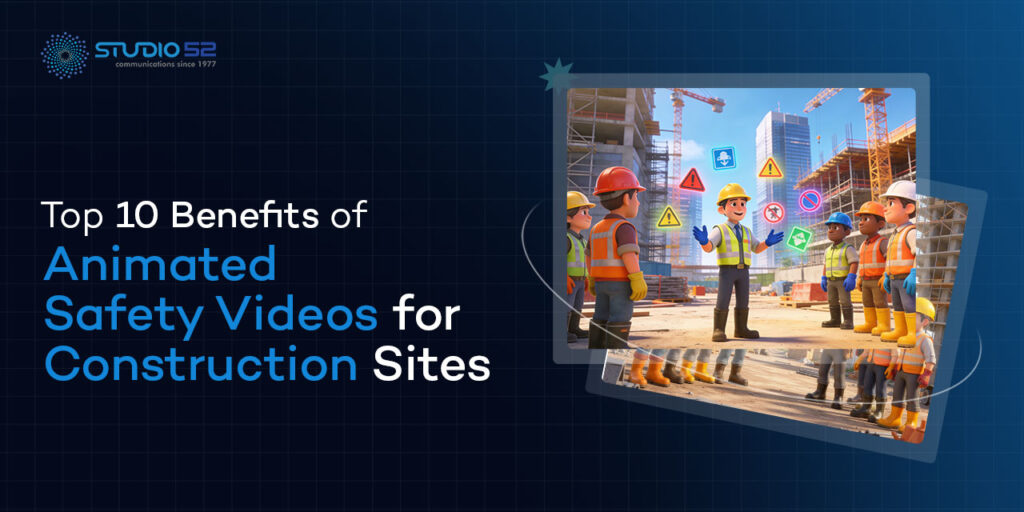

A construction site is one of the toughest places to keep people safe. On any given day, crews are working around heavy machinery, climbing to heights, dealing with live wires, and weaving past moving vehicles. Conditions shift by the hour. So safety training has to do more than tick a box. It has to actually stick.
And that is exactly where most training falls short. Thick manuals and long classroom sessions tend to blur together. Now add a workforce that speaks five different languages, and a lot of that message gets lost.
Animated safety videos solve this in a way paper never could. They show workers what to do instead of just telling them. Unlike standard construction safety videos that simply film a presenter talking, animation makes complicated hazards simple and plays real scenarios out on screen. People learn the right move before something goes wrong, not after.
Table of Content
What Are Animated Safety Videos?
Put simply, animated safety videos use 2D or 3D visuals, characters, voiceover, and motion graphics to explain safety rules, hazards, and emergency procedures. They are a modern take on traditional construction site safety training videos, swapping a wall of text for a short visual story that anyone can follow.
You will often see them cover PPE usage, working at height, crane and lifting safety, excavation safety, fire safety, electrical safety, vehicle and pedestrian safety, and emergency evacuation.
Top 10 Benefits of Animated Safety Videos for Construction Sites
1. Simplifies Complex Safety Procedures
Some procedures are just hard to explain on paper. Think lockout/tagout, scaffolding checks, lifting plans, or confined space entry. Each one is a sequence of steps that is easy to get wrong. Animation breaks them down visually, one clear step at a time, so the logic actually makes sense.
2. Improves Worker Engagement
Be honest. Nobody remembers much from a 40-page safety binder. Animated safety videos hold attention because they are interesting to watch. When training feels less like a lecture and more like a short story, people pay attention, and the message lands.
3. Helps Workers Remember Safety Rules Better
Here is the thing about visuals. They stick. When a worker watches a hazard unfold and sees what it leads to, that image stays with them. Back on-site, they remember the right action because they have already seen the wrong one.
4. Reduces Language and Literacy Barriers
Construction teams are diverse, and not everyone reads the same language or reads comfortably at all. Animated safety videos lean on visuals, icons, subtitles, and multilingual voiceovers. A clear shot of someone clipping on a harness needs no translation at all.
5. Demonstrates Hazardous Scenarios Safely
You obviously cannot stage a fall from height just to prove a point. It would be dangerous and expensive. Animation lets you show falls, collisions, fires, and electrocution risks without putting a single person in harm’s way.
6. Supports Consistent Safety Training
Every worker gets the exact same message, no matter who delivers it or where the site is. Trainer quality stops being a gamble. Whether you run one site or ten, the standard stays identical across the board.
7. Saves Time During Induction and Toolbox Talks
Animated safety videos slot right into inductions, daily toolbox talks, refresher sessions, and contractor onboarding. Used as construction safety training videos, they get the key points across fast, without dragging out the working day.
8. Improves Compliance with Safety Standards
Videos give you a structured, documented way to deliver training, and that paper trail matters. Well-made construction safety videos back up your internal HSE requirements, keep clients happy, and help prove regulatory compliance when someone asks.
9. Encourages Safer Behaviour on Site
Seeing a consequence hits harder than reading about one. When workers watch where a shortcut leads and see the payoff of doing it properly, they take the rules more seriously. It is human nature.
10. Can Be Reused Across Multiple Projects
Once a video is made, it keeps working for you. The same content runs across different sites, departments, and contractors for years. That reusability is what makes animation a smart investment rather than a one-off spend.
Where Can Construction Companies Use Animated Safety Videos?
There are plenty of moments where these videos pull their weight: new worker induction, contractor onboarding, toolbox talks, HSE campaigns, site-specific hazard awareness, equipment operation training, emergency response training, incident prevention programs, refresher training, and multilingual workforce training.
Types of Animated Safety Videos for Construction Sites
- 2D Animated Safety Videos—Great for simple concepts, awareness campaigns, PPE rules, and general safety communication where clarity beats realism.
- 3D Animated Safety Videos—Best for complex activities like equipment movement, crane operations, and fall hazards that benefit from realistic, detailed simulation.
- Mascot-Based Safety Videos—A friendly safety character can guide workers through different topics, which makes the whole thing more approachable and easy to recall.
- Scenario-Based Incident Prevention Videos—These walk-throughs of unsafe behavior show the consequence and then demonstrate the correct preventive action.
Examples of Construction Safety Topics That Work Well in Animation
Animation suits a wide range of subjects, including working at height, scaffolding safety, crane and lifting operations, excavation and trenching safety, electrical safety, fire prevention, PPE compliance, manual handling, slips, trips and falls, confined space entry, vehicle and pedestrian segregation, emergency evacuation, heat stress awareness, and dropped object prevention.
Why Animation Works Better Than Traditional Safety Training
| Traditional Safety Training | Animated Safety Videos |
| Text-heavy manuals | Visual and easy to understand |
| Depends on trainer quality | Consistent message every time |
| Can be boring | More engaging and memorable |
| Hard to show dangerous incidents | Can safely simulate hazards |
| May not suit all languages | Can include multilingual voiceover and subtitles |
How to Create an Effective Animated Safety Video
Building effective construction site safety training videos starts with clear safety objectives, built around real site hazards rather than generic ones. Keep the script short and direct. Use simple language. Add voiceover and subtitles so nobody is left out. Show both the unsafe and the safe action, fold in your company-specific rules, and finish with a strong safety message that workers actually carry with them.
Conclusion
Animated safety videos are a powerful tool for any construction company that wants clearer safety communication, fewer incidents, and better-trained workers. Compared to ordinary construction safety videos, animations turn complicated procedures into simple visual stories that help people understand, remember, and apply the rules where it counts, out on the site.
If you manage large teams, multilingual crews, and high-risk work, animated safety videos can become a core part of a stronger safety culture.
Need animated safety videos for your construction site? Explore our 2D and 3D animation video production services or talk to our team today and take the first real step toward a safer site.