


Walk into any serious production studio in Dubai or Riyadh right now and you will notice one thing they all have in common: a green screen. Chroma video production has quietly become the backbone of how Gulf brands create content that actually competes. Whether you are a startup in Muscat or an enterprise in Abu Dhabi, this technology levels the playing field. Here is a plain-English breakdown of why brands across the region are making the switch.
Table of Content
Introduction
A client once told me their product video took three shoot days, two location permits, and a last-minute reshoot because of afternoon glare. The final cut looked almost identical to what a single studio day with a green screen would have produced, at half the cost and none of the stress.
That story is more common than you think, especially for brands operating across the UAE, Saudi Arabia, and Oman, where production demands are high and timelines are rarely forgiving.
Chroma video production has been around for decades. Weather presenters, film studios, and news channels have relied on it for years. What has changed is how accessible and strategically valuable it has become for everyday brands. If you have been on the fence about green screen video production, what follows might change your thinking.
What Is Chroma Video Production?
The concept is simpler than it sounds. Your subject, whether a presenter, a product, or an actor, is filmed in front of a solid colored background, almost always green or blue. In post-production, that color is digitally removed and replaced with whatever visual environment fits your story.
A corporate spokesperson can appear against a branded skyline. A product can sit inside a lifestyle scene that would cost thousands to build physically. A trainer can deliver a course from a virtual classroom that exists only on a hard drive.
Green became the industry standard for chroma key video production because it sits furthest from natural skin tones on the color spectrum. That distance makes it easier for editing software to cut cleanly without leaving a halo around the subject. Blue serves a similar role and tends to work better when talent is wearing green or when shooting conditions make green impractical. That is the core logic behind blue and green screen video, and it has held up for decades because it works.
Benefits of Chroma Video Production Services
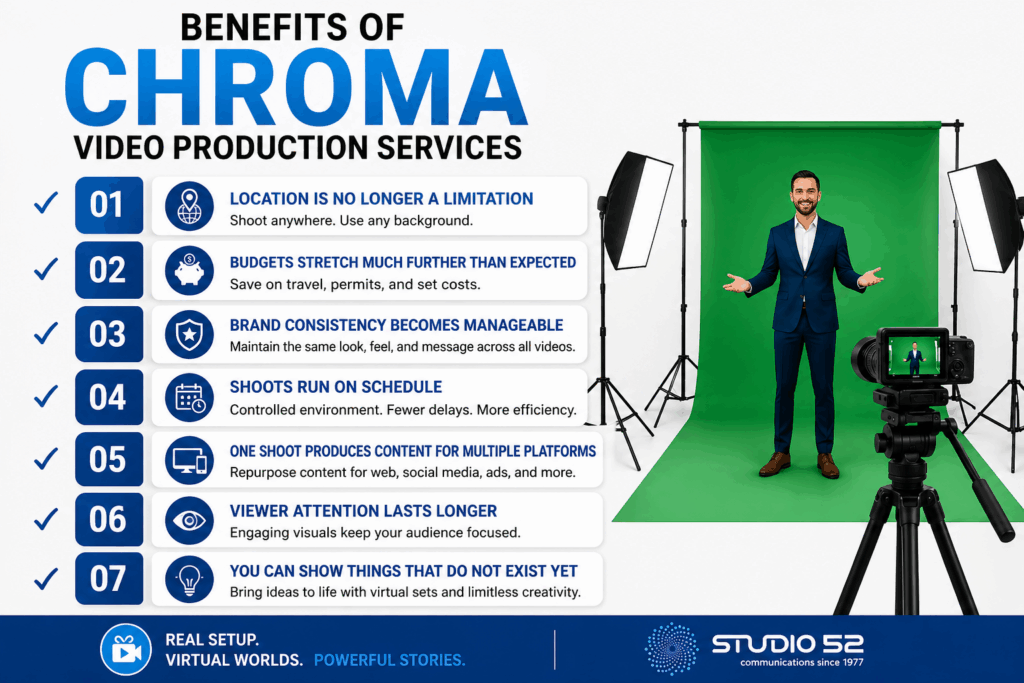
1. Location Is No Longer a Limitation
Traditional shoots box you in. The background you film is the background you keep. If the brief changes or the client wants something different, you book another day and spend more money. Green screen video production cuts that dependency completely. You shoot your subject once under controlled conditions, and the world around them is built in post. One session can produce content for five different campaigns if the backgrounds are planned well.
2. Budgets Stretch Much Further Than Expected
People assume chroma key video production adds cost. Usually it removes it. Think about what a location shoot in the Gulf actually involves. Permits in multiple emirates, crew travel, equipment transport, catering on site, and the very real possibility that weather or logistics push the timeline back. A studio session eliminates most of that. For brands producing content regularly across Saudi Arabia, the UAE, and Oman, those recurring savings matter.
3. Brand Consistency Becomes Manageable
Keeping a consistent visual identity across a library of video content is harder than it looks. Lighting changes between locations. Backgrounds clash with brand colors. A series that should feel unified ends up looking like it was made by three different teams. Chroma video for branding solves this quietly but effectively. When the background is built digitally, it can be matched precisely to brand guidelines every single time, no guesswork involved.
4. Shoots Run on Schedule
Production delays are expensive. A location becomes unavailable. A permit gets pushed. The sun sets an hour earlier than expected. Any working producer has a story like this. Green screen video marketing removes most of those variables. The studio does not care what the weather is doing outside. The light is set before the talent walks in and it stays that way for the entire shoot. That reliability is genuinely undervalued until you have lost a day to something preventable.
5. One Shoot Produces Content for Multiple Platforms
This is where blue and green screen video production becomes a real strategic asset. The talent footage is shot once. The background is swapped depending on the platform, the audience, or the campaign message. A single studio day can produce a YouTube version, a LinkedIn cut, a website header video, and an outdoor digital screen format, each looking intentional and platform-specific. That kind of output from a single shoot day changes how efficiently a marketing team can operate.
6. Viewer Attention Lasts Longer
Watch time is everything in digital video. Platforms reward it. Brands benefit from it. And the research consistently shows that visual quality is one of the strongest predictors of how long someone stays with a video. Green screen video marketing allows production teams to build backgrounds that are visually engaging, on-brand, and purposefully designed to keep the viewer’s eye moving. It is not decoration. It is a retention strategy.
7. You Can Show Things That Do Not Exist Yet
This particular benefit does not get enough attention. Chroma video production lets brands visualize products still in development, properties not yet built, and service experiences that exist only as concepts. For real estate brands in Dubai or tech companies launching in Riyadh, this is enormously valuable. A buyer can walk through a virtual apartment. A customer can see how a product works before it ships. That kind of content builds confidence in ways that renders and brochures simply cannot replicate.
Real-World Use Cases of Chroma Video Production
Off-plan property developers across Dubai are now standard users of chroma key video production, creating walkthrough videos for apartments that exist only in architectural drawings. Retailers are placing products inside aspirational lifestyle scenes without a single location shoot. Enterprise brands are filming leadership communications in controlled studio environments that look like purpose-built boardrooms.
In Saudi Arabia, where content demand has grown sharply alongside Vision 2030 investments, green screen video production is being used for government communications, tourism campaigns, and large-scale corporate training programs. In Oman, hospitality brands are producing multilingual content for international audiences without flying production crews to multiple destinations.
Future of Chroma Video in Branding
Real-time compositing is already changing how shoots are run. Directors can now see the final background on a monitor during filming rather than waiting for post-production to show them the result. Virtual LED walls are pushing this further, creating immersive on-set environments that respond to camera movement. These tools are moving from film studios into commercial production, and brands in the Gulf that adopt them early will produce content that looks significantly ahead of their competition.
Conclusion
Smarter production decisions separate the brands that grow from the ones that plateau. Chroma video production gives marketing teams creative range, cost efficiency, scheduling reliability, and the ability to scale content without scaling budgets proportionally. In markets as competitive as the UAE, Saudi Arabia, and Oman, that combination is hard to argue against.
Studio 52 has worked with brands across the Gulf for over two decades. Our green screen studio, production crew, and post-production team have handled everything from single-day corporate shoots to large-scale campaign productions.
If your next project deserves production that reflects your brand properly, reach out to Studio 52 today. Tell us what you are building and we will tell you exactly how to make it better.