
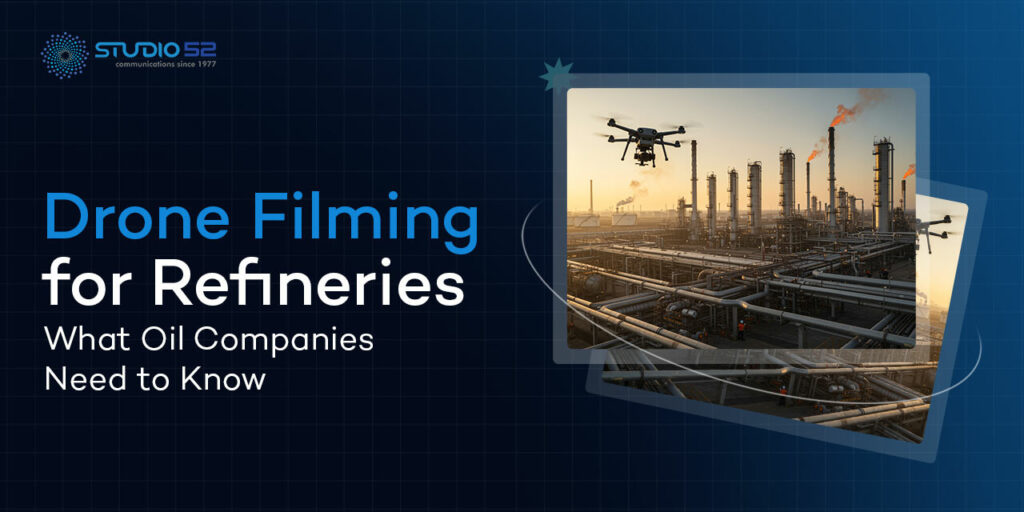

Drone filming for refineries is changing how oil companies in Saudi Arabia approach inspections and safety. This blog explores how drones reduce risk, speed up inspections, and improve operational efficiency through real-world scenarios. It also covers applications, drone types, compliance, and future trends, offering a practical understanding of how modern refinery operations are evolving with drone technology.
There is a moment before every inspection where things slow down. Not because work stops, but because everyone knows what comes next. Planning, permissions, equipment setup, safety checks. And then finally, the actual inspection. At a refinery, even a simple task rarely feels simple. A team stands near a tall structure waiting for clearance. The job itself might take an hour, but getting to that point can take much longer. And somewhere in the background, there is always that quiet awareness of risk. This is where things have started to shift. Instead of building access, teams now create visibility. Instead of sending people into difficult areas, they send machines that can go there safely.
That shift is what defines drone filming for refineries today. It is not about replacing processes completely, but about making them more practical, more efficient, and far less risky.
Table of Content
Understanding Drone Filming in Oil Refineries
Drone filming inside a refinery is not about capturing dramatic aerial views. It is about access. There are areas in every refinery that are hard to reach, expensive to access, or simply unsafe for regular inspection. Drones provide a way to observe those areas without interrupting operations. With the growing role of drone technology in the oil and gas industry, inspections are no longer tied to physical access alone. Teams can now gather visual data from above, around, and even within structures. This changes how decisions are made. Instead of waiting for reports, teams can see conditions in real time. Instead of relying only on manual checks, they can combine ground knowledge with aerial insight. And that combination tends to be far more effective.
Key Benefits of Drone Filming for Oil Refineries
Improved Safety
If there is one reason companies start using drones, it is this. Refineries are controlled environments, but they are still high-risk. Working at height, entering confined spaces, or operating near heat and pressure always carries some level of danger. With drone inspection for oil refineries, much of that exposure can be avoided. Inspections that once required physical presence can now be carried out remotely. Teams remain at a safe distance while drones capture the necessary data. Over time, this does more than reduce incidents. It changes how safety is experienced on-site.
Faster Inspections
Time behaves differently in industrial environments. Even small delays can affect multiple operations. Traditional inspection methods often involve preparation before execution. Access needs to be arranged, equipment needs to be installed, and safety checks must be completed. With drone inspection services for oil and gas, that preparation phase becomes much shorter. Drones can be deployed quickly and start capturing data almost immediately. Inspections that once stretched over days can often be completed within hours. This allows teams to move forward without unnecessary waiting.
Cost Efficiency
Efficiency is not only about speed. It is also about cost. Manual inspections often come with hidden expenses. Equipment setup, labour, and operational interruptions all contribute to the overall cost. By using industrial drone inspection services, many of these factors are reduced. There is less need for temporary structures. Fewer people are required for each task. Operations can continue without major disruption. Over time, this leads to more consistent and manageable costs.
Better Visual Documentation
There is a noticeable difference between written reports and visual evidence. Traditional inspection reports rely heavily on descriptions. While useful, they sometimes lack clarity. With drone filming services, documentation becomes more detailed and easier to interpret. High-resolution visuals capture the condition of structures clearly. This helps teams identify issues, track changes, and plan maintenance more effectively. It also makes communication between departments much smoother.
Operational Efficiency
When inspections become safer, faster, and clearer, the impact spreads across the entire operation. With drone monitoring for oil refineries, teams gain ongoing visibility into their assets. This allows them to identify potential issues early and respond before they become larger problems. Instead of reacting to situations, teams can manage them proactively. And that shift makes a significant difference over time.
Common Drone Filming Applications in Refineries
Drone usage in refineries is not limited to one task. It has gradually expanded into multiple areas. Infrastructure inspection is one of the most common applications. A refinery infrastructure inspection drone can examine pipelines, storage tanks, and elevated structures without interrupting operations. Drones are also used for safety monitoring. Through drone services for oil and gas industry, teams can oversee restricted zones and identify risks more efficiently. In emergency situations, drones provide immediate aerial visibility. They help teams understand conditions quickly and plan their response more effectively. During construction and expansion projects, drones are used to track progress and maintain alignment with plans. At the same time, companies use drone filming services to create visual content for internal and external communication.
Types of Drones Used in Refinery Filming
Different environments require different tools. Industrial inspection drones are designed for stability and precision, making them suitable for detailed inspections. Thermal imaging drones detect temperature variations, which is essential for identifying issues during aerial inspection for refineries.
Boost your operations with expert Oil & Gas Inspections in KSA. Ensure safety, compliance, and efficiency with advanced technology and certified professionals. Book reliable inspection services today for better performance.
FPV drones allow operators to navigate tighter spaces, while long-endurance drones are used for covering larger areas over extended periods.
Together, these technologies support a more flexible and effective approach to inspections.
Safety and Compliance Considerations
Drone operations in refineries must follow strict guidelines. In Saudi Arabia, aviation regulations determine how drones can be used. Necessary permissions must be obtained before any operation begins. At the same time, refinery safety protocols must be followed to ensure that drone activities do not interfere with ongoing processes. Data security is another important factor. The information captured during inspections is sensitive and must be stored and managed carefully. Certified operators play a key role in ensuring that drone inspection services for oil and gas are conducted safely and responsibly.
Best Practices for Drone Filming in Refineries
Successful drone operations depend on preparation and coordination. It begins with clear planning. Teams need to define objectives and understand potential risks before starting. Coordination with on-site safety teams ensures that drone activities align with operational requirements. Using the right equipment is equally important. Different tasks require different capabilities, and selecting the appropriate tools improves results. Finally, proper data management ensures that collected information is used effectively, turning visuals into actionable insights.
Future Trends of Drone Technology in Oil Refineries
Drone usage in refineries is still evolving. AI-powered inspections are making it possible to detect issues automatically, reducing the need for manual analysis. Autonomous drones are being developed to carry out inspections independently. Integration with IoT systems is creating connected environments where data flows seamlessly between devices.
As these developments continue, drone technology in oil and gas industry will become even more embedded in daily operations.
Why Professional Drone Filming Services Matter
While drones themselves are powerful tools, their effectiveness depends on how they are used. Experienced providers understand refinery environments, regulatory requirements, and operational challenges. They ensure that inspections are carried out safely and that the data collected is reliable. A company like Studio52, for example, focuses on combining technical expertise with practical execution, helping oil companies get accurate visuals and meaningful insights without disrupting operations. The difference is not just in flying drones, but in delivering results that can actually be used.
Conclusion
Refineries are not becoming simpler. If anything, they are becoming more complex with time. As that complexity increases, the need for safer and more efficient inspection methods becomes more urgent. Drone solutions offer a way to meet that need without adding pressure to existing systems. They allow teams to see more, do more, and risk less. And in an environment where every decision carries weight, that is not just useful. It is necessary.
FAQs
Why do oil companies use drones for refinery inspections?
Are drones safe to use in refinery environments?
What refinery structures can drones inspect?
How do drones help improve safety in oil refineries?
How fast can drones inspect refinery infrastructure?
What technology is used in refinery drone inspections?