
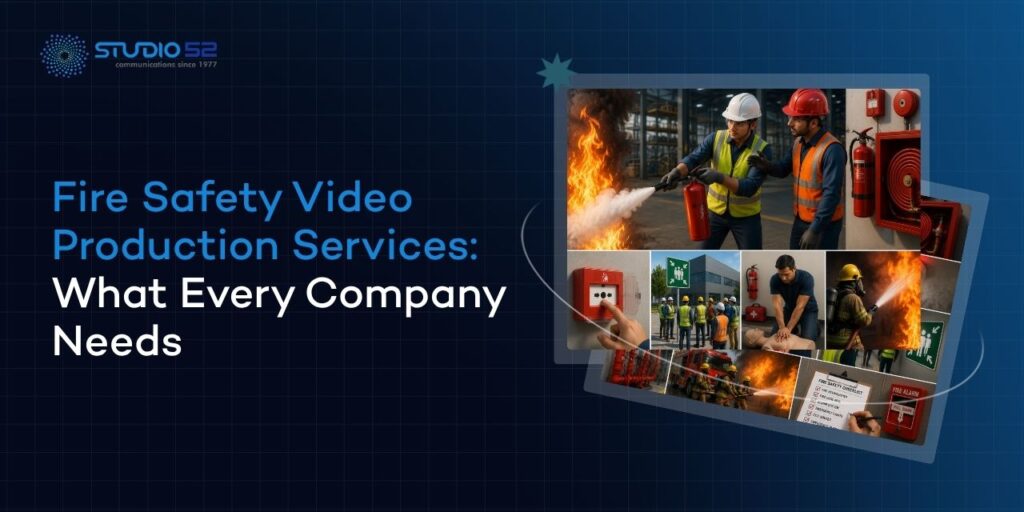

Fire safety video production helps companies train employees, contractors, and visitors through clear, memorable visual content. It covers prevention, evacuation, extinguisher use, and emergency roles. This blog explains how fire safety videos improve compliance, reduce accidents, and save training time. It also covers the key elements, video types, and industries that rely on them most. It also walks through the production process and explains why a professional team like Studio 52 makes a genuine difference.
Nobody plans to be calm during a fire. Either the training kicks in or it doesn’t, and there’s no in between once the alarm actually goes off.
That’s the uncomfortable truth behind workplace fire safety. It’s exactly why so many companies have moved away from PDFs and induction booklets toward something employees actually remember: video. A written manual gets skimmed once and filed away. A verbal briefing is often only half-listened to on someone’s first day. It gets lost somewhere between the parking permit talk and the IT login setup. But a fire safety training video, done properly, sticks. People picture themselves in it. And that’s the whole point.
Whether you’re running a warehouse, a hospital, a construction site, or a corporate office, safety video production has become less of a nice-to-have and more of a baseline expectation. So let’s get into what it actually involves, why it matters more than most businesses realise, and how to do it right.
Table of Content
WHAT IS FIRE SAFETY VIDEO PRODUCTION?
In simple terms, fire safety video production is the process of turning fire safety knowledge into something people can actually watch, follow, and remember. It covers the full picture: fire prevention, what to do when an alarm sounds, how to evacuate properly, and how to use equipment like extinguishers without fumbling through it in a panic.
There’s no single “correct” format here. Some companies go fully live-action, filming on their real premises with real staff walking through real exits. Others use animation, particularly when a scenario would be dangerous or impractical to film for real, you’re not setting an actual fire in a warehouse to make a training video, obviously. Plenty of businesses land somewhere in between, blending both styles depending on what the moment calls for.
WHY EVERY COMPANY NEEDS FIRE SAFETY VIDEOS
Improves Employee Awareness
People forget what they read. They tend to remember what they’ve seen, especially if it felt close to their own workplace. A good fire safety video doesn’t just list hazards in the abstract, it shows them, in context, in a setting that looks like the one the viewer actually works in. That’s abstract;what makes the difference between information that’s technically delivered and information that’s actually retained.
Supports Safety Compliance
Most industries don’t treat fire safety training as optional, and for good reason. Video gives you something a quick verbal briefing never can: consistency. Everyone gets the same message, delivered the same way, regardless of who’s running induction that week or which site they’re starting at. It’s also far easier to document for audits, which matters more than people expect until the day it actually matters.
Reduces Workplace Accidents
This one’s fairly intuitive but worth saying directly: a video that shows employees how fires actually start, not just how to react once one’s already burning, tends to prevent more incidents than reactive training ever does. Prevention and response together. Not one or the other.
Turn every incident into a valuable learning opportunity with Lesson Learnt Videos. Engage your workforce, reinforce safety best practices, prevent repeat mistakes, and build a stronger, more safety-conscious workplace today.
Saves Training Time
Once it’s made, a fire safety video doesn’t need remaking every time someone new joins. For new hires, contractors, and visitors, the same video can be reused indefinitely, which quietly saves a surprising amount of time and money compared to running repeat in-person sessions.
KEY ELEMENTS OF AN EFFECTIVE FIRE SAFETY TRAINING VIDEO
Fire Prevention Guidelines
This covers the handling of flammable materials, basic electrical safety, and the kind of everyday housekeeping habits, clutter, blocked exits, and overloaded sockets that quietly increase fire risk without anyone noticing until it’s too late.
Emergency Evacuation Procedure
Arguably the most important section of any fire safety video. It needs to clearly cover how to respond when the alarm sounds, the actual exit routes for the building, where the assembly point is, and the specific do’s and don’ts: no lifts, close doors where it’s safe to do so, and don’t go back for belongings.
Fire Extinguisher Usage
A lot of workplace injuries during small fire incidents happen simply because nobody actually knew how to use the extinguisher in front of them. This section should cover the different extinguisher types, which one applies to which kind of fire, and the safety checks to make before using one at all.
Roles and Responsibilities
Fire wardens, general staff, visitors, contractors, and the emergency response team, everyone has a different job during an evacuation, and a good video makes that distinction clear so nobody’s standing around wondering what they’re supposed to be doing.
Real Workplace Scenarios
Stock footage rarely lands. The fire safety videos that actually work show situations employees recognise: a fire breaking out in an office area, an industrial plant, a warehouse, a construction site, somewhere that looks like where they actually stand every day.
TYPES OF FIRE SAFETY VIDEOS COMPANIES CAN CREATE
Fire Safety Induction Video For new employees, visitors, and contractors on their very first day, before they’ve had time to learn the building informally.
Fire Evacuation Video Built specifically around exit routes and the precise steps to take during an evacuation.
Animated Fire Safety Video Useful for explaining technical or dangerous scenarios that simply can’t be filmed safely in real life.
Live-Action Fire Safety Video Shot at the company’s actual site, with real staff, real exits, real signage, which tends to build faster recognition than animation alone.
Fire Drill Training Video Walks employees through exactly how they should behave during a scheduled drill, so the real thing feels familiar rather than chaotic.
Strengthen employee training using a safety video production company that creates high-quality safety videos to improve awareness, reinforce best practices, and support long-term operational safety.
INDUSTRIES THAT NEED FIRE SAFETY VIDEO PRODUCTION
Fire risk doesn’t look the same in a hospital as it does on a construction site, which is exactly why generic training rarely works. The industries that lean on this most heavily include manufacturing, oil and gas, construction, warehousing and logistics, healthcare, schools and universities, offices and corporate buildings, and hospitality and retail. Each one carries its own hazards, layouts, and regulatory expectations, so a one-size-fits-all video usually ends up fitting nobody particularly well.
BENEFITS OF PROFESSIONAL FIRE SAFETY VIDEO PRODUCTION
There’s a noticeable gap between a video filmed quickly on a phone and one produced properly. Working with an experienced team gets you a consistent training message across the whole organisation, stronger employee engagement than a slideshow could ever manage, content built around your actual site and procedures rather than something generic, less confusion during a real emergency because staff have effectively already lived through the scenario once, and a video flexible enough to use for onboarding, refresher training, and audits alike.
HOW TO CREATE A FIRE SAFETY VIDEO FOR YOUR COMPANY
Step 1: Understand Workplace Fire Risks Walk the site. Identify actual hazards and high-risk areas before filming a single frame.
Step 2: Prepare the Script Keep it simple and direct. Nobody should have to mentally translate jargon during a section about evacuating a burning building.
Step 3: Choose the Video Style Live-action, animation, or a mix, depending on budget, scenarios, and what needs showing.
Step 4: Include Company-Specific Procedures Real site layout, real exits, real alarm points, real assembly areas. Generic visuals don’t transfer the way specific ones do.
Step 5: Review with Safety Experts Get the final script and footage checked by someone qualified before it goes anywhere near a screen full of employees.
Step 6: Distribute the Video Push it through induction sessions, LMS platforms, internal portals, and regular safety meetings, not as a one-time watch, but as something that stays part of the culture.
Health and safety video production creates engaging training videos that help businesses improve workplace safety, employee awareness, compliance, and risk prevention.
COMMON MISTAKES TO AVOID IN FIRE SAFETY VIDEOS
A handful of mistakes show up again and again: generic content that doesn’t match the actual workplace, videos that run too long and lose attention before the important part lands, evacuation procedures that ignore the real site in favour of stock footage, technical language nobody outside safety training actually uses day to day, and videos that quietly go out of date the moment a site layout or procedure changes without anyone updating the footage to match.
WHY CHOOSE A PROFESSIONAL SAFETY VIDEO PRODUCTION COMPANY?
Making a fire safety video that actually works takes more than pointing a camera at an exit sign. It takes proper scripting and storyboarding, filming or animation that holds attention instead of losing it halfway through, clear visual explanations that leave no ambiguity, branding and standards woven in properly, and a final product that genuinely feels worth watching rather than something employees tolerate.
This is where Studio52 comes in. With years of experience producing corporate and safety content across the UAE, Saudi Arabia, and the UK, Studio 52 knows how to take technical safety requirements and turn them into video content employees actually pay attention to and actually remember when it counts.
CONCLUSION
Fire safety video production isn’t a box to tick. It’s one of the more practical investments a company can make in protecting its own people. A properly made video standardises the message, supports compliance, cuts down on preventable accidents, and gives employees something they can genuinely fall back on if the alarm ever does go off for real. The cost of making one is small. The cost of not having one, in the moment it actually matters, isn’t.
Ready to create a fire safety training video your team will actually remember? Get in touch with Studio 52’s production team and build content that’s clear, engaging, and built around your workplace, not someone else’s.
UAE: +971 44541054
Saudi: +966 12 4220506
Email: askus@studio52.tv
FAQs
How long should a fire safety training video be?
What’s the difference between a fire safety video and a fire evacuation video?
Can animated fire safety videos work as well as live-action ones?
Do small businesses really need professional fire safety video production?
How often should a fire safety training video be updated?