
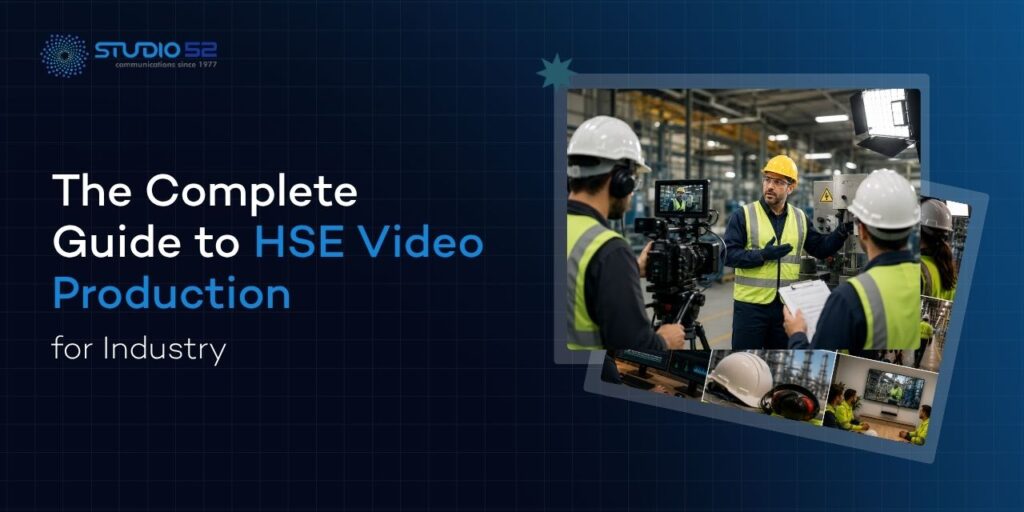

Every year, thousands of workers are injured on industrial sites. Many of those incidents were preventable. The procedures existed. The rules were written down somewhere. But somewhere between the safety manual and the job site, the message got lost.
That is the exact gap HSE video production was built to close. A well-made safety video does not just tick a training box. It shows workers what danger actually looks like, what the right response is, and why it matters in a format they will actually sit through and remember. For industries where a single mistake can be fatal, that is not a small thing.
Table of Content
What Is HSE Video Production?
At its core, HSE video production is the process of turning health, safety, and environmental procedures into video content that workers can watch, understand, and apply on the job. That sounds simple, but there is a lot that goes into doing it well.
It is not about filming someone reading out a checklist. Good HSE video production takes your specific site conditions, your actual hazards, your workforce profile, and your regulatory requirements and builds content around all of them. The result is training material that feels relevant rather than generic, which makes a real difference in how well people absorb it.
Why Industrial Companies Need HSE Videos
Think about the last time your site took on a large batch of contractors. How consistent was their safety induction? Did every single one walk away with the same understanding of your site rules and emergency procedures? Probably not.
That inconsistency is one of the biggest reasons industrial companies turn to workplace safety training videos. A video delivers the same message every single time, to every single person, regardless of who is delivering the training or what language the worker speaks. It removes the human variable from a process where consistency genuinely matters.
Beyond that, industrial safety videos support HSE compliance by creating a clear, documented record of who was trained and when. They speed up safety induction for new starters and contractors. They simplify technical procedures that would take pages to explain in writing. And in high-risk environments, they give workers a reference point they can return to when something does not feel right.
Types of HSE Videos
The category of HSE video covers quite a range of content, and it helps to understand what each type is actually designed to do.
Safety induction videos are usually the first thing a new worker or contractor sees on a site. They cover the essentials: hazard awareness, emergency exits, site rules, and who to report to if something goes wrong.
HSE compliance videos are built around regulatory standards. They document your processes and demonstrate that your workforce has been properly trained, which matters enormously during audits.
Oil and gas safety videos deal with the very specific risks of that sector. Drilling operations, confined space entry, hot work permits, and H₂S exposure. These are not risks you can explain adequately with a handout.
Emergency response videos are scenario-based. A fire. A chemical release. A man overboard. Workers need to know exactly what to do before those situations happen, not during them.
Behavior-based safety videos take a different angle. Rather than just covering procedures, they focus on attitudes and habits, trying to shift the culture rather than just the knowledge.
Equipment and machinery safety videos cover operating procedures, lockout/tagout protocols, and PPE requirements in a format that is far clearer than a written manual.
Environmental safety videos address spill prevention, waste handling, and environmental compliance, particularly relevant for oil and gas and chemical industries.
HSE Video Production Process
The production process matters as much as the final video. A good HSE video production company does not just show up with a camera. They start by getting a proper understanding of the safety objective. What specific gap in knowledge or behavior does this video need to address?
From there, the team reviews your site risks, standard operating procedures, and applicable regulations. That research phase feeds directly into scriptwriting and storyboarding, where the safety message gets shaped into a clear visual narrative.
Production then moves into filming on location, animation, or a mix of both depending on the content. Voiceover recording and subtitle work follow, then a structured review stage involving your HSE team before final delivery.
Studio52 has spent decades creating HSE video content for high-risk industries across the UAE, Saudi Arabia, and the UK. Get in touch and let us talk through what your workforce needs.
Filmed vs Animated HSE Videos
There is no single right answer here. The format should follow the content.
Filmed videos work best when authenticity is important. Showing real equipment, real site conditions, and real workers doing the right thing creates a credibility that animation cannot always replicate. For safety induction videos and behavior-based safety content, that realness carries weight.
Animated HSE videos come into their own when the subject matter is either too complex or too dangerous to film directly. Processes that happen inside machinery, hazardous atmospheres, underground pipelines, these things are much clearer in animation. There is also a practical advantage: animated videos are significantly easier to adapt into multiple language versions without reshooting anything.
A hybrid approach, combining real footage with animated sequences, is often the strongest option for oil and gas safety videos and emergency response content where you want both the credibility of real footage and the clarity of visual explanation.
HSE Videos for High-Risk Industries
Some industries simply cannot afford to treat safety training as a formality. Oil and gas sits at the top of that list. The hazards are severe, the regulatory requirements are strict, and the workforce is often multilingual and geographically dispersed. Safety induction videos, operational procedure content, and emergency response videos are not optional here.
Construction, manufacturing, logistics, marine and offshore operations, and chemical processing all carry similar demands. Each sector has its own specific risk profile, its own regulatory landscape, and its own workforce characteristics. Generic safety content cannot address any of that effectively. Industry-specific HSE video production can.
How HSE Videos Support Compliance
Compliance is not just about having the right paperwork. It is about demonstrating that your workforce genuinely understands your safety standards, consistently, across every site and every shift.
HSE compliance videos help you do that by standardizing training delivery, creating a documented record that survives staff turnover and contractor rotations, and giving you content you can update quickly whenever SOPs change. When an audit comes around, being able to show consistent, documented safety training video carries real weight.
Best Practices for Effective HSE Videos
Keep the message focused. Trying to cover too much in one video is one of the most common mistakes in safety video production, and it kills retention. One topic, done well, is always more effective than five topics rushed through.
Use scenarios your workers will actually recognize. A safety video that feels relevant to the viewer’s actual job lands far better than one that feels abstract.
Build in multilingual voiceover and subtitles from the start if your workforce is mixed. It is much harder to retrofit that later.
Keep videos short enough to hold attention, typically three to ten minutes depending on the topic.
And make sure the content reflects your company’s actual HSE policies, not just generic industry guidance.
How to Choose an HSE Video Production Company
The most important thing to look for is genuine industrial knowledge. A safety video production company that understands HSE regulations, site hazards, and workforce dynamics will produce content that is accurate, useful, and compliant. A general video agency without that background will produce something that looks fine but misses the point.
Beyond that, check for animation capability, multilingual production services, on-location filming experience, and a review process that properly involves your HSE team.
Studio 52 has been producing industrial safety videos for clients across the Middle East and the UK for decades. From oil and gas safety videos to animated HSE compliance content, the team handles the full process.
Reach out to Studio 52 and let us build something your workforce will actually benefit from.
Conclusion
A well-produced HSE video does something that no manual or classroom session quite manages. It puts workers directly inside a scenario, makes the risk feel real, and shows them exactly what the right response looks like. That is not a soft benefit. In industries where mistakes have serious consequences, the quality of your safety communication directly affects outcomes.
From safety induction videos to full animated HSE compliance programs, the investment in proper video production pays for itself quickly when it means fewer incidents, stronger compliance, and a workforce that actually trusts your safety standards.
Need professional HSE video production for your industrial workforce? Connect with Studio 52 to create filmed, animated, and multilingual safety videos built for high-risk industries.
FAQs
What is HSE video production?
How long should a safety induction video be?
Can HSE videos be produced in multiple languages?
Are animated HSE videos effective for oil and gas training?
How do HSE videos support compliance audits?