
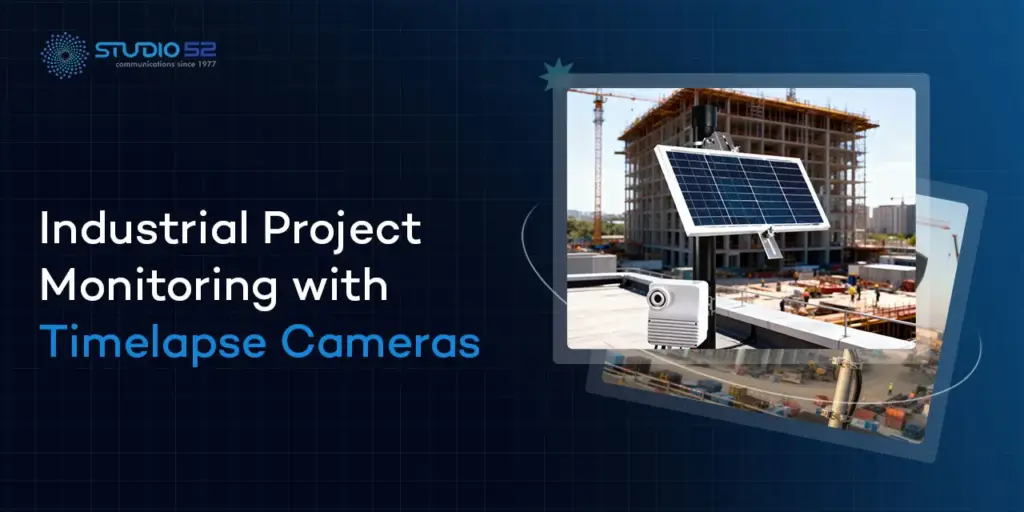

Industrial projects move fast, involve dozens of stakeholders, and carry massive financial risk. One missed milestone or undocumented delay can spiral into something much bigger. This blog explores how time-lapse cameras are changing the way industrial projects are monitored, reported, and documented and why more project teams are making it a non-negotiable part of how they work.
Table of Content
Introduction
Let’s be honest. Managing an industrial project is controlled chaos at the best of times. You have got contractors working at different hours, multiple work fronts running at once, clients asking for constant updates, and timelines shrinking when unexpected issues arise. Professional timelapse video production gives you a way to track everything on site, even when you are not there.
That is a tough ask. And traditional monitoring methods like site visits, daily reports, and WhatsApp photo updates just do not cut it anymore.
So what actually works? More industrial project teams are turning to timelapse cameras not as a novelty or just for the final showreel, but as a true project management tool. They provide full visibility, accurate documentation, and the kind of reporting stakeholders want to see. Let us get into it.
What Does Industrial Project Monitoring Timelapse Actually Mean?
At its simplest, it is this: cameras placed across your site, capturing images at set intervals throughout your project. These images are compiled into time-compressed footage showing months of work in minutes. What makes it useful for industrial projects is not just the final video, but the ongoing visibility.
Think about it this way: a timelapse system installed on day one becomes a silent, always-on witness to everything on site-capturing equipment movements, structural progress, workforce activity, and weather-related stoppages, all automatically timestamped and stored in the cloud.
No one has to remember to document it or be physically present the system does it all. Compare that to manual monitoring, where a site manager walks the project once a day, takes a few photos, and writes a report already hours out of date. The difference is not subtle. It’s the difference between a real picture of your project and just hoping things are going to plan.
Why Industrial Projects Specifically Need This
Not every project carries the same level of complexity, but industrial projects are on another level.
They involve massive footprints, often hundreds of acres, with multiple contractors working in parallel and limited visibility into each other’s progress. Clients, investors, regulatory bodies, and senior management all expect updates on their own schedule. With high financial stakes, even a two-week delay can trigger penalties, contract reviews, and reputational damage.
Here is what makes visual monitoring important in that context. You cannot manage what you cannot see. In industrial projects, there are too many moving parts for anyone to track at once. Monitoring Your Construction Site With Timelapse Camera breaks down exactly how a camera network fills that gap without missing a shift or forgetting to document busy site activity.
Beyond daily operations, accountability matters. When issues arise as they often do on large industrial projects questions of what happened and who is responsible can become contested. Timelapse footage cuts through the noise, showing exactly what happened and when, with no room for interpretation.
And then there is the compliance angle. Many industrial sectors, including oil and gas, energy, and heavy manufacturing, operate under strict documentation requirements. A continuous, verifiable visual record of your project is not just useful. In some cases, it is required.
The Real Benefits (Beyond the Obvious)
You have probably heard that construction timelapse camera help with progress tracking. That is true. But the value goes further than most people realise.
You stop relying on second-hand information. Right now, your picture of what is happening on site probably comes filtered through someone else, a site manager, a foreman, or a contractor’s weekly report. Every filter introduces delay and potential distortion. Timelapse gives you direct, unfiltered visibility whenever you need it.
Your stakeholder updates actually land. There is a big difference between sending a client a written progress report and showing them a crisp visual update of everything that has happened on site this month. The second option builds confidence in a way the first simply does not. Clients who can see the work happening are easier to work with, full stop.
You catch problems while they are still small. This might be the most underrated benefit. When you can review footage of your site regularly, patterns emerge. A particular work zone is consistently slow. A piece of equipment is sitting idle more than it should be. A sequence that was supposed to happen has not started yet. Catching those signals early, before they cascade into something bigger, is where timelapse monitoring pays for itself.
Your project documentation becomes genuinely useful. Most project archives are a mess of scattered photos, PDF reports, and email chains. A timelapse system creates a structured, chronological visual record that is easy to navigate, easy to share, and easy to present. That record has value long after the project ends, whether you are resolving a dispute, onboarding a new client, or preparing a bid for a similar scope of work.
You get a marketing asset that actually tells a story. A well-produced Timelapse Video In Construction Marketing And Sales is compelling content. It shows scale, complexity, and execution capability in a way that no brochure or case study can replicate.
The Technology Doing the Heavy Lifting
The Timelapse Video Construction Cameras used in industrial deployments today are a long way from consumer-grade hardware.
We are talking high-resolution sensors, from HD up to 4K and 8K, capable of capturing fine detail across large distances. That matters when you need to review footage closely, whether for quality assurance, safety auditing, or documentation purposes.
Durability is non-negotiable. Industrial sites are hostile environments. Extreme heat, dust, rain, vibration, and sometimes hazardous atmospheres. The hardware used in professional industrial timelapse deployments is weatherproofed, ruggedized, and built to run reliably for the full duration of a project without requiring constant maintenance.
Cloud-based storage and access have changed the game significantly. Footage is automatically uploaded and available through a secure online portal. Project teams can log in, review footage, pull clips for reporting, and share updates with stakeholders without anyone needing to physically retrieve anything from the site.
And for larger project operations, these systems connect with the tools teams are already using. Project management platforms, scheduling software, reporting dashboards. Visual data flows into the broader project intelligence environment rather than sitting in a silo.
Where It Gets Used
Industrial timelapse monitoring has found a home across a wide range of sectors, and for good reason.
Manufacturing plant construction. Long build durations, complex sequencing, and multiple specialist contractors. Timelapse Cameras Construction Industry Best Way Monitor Share Growth Projects gives project leaders a coherent view of the whole build, not just individual workfronts.
Oil and gas. Refineries, processing facilities, pipeline projects. Documentation requirements are strict, safety auditing is ongoing, and the cost of disputes is enormous. Timelapse footage is increasingly part of the standard project delivery toolkit.
Infrastructure and utilities. Water treatment plants, power substations, and transmission corridors. Many of these projects are in remote or constrained locations. Remote visual monitoring reduces the need for constant on-site presence.
Energy and industrial facilities. Solar farms, wind installations, and battery storage. Investor reporting is a major driver here. Being able to show progress visually, not just through financial updates, makes a real difference in stakeholder relations.
How the Process Actually Works
There’s nothing complicated about setting up a Timelapse Video Construction Site Monitoring System — the process is straightforward. It begins with a site visit and planning session, where camera positions are mapped based on project scope, key areas, and optimal viewing angles.
Cameras are then installed, configured, and connected, with capture intervals set based on project pace-a fast-moving site may need images every few minutes, while a slower build may use hourly captures.
From that point, everything runs automatically. Images upload to secure cloud storage continuously. The monitoring portal is live and accessible to whoever needs it. Alerts can be configured for specific triggers.
At project completion, the team compiles the full archive into a professionally produced timelapse video. They can cut the final output in multiple formats depending on how you plan to use it, whether for a board-level presentation, a client handover, or a social media release.
Choosing a Timelapse Partner for Industrial Work
This is worth thinking carefully about. Industrial timelapse monitoring requires specialised expertise, and not every provider can handle it well. Experience on industrial sites matters enormously, as the logistics of installing and maintaining equipment in an active refinery or a heavy construction environment are very different from a commercial building project.
Equipment quality is not an area to cut corners on. You want cameras and infrastructure that will hold up for the duration of your project without needing constant attention. Ask about specifications, and ask to see examples of footage quality.
The monitoring platform matters too. A good system gives you intuitive access to footage, clear progress timelines, and the ability to generate reports without wrestling with the interface. If it takes an IT specialist to pull a clip, that is a problem.
Ask for a portfolio. Any credible industrial timelapse provider should show completed projects of similar scale and explain the outcomes. Studio 52 has years of experience on complex industrial builds, uses equipment designed for tough conditions, provides a user-friendly platform, and delivers final productions that teams use, not just store.
Wrapping Up
Industrial projects are too big, too complex, and too high-stakes to manage on faith and fragmented reports. Timelapse monitoring gives you the visibility to manage with confidence. It gives your stakeholders the transparency they are asking for. It gives your team the documentation they need when things get contested. And it gives your business a record of what you have built and how you built it.
That is a lot of value from cameras that run quietly in the background, doing their job every single day.
Talk to the Studio 52 team today and find out how Timelapse Video monitoring can transform the way you run your next industrial project.