

Construction sites are one of the workplaces where the highest number of accidents occurs because of various reasons. Such as, insufficient training, miscommunication, inattentive employee, inadequate equipment knowledge, unaware of certain situations and many more. To avoid such workplace accidents and bring safety in the workplace, construction companies need to provide rigorous training. Safety Training videos are one of the powerful tools to make trainings effective.

According to the latest report released by the Bureau of Labor Statistics, 5190 severe injuries occurred in 2021, of which a whopping 20% occurred in the construction industry.
Construction sites are highly dangerous, and failure to follow safety protocols can lead to fatal consequences such as accidents, electrocutions, injuries, and financial losses. These risks highlight the urgent need for effective safety measures across every construction site.
To mitigate these dangers, construction companies must prioritise rigorous worker training. Construction safety videos provide a powerful solution, delivering clear, consistent, and engaging safety instructions that help employees understand hazards, follow protocols, and maintain a safer workplace.
The best way to design a comprehensive safety module is through safety training videos. Here are 8 reasons you should use safety training videos.
Table of Content
1. Targeted Safety Training for Common Hazards on Construction Sites.
Construction sites pose common hazards such as falls from heights, machinery accidents, and electrocutions, which account for a significant number of industry fatalities. OSHA has identified these as leading causes of death in construction.
To address this, targeted training through construction training videos helps raise worker awareness about the consequences of ignoring safety protocols. Using visuals, music, and storytelling, a construction safety animation video delivers impactful messages that resonate more strongly than verbal instructions alone.
By visually demonstrating real-life hazards and outcomes, these videos make safety information more relatable, encourage responsible behaviour, and help reduce accidents on construction sites.
2. Improved Compliance and Legal Protection
Improved compliance and legal protection are paramount for construction companies, especially considering the prevalence of safety violations in the industry. According to OSHA, five out of the top 10 frequently violated safety standards pertain specifically to construction. These include:
- Fall Protection, construction (29 CFR 1926.501)
- Ladders, construction (29 CFR 1926.1053)
- Scaffolding, construction (29 CFR 1926.451)
- Fall Protection Training, construction (29 CFR 1926.503)
- Eye and Face Protection, construction (29 CFR 1926.102)
Source (https://www.osha.gov/data/commonstats)
As per the law, construction businesses must provide fall protection training. Safety videos are an accessible and impactful way to convey safety protocols, emergency caution, etc. You can easily outsource safety protocols from reliable video production companies like Studio52, and can efficiently obtain high-quality training materials tailored to their specific needs.
In compliance with the law, construction businesses are required to provide fall protection training to their employees. Health and safety videos construction teams rely on offer an accessible and impactful way to communicate safety protocols, emergency procedures, and critical site information. By outsourcing professional video production, companies can obtain high-quality, customised training materials that are easy to distribute across their workforce.
Through well-structured safety construction videos, workers gain a clearer understanding of safety procedures and are more likely to follow correct practices such as proper ladder use, safe scaffolding techniques, and wearing appropriate personal protective equipment. This approach helps construction businesses stay compliant with OSHA standards, including Fall Protection, Ladders, Scaffolding, Fall Protection Training, and Eye and Face Protection regulations.
Moreover, implementing safety training videos will also ensure that your workplace is compliant with the above 5 OSHA regulations. Thus, construction safety training videos ensure maximum safety compliance and save you from future legal complications.
3. Remove Language Barriers in Safety Training
In a workplace with a diverse workforce, language barriers can impede the effective communication of safety training material. To bridge this gap, consider producing or outsourcing safety training videos in different languages from multilingual video production houses such as Studio52.
Multilingual safety training videos can be created by adding voice-overs in different languages to existing safety training videos after they have been produced. Your workers can select their preferred language to watch the safety training video. This approach ensures that all employees, regardless of their linguistic background or proficiency, can comprehend the training content effectively.
4. Increase the Retention Rate of Safety Training
It’s crucial to make the training interactive to enhance the retention rate of safety messages. Traditional methods like in-person lectures may fall short here, lacking the capability for active engagement. In contrast, safety videos offer excellent interactivity features with their visuals and sounds.
One effective way to achieve this is by incorporating quizzes at the end of the safety training video. These quizzes can present emergency scenarios or safety procedures, prompting employees to apply their knowledge and skills. By actively engaging with the content, employees not only reinforce their learning but also gain a better understanding of safety protocols.
Moreover, quizzes serve as an assessment tool, allowing employers to gauge employees’ comprehension of the training material. This feedback loop enables businesses to identify areas requiring further clarification or reinforcement, contributing to overall safety improvement efforts.
Incorporating interactive elements like quizzes into safety training videos increases engagement and fosters a culture of continuous learning and knowledge retention among employees.
5. Save Time on On-Field Training
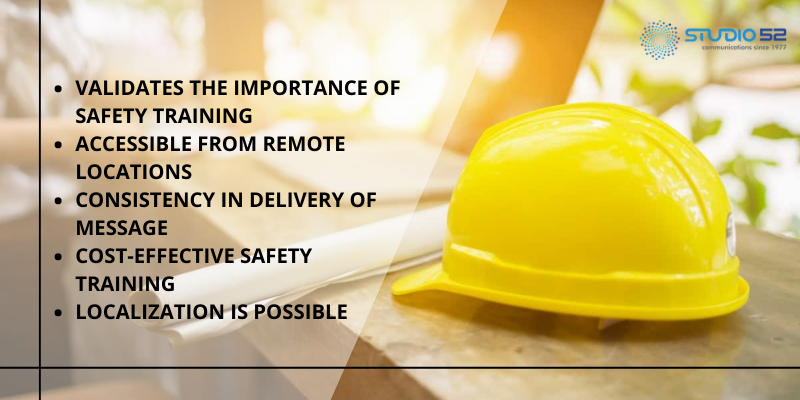
Safety training videos offer remote accessibility to your workers, allowing them to access the training material from anywhere, at any time. This eliminates the need for traditional field training sessions, saving valuable time and resources.
With this flexibility, workers can complete the safety training outside of their regular working hours, minimising disruptions to their workflow and productivity. Moreover, it relieves the burden of managing everyone’s schedule for training sessions, streamlining the process for both employees and employers.
By enabling workers to access training remotely, safety training videos optimise the utilisation of manpower on-site. Employees can undergo training at their convenience, ensuring that safety protocols are effectively communicated and understood without compromising operational efficiency.
6. Streamlined Tracking and Documentation of Safety Training:
Managing and documenting employee training and certification can be challenging, but safety training videos simplify the process. By delivering construction site safety videos through a learning management system, companies can track participation, monitor progress, and ensure timely completion of training modules. This centralised approach makes it easy to see how many workers have completed safety training, supporting audits and inspections. It also highlights knowledge gaps, enabling targeted retraining and continuous improvement of on-site safety protocols.
7. Customization Opportunities:
Safety training videos offer opportunities for customization to suit the specific needs of your workplace. You can tailor videos to showcase the exact locations and hazards present in your workplace, making employees more aware of potential risks. Additionally, you can incorporate branding elements such as logos and colours to reinforce your company’s commitment to safety. By aligning safety training videos with your brand identity, employees are more likely to take safety protocols seriously, fostering a culture of safety within the organisation.
8. Continuous Improvement and Feedback Loop:
Gathering feedback from employees on safety training videos for construction enables continuous improvement of training materials. By collecting input on video content, instructions, and pacing, companies can address areas of confusion or concern. Actively involving employees in this feedback process encourages a stronger focus on safety and provides valuable insights for refining training content. This iterative approach ensures that safety training remains relevant, engaging, and effective, ultimately driving better safety outcomes on construction sites.
Also read: The power of workplace safety training videos
Let’s read why safety training videos are so successful
- Picture Speaks Thousand Words: Construction training are complex training. It takes huge efforts for trainer to explain and for trainee to comprehend the content of the training. While, it’s easy for employer and employee, if content is presented in the video format.
- Safe Environment: Employees appreciate when the company is protective about them. Safety training don’t make them respect your company only, but also make them feel safe at workplace.
- Risk Identification: Safety videos for construction help employees realize that ignorance leads to disaster, where the risks lie, and they can find the areas where they need to be extremely cautious.
- Identical message delivery: Same training for each set of employees will lead to no miscommunication between them. Identical message gives clarity of entire training.
- Study of Incidents: Safety videos for construction have recording of live work, that’s why it becomes convenient for construction companies to study accidents and reasons behind them.
- Remote Location: Trainer doesn’t need to go to different places. Training videos can be mailed and the training session can take place at remote locations too.
- Time Saving: Time is precious. When training videos are handy, training coordination and arrangements don’t eat up your time.
- Cost Reduction: Each time calling trainer, paying fees to her, bearing travel cost will add to training expense, but when your Construction video production company has prepared a quality safety training video for your company, you can have the benefit of one time investment for long time.
Conclusion
The construction industry ranks second in workplace fatalities, largely due to workers not following safety protocols. One of the most effective ways to ensure compliance is by showing the consequences of neglecting these protocols. Safety videos for construction serve this purpose effectively, offering higher engagement and better retention of essential safety dos and don’ts.
In summary, safety videos for construction provide targeted training, improve compliance, overcome language barriers, and enhance retention. They help spread safety awareness across the workforce, ultimately reducing accidents and creating a safer work environment.
Safety training videos must be produced using the right strategy to make them effective. With Studio52‘s multilingual suite and expertly written scripts, you can effectively enhance safety awareness and reduce accidents in your workplace. Invest in the right strategy for safety training videos today to safeguard your workforce and promote a culture of safety within your organisation.
Book a free consultation with our experts for strategic safety training videos.