
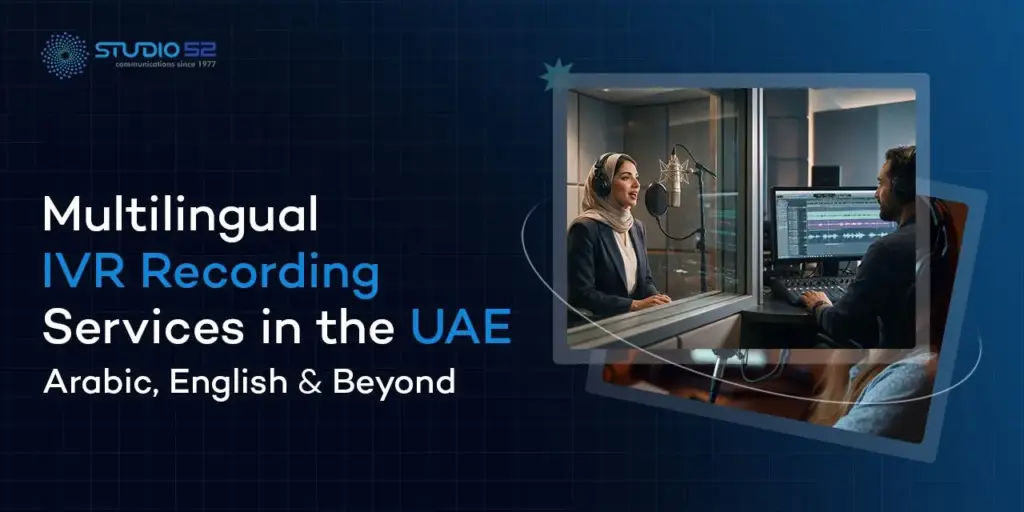

Walk into any office in Dubai or Abu Dhabi and you’ll find people speaking a dozen languages before lunch. That’s just how the UAE works. So when a customer calls a business and gets stuck in a phone menu they can’t follow, it’s not a small annoyance. It’s often the first real interaction they have with that brand. And it sets the tone for everything after.
This is where a well-built IVR system earns its keep. Interactive Voice Response — the automated menu that greets callers, routes them, and answers the basics before a human picks up — only works if people can follow it. In a market this diverse, that usually means offering more than one language, which is exactly what good IVR Recording Services UAE are built around.
That’s the idea behind Multilingual IVR Recording Services UAE: professionally recorded greetings, menus, and prompts in Arabic, English, and whichever other languages a company’s customers actually speak. Done well, it’s a small investment. It quietly improves almost every phone interaction a business has.
Table of Content
So What Exactly Is a Multilingual IVR?
The Basics
An IVR is the automated voice that answers before a person does. It might welcome the caller, list department options, share business hours, or point them toward the right team. Nothing fancy. But it does a lot of quiet work.
Make it multilingual, and callers get a choice early on: press 1 for Arabic, 2 for English, and so on. From there, everything they hear — department names, hold messages, voicemail prompts — should feel like it was written for them. Not translated at them.
What Goes Into Producing One
A proper multilingual IVR involves several moving parts. The studio localizes the script rather than just translating it. They cast the right voice talent. They record in a treated studio, edit the audio cleanly, and export it in whatever format the client’s phone system needs.
Why This Actually Matters in the UAE
The UAE’s population skews heavily international. Arabic speakers share the market with large South Asian, Filipino, and Western expat communities, plus a constant flow of visitors. A single-language phone system isn’t wrong exactly. But it leaves people out.
A few things tend to happen when a business gets multilingual IVR right. Customers reach the right department faster because they’re not guessing their way through a menu in a second language. The greeting itself builds the brand a little — a clean, professionally recorded welcome message signals attention to detail, even in small moments. And for businesses juggling several markets at once, consistent tone and terminology keep the brand from feeling like it’s splitting into different personalities.
Arabic or English First?
Most UAE businesses build around these two languages. The split usually comes down to who’s calling.
Arabic IVR Recording anchors banking, healthcare, government services, and any business that regularly talks to Arabic-speaking customers — which, across most sectors here, is nearly everyone. One decision matters most: Modern Standard Arabic or a more local Gulf/Emirati style. More on that below.
English IVR Recording UAE services carry a lot of the load for hospitality, retail, tourism, and corporate environments, where the caller base often skews expat or international.
Realistically, most companies don’t have to choose. They offer both, then check their actual call data to decide if a third language — Hindi and Urdu are common additions given the demographics — is worth adding.
What You Actually Get From Doing This Properly
It’s tempting to treat IVR recording as a box-ticking exercise: record the script, upload the files, move on. But there’s a real gap between a rushed recording and a properly produced one. Callers notice, even if they can’t say exactly why.
Clear, well-paced prompts help people get help faster instead of feeling confused. Logically structured menus cut down on misrouted calls and unnecessary transfers, which saves staff time too. And a system that handles routine questions on its own — hours, locations, simple routing — frees up the support team for calls that actually need a human.
This is really the value proposition behind professional IVR Voice Over Services UAE: the recordings themselves might sound simple, but they’re doing measurable work in the background.
Which Languages Are Worth Adding?
This isn’t a “more is better” situation. Arabic and English cover most of the ground for most businesses. Beyond that, it depends entirely on who’s calling:
- Hindi — worth considering if a large share of your customers are Indian
- Urdu — relevant for businesses with a significant Pakistani customer base
- Malayalam, Bengali, Tamil, Tagalog — niche, but occasionally the right call depending on the sector and location
Companies often add languages because it sounds inclusive, without checking whether anyone presses that button. A menu with seven language options is often worse than one with two. It simply takes longer to get through.
Where This Gets Used
Multilingual IVR shows up across nearly every industry in the UAE. A few sectors lean on it especially hard.
Everyday Services
Banks and financial institutions use it to route account queries and general support without tying up call center staff. Hospitals and clinics rely on it for appointment lines, department routing, and clear emergency instructions that can’t afford to be misunderstood. Retailers lean on it for order status, delivery updates, and returns.
Customer-Facing Industries
Hotels use it to make a first impression on guests arriving from all over the world. Real estate firms route sales, rental, and support calls that often come from buyers who aren’t even UAE-based. Government departments use it to make public services accessible to a population that speaks dozens of first languages.
The Pieces That Make Up a Full System
A complete multilingual IVR setup is usually built from a handful of recording types:
- Welcome greeting
- Language selection prompt
- Department routing messages
- Business hours announcements
- On-hold messages
- Voicemail greetings
- After-hours or emergency notices
None of these are complicated on their own. The value comes from recording all of them consistently, in every offered language.
A Few Things Worth Getting Right
Use native speakers, not just fluent ones. This matters most in Arabic, where dialect and tone shift the whole feel of a message. A non-native voice reading a technically correct script often still sounds slightly off. Callers pick up on that, even without knowing why.
Keep it short. People listen over a phone line, often distracted, sometimes in a rush. Long-winded instructions are where callers tune out or hang up.
Localize, don’t just translate. A script translated word-for-word tends to sound stiff. Good localization adjusts phrasing and terminology so it reads naturally to a native ear.
Test every language version in the live system. Timing, volume, and pronunciation can all shift once a file loads into the actual phone platform. Testing before launch catches problems a script read-through never will.
Arabic Specifically: MSA or Gulf/Emirati?
This is one of the more consequential decisions in the whole project. It’s easy to get wrong by defaulting to whichever option seems “safer.”
Modern Standard Arabic works well for formal, broad-reach communication — government bodies, educational institutions, or any business speaking to Arabic speakers across multiple countries, not just the UAE.
Gulf or Emirati Arabic feels more local and conversational. It tends to land better with businesses whose customers are specifically UAE- or Gulf-based, and who want the phone experience to feel personal rather than official.
There’s no universally correct answer here. It comes down to audience, industry, and how formal the brand wants to sound.
Why Bother With a Professional Studio
Businesses can record IVR prompts with a decent microphone and basic editing software. Plenty have tried. The results are usually fine — the way a phone photo is usually fine, until you compare it to something shot properly.
A dedicated IVR Recording Studio UAE brings a few things that are hard to replicate otherwise. This is also where broader Multilingual Voice Over Services UAE providers tend to separate themselves from smaller freelance setups — consistency across every language matters as much as quality in any single one:
- Access to native voice talent across multiple languages and dialects
- Acoustically treated rooms that keep background noise out of the recording
- Proper editing and mastering so volume and tone stay consistent across every prompt
- The ability to deliver files in whatever format the phone system needs
Discover why professional IVR recording for modern customer service is essential for delivering seamless, engaging, and professional customer interactions.
Common Mistakes to Avoid
A few patterns show up often enough to be worth flagging directly.
Language and Script Issues
Offering too many language options slows the menu down for everyone. Using voice talent that’s fluent but not native to the dialect creates subtle awkwardness. Translating scripts literally, instead of localizing them, produces phrasing that sounds off even when it’s grammatically correct.
Production and Maintenance Issues
Inconsistent audio quality — different volume levels or background noise between prompts — is more noticeable than people expect. Menus that run too long make callers give up before they reach the option they need. And stale messages, like outdated business hours or a department that no longer exists, erode trust fast.
Where This Is Heading
IVR technology isn’t standing still. AI-assisted routing is starting to let systems understand spoken requests instead of relying purely on keypad selections. Businesses increasingly pull in customer history and CRM data, so the system feels tailored rather than generic. And demand for proper Arabic localization keeps growing, as companies realize a technically correct script isn’t the same as one that sounds right to a native speaker.
The general direction points toward systems that combine automation with enough intelligence to know when to hand off to an actual person.
What It Costs
There’s no single number here. Pricing depends on the number of languages, the script length, how many prompts need recording, the voice talent and dialect work required, and how much editing and revision the project needs.
A short bilingual project is a relatively light lift. A large multilingual system with hundreds of prompts across several languages is a different scale of production entirely. For an accurate quote, hand the studio a finished script and clear language requirements up front, rather than asking for a ballpark before the scope is defined. Businesses looking for IVR Voice Recording Dubai specifically should also confirm whether the studio works on-site or remotely, since this can affect both turnaround time and pricing.
Picking a Provider
A few questions are worth asking before committing to a studio.
On Talent and Quality
Do they have native speakers for the specific languages and dialects you need — not just “Arabic,” but the right kind of Arabic? Can you hear samples that show real pronunciation and pacing, rather than a polished demo reel? Do they localize scripts, or just translate them?
On Process and Price
What does their recording and editing process look like? Can they hit your timeline if you’re working toward a launch date? Is the pricing structure clear about what’s included — recording, edits, revisions, final delivery — before you sign anything?
Bringing It Together
Multilingual IVR isn’t flashy technology. But in a market as linguistically mixed as the UAE, it’s one of the more practical investments a business can make in customer experience. Arabic and English cover most companies’ needs. Anything beyond that should earn its place through data, not assumption.
Production quality makes the real difference: native voice talent, genuine localization instead of literal translation, and recordings tested in the live system before anyone relies on them.
Ready to upgrade how your business sounds on the phone? Contact Studio52 to talk through your multilingual IVR recording needs — Arabic, English, or anything in between.