
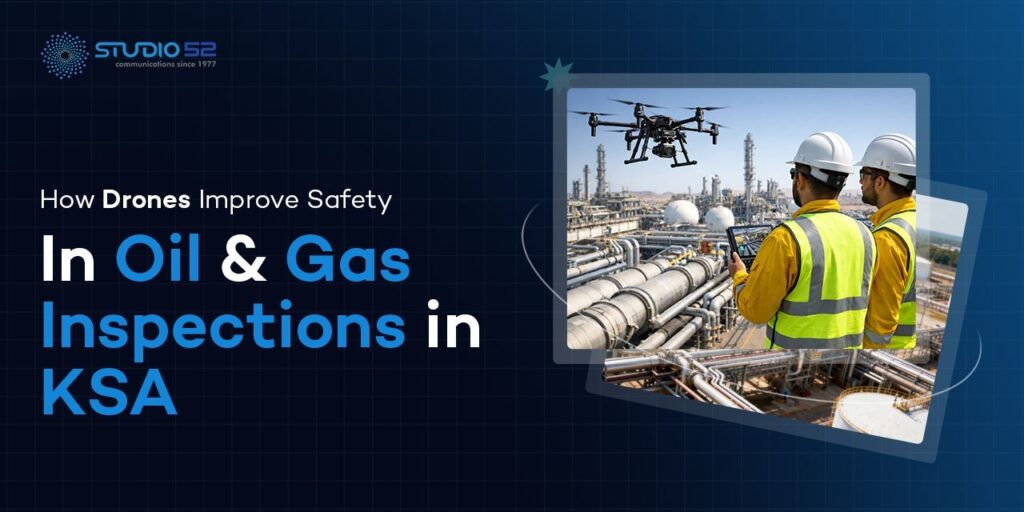

The oil and gas industry in Saudi Arabia is undergoing a massive transformation by integrating advanced drone technology for refinery inspection. This blog explores how drone services in Saudi Arabia are replacing hazardous manual tasks with high-tech aerial solutions. From flare stack inspections to leak detection, drones minimize human risk while providing real-time data. Learn why top drone companies in saudi arabia like Studio52 are leading the charge in making industrial sites safer and more efficient through innovative drone filming for refineries.
The energy sector is the heartbeat of the Kingdom, and ensuring its safety is a top priority. For decades, inspecting massive infrastructure meant putting workers in high-risk situations. However, the rise of drone services in Saudi Arabia has completely changed the game. By utilizing drones for oil and gas industry operations, companies can now reach the unreachable without risking a single life. This technology is not just a luxury; it is becoming a standard for safety and precision across the region.
Table of Content
Overview of the Oil & Gas Industry in Saudi Arabia
Saudi Arabia holds some of the world’s largest oil reserves, making its refineries and pipelines critical global assets. Maintaining these facilities requires constant vigilance. Traditionally, this meant extensive downtime and complex logistics. Today, the integration of drones in oil and gas industry workflows allows for continuous monitoring. As the Kingdom pushes toward Vision 2030, adopting drone services for oil and gas industry needs is a key part of industrial modernization and safety excellence.
Traditional Oil & Gas Inspection Methods and Their Risks
Before drone technology for refinery inspection became common, technicians relied on scaffolding, rope access, and heavy machinery. These methods are inherently dangerous. Workers faced extreme heat, potential falls, and exposure to toxic fumes. Manual inspections are also slow and can lead to human error due to fatigue. Transitioning to oil and gas drone inspection removes these physical burdens, allowing for a much safer approach to data collection in volatile environments.
Introduction to Drone Technology in Industrial Inspections
Modern industrial drones are far more than just flying cameras. They are sophisticated data-gathering tools equipped with specialized sensors. Drone filming in Saudi Arabia has evolved to include thermal imaging and gas sniffers. When we talk about drones for oil and gas inspection, we are talking about stable, explosion-proof machines designed to operate near high-heat sources. These tools provide a bird’s-eye view that was previously impossible to obtain safely.
Regulatory Framework for Drone Operations in KSA
Operating drones in the Kingdom requires strict adherence to GACA (General Authority of Civil Aviation) regulations. Safety is the core of these laws, ensuring that drone filming for refineries does not interfere with manned aircraft or sensitive operations. Professional drone companies in Saudi Arabia handle all the legalities, ensuring every flight is permitted and insured. Following these frameworks is essential for maintaining the high safety standards expected in the Saudi energy sector.
How Drones Enhance Safety in Oil & Gas Inspections
The primary goal of drone inspection for oil and gas is to keep people out of harm’s way. By sending a drone instead of a person, the “human factor” in dangerous zones is eliminated. Drones can fly into areas where temperatures are too high or air quality is too poor for humans. This shift significantly reduces the Total Recordable Incident Rate (TRIR) for companies utilizing drones oil and gas technology.
Eliminating the Need for Working at Heights
Falling from heights remains a leading cause of industrial accidents. Using drones for oil and gas industry inspections means technicians can stay firmly on the ground. Whether it is checking a cooling tower or a tall chimney, the drone climbs the height instead of a worker. This reduction in scaffolding use not only saves time but removes the highest statistical risk factor from the inspection process.
Reducing Confined Space Entry
Entering storage tanks or pressure vessels is one of the most feared tasks in a refinery. These spaces can trap toxic gases or have low oxygen levels. Drone technology for refinery inspection allows specialized “collision-tolerant” drones to enter these spaces. They capture high-definition visuals and structural data without a human ever having to step inside, making oil and gas drone inspection a literal lifesaver.
Minimizing Offshore Platform Risks
Offshore environments are notoriously harsh with high winds and corrosive salt spray. Performing manual checks on the underside of a platform is incredibly dangerous. Drone services in Saudi Arabia provide specialized offshore units that can withstand these conditions. By using drones for oil and gas industry tasks at sea, operators avoid the risks associated with boat transfers and hanging over open water.
Detecting Gas Leaks Without Direct Exposure
Gas leaks are invisible killers. Traditional detection required workers to walk through sites with handheld sensors, potentially walking right into a cloud of methane or H2S. Modern drones for oil and gas inspection are equipped with Optical Gas Imaging (OGI) sensors. They can “see” leaks from a distance, allowing the team to identify the source while remaining in a safe, upwind location.
Emergency Response & Disaster Assessment
In the event of a fire or structural failure, every second counts. Sending a ground team into an unstable area is a massive risk. Drone filming in Saudi Arabia allows emergency teams to get a live feed of the situation instantly. This real-time data helps commanders make informed decisions, ensuring that responders are only deployed when and where it is safe to do so.
Key Applications of Drones in Oil & Gas Inspections
- Pipeline inspection and monitoring: Covering hundreds of kilometers of desert terrain to find leaks or soil erosion.
- Storage tank inspection: Checking for internal and external corrosion without draining the tank.
- Flare stack inspection: Inspecting live flares while they are still burning to avoid costly shutdowns.
- Refinery structural assessments: Identifying cracks or fatigue in steel structures via drone filming for refineries.
- Offshore platform monitoring: Assessing the integrity of rigs in the Arabian Gulf.
- Corrosion detection: Using high-zoom cameras to find “CUI” (Corrosion Under Insulation).
- Environmental compliance monitoring: Ensuring no oil spills or harmful emissions are affecting the local ecosystem.
Advanced Technologies Enhancing Drone Safety
The safety of drone services for the oil and gas industry is bolstered by incredible hardware. Thermal Imaging identifies hotspots that could lead to fires. LiDAR Mapping creates precise 3D models of plants to find structural shifts. AI & Machine Learning can automatically flag defects in thousands of photos. Finally, Real-Time Data Analytics allows engineers in a central office to see what the drone sees, ensuring immediate expert oversight.
Cost & Operational Benefits Linked to Safety
Safety and efficiency go hand in hand. When you use drone inspection for oil and gas, you don’t need to build expensive scaffolding. You don’t need to shut down an entire unit for a week just to look at a valve. By keeping the plant running while conducting drones oil and gas surveys, companies save massive amounts of resources while simultaneously improving their safety record.
Future of Drone Inspections in KSA’s Oil & Gas Sector
The future looks autonomous. We are moving toward “Drone-in-a-Box” solutions where drones for oil and gas industry inspections launch automatically on a schedule. These systems will reside on-site and perform routine safety sweeps without human pilots. As AI improves, drone technology for refinery inspection will become even more predictive, catching failures before they even happen.
Why Oil & Gas Companies in KSA Should Adopt Drone Inspections Now
The digital transformation of Saudi Arabia is moving fast. Companies that delay adopting oil and gas drone inspection are not just falling behind in tech; they are maintaining unnecessary risks. With the availability of expert drone services in Saudi Arabia, there is no reason to continue with outdated, dangerous manual methods. Protecting your workforce is the best investment you can make.
Role of Professional Drone Service Providers
You need a partner who understands the complexities of the Saudi energy landscape. Studio52 stands out among drone companies in Saudi Arabia by providing end-to-end solutions. From securing GACA permits to deploying expert pilots with specialized sensors, Studio52 ensures that drone filming in saudi arabia is done with the highest level of professionalism and safety. They provide the actionable data needed to keep your refinery running smoothly and your workers safe.
Conclusion
The transition to drones for oil and gas inspection is one of the most positive shifts in industrial history. It replaces danger with data and risk with reliability. By embracing drone services for oil and gas industry applications, the Kingdom’s energy sector is setting a global example for safety. The sky is no longer the limit; it is the vantage point from which we protect our most valuable assets.
FAQs
How do drones improve safety in oil & gas inspections?
What types of drones are used in oil & gas inspections?
Can drones detect gas leaks effectively?
How do drones help in offshore inspections?
Can drones inspect confined spaces?