
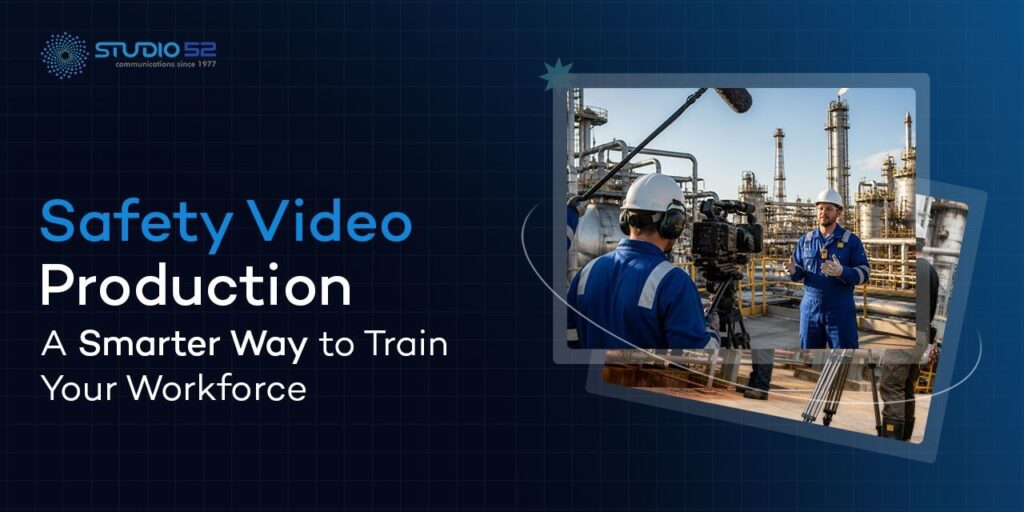

Most safety accidents don’t happen because workers don’t care. They happen because training didn’t stick. This blog looks at why safety video production is changing how companies across the UAE, Saudi Arabia, and the UK train their people. From faster onboarding to better retention, safety training videos for employees are replacing dusty manuals and one-off lectures. You’ll find out what makes a safety moment video actually work, which industries need this most, and why Studio52 gets it right.
Walk onto almost any site and you’ll find a safety manual sitting somewhere, mostly unread. That’s not because people don’t care about staying safe. It’s because a thick binder full of instructions was never going to hold anyone’s attention past page two.
This is where safety video production comes in, and honestly, it’s overdue. A good safety training video shows people exactly what could go wrong and exactly what to do about it in a way that actually sticks. If your company is still handing out photocopied checklists for induction day, there’s a better way, and it’s worth a look.
Table of Content
Why Traditional Safety Training No Longer Delivers Maximum Results
Classroom sessions worked fine twenty years ago. They don’t work so well now. People’s attention spans have shrunk, workforces are more mixed than ever, and on a lot of GCC and UK sites you’ll have workers who don’t speak the same first language as the trainer standing in front of them.
There’s also a consistency problem. One supervisor might explain a lockout procedure one way on Monday, and a different supervisor might explain it slightly differently on Thursday. Multiply that across shifts and sites, and you end up with gaps nobody notices until something goes wrong.
Why Safety Video Production is a Smarter Training Solution
A camera doesn’t get tired halfway through a shift and skip a step. Once you’ve filmed a video, it plays the same way every single time, whether it’s shift one or shift three hundred, in Dubai or in Sheffield.
People also just remember visuals better than text. Show someone a worker forgetting to lock out a machine before maintenance, and they’ll picture that scene in their head weeks later. That’s why workplace safety videos consistently beat printed materials when it comes to actual recall, not just ticking a training box.
Top Benefits of Safety Video Production for Businesses
The obvious win is time. New hires can watch safety training videos for employees on their own schedule instead of waiting around for the next group induction session. That alone can shave days off onboarding.
Then there’s consistency, since every location gets the exact same message, word for word. And there’s a paper trail benefit too. A recorded, timestamped training video holds up a lot better in an audit than “yes, we told them verbally.”
Industries That Benefit Most from Safety Video Production
Construction sites, oil and gas facilities, manufacturing plants, logistics hubs, and hospitals. These are the places where a missed step can genuinely hurt someone, and they’re exactly where video training earns its keep. Hospitality and facilities teams need it too, particularly for fire drills and hygiene protocols.
Across Saudi Arabia and the UAE especially, where massive infrastructure and energy projects are constantly onboarding new contractors, workplace safety training videos have basically become the default requirement now, not a nice-to-have.
Types of Safety Videos Every Company Should Produce
You’ll usually need a proper induction video, some equipment-specific how-to clips, an emergency response guide, and a stack of shorter clips for daily toolbox talks. The smartest approach mixes longer content for onboarding with short safety videos that hammer home one lesson at a time, often under two minutes.
Companies that consistently produce the best workplace safety videos usually treat this as an ongoing library, not a one-time project, adding new clips as procedures or equipment change.
Key Elements of an Effective Safety Training Video
Keep it simple. Steps should follow a logical order, without technical jargon that loses half the room if English isn’t their first language. Filming on the actual site, or somewhere that looks like it, makes a huge difference too. Nobody connects with a generic office scene when they work in a warehouse.
A strong safety moment video should end with something specific to do, like reporting a hazard immediately, not a vague “Stay safe out there.” Many companies build a rotating library of safety moment videos so toolbox talks never feel repetitive.
Step-by-Step Safety Video Production Process
It usually starts with reviewing the actual risk assessment for that task, then scripting around it. From there you storyboard the key scenes, film on location where possible, and move into post production for narration, subtitles, and any graphics needed. The final sign-off comes after the client reviews the cut.
How Safety Videos Improve Workplace Safety Culture
When training feels like something worth watching instead of a box to tick, people start treating safety differently day to day. Videos refreshed every so often keep the message alive instead of fading two weeks after induction, which is exactly when a lot of bad habits creep back in.
Mistakes to Avoid When Creating Safety Videos
The biggest one? Making it too long. Nobody retains a fifteen-minute lecture disguised as a video. Generic stock footage is another mistake, since workers can tell instantly when a clip wasn’t filmed anywhere near their actual job. Overacted scripts don’t help either; they just make the whole thing feel fake. Partner with a health and safety video agency to produce impactful safety training videos that educate employees and promote safer workplace practices.
How to Choose the Right Safety Video Production Company
Find a team that’s actually filmed on industrial sites before, not just corporate offices. Ask to see past safety training videos and production work, check they understand local regulations, and make sure they can handle scripting in more than one language if your workforce needs it.
Why Professional Safety Video Production is a Long-Term Investment
A well-made video gets reused for years, across new hires, refreshers, and audits, which makes the upfront cost look pretty small compared to running live sessions on repeat, or worse, dealing with the cost of an incident that better training might have prevented.
Why Choose Studio52 for Safety Video Production
Studio52 has spent years filming safety content across the UAE, Saudi Arabia, and UK, working directly with site teams to get the details right instead of guessing. Whether it’s a full introduction film or a quick safety moment video for a Monday toolbox talk, the team knows how to keep it accurate without making it boring.
Conclusion
Safety training doesn’t have to be something people forget the second they leave the room. Done right, safety video production turns a compliance requirement into something your workforce actually remembers when it matters.
Want training your team will actually watch and remember? Get in touch with Studio52 and let’s build safety videos that work as hard as your site does.
UAE: +971 44541054
Saudi: +966 12 4220506
Email: askus@studio52.tv