

Industrial workplaces in the GCC are affected by avoidable incidents every year. These accidents often cause interruptions to operations in the industries of the UAE and Saudi Arabia. Most trace back to one gap: poor safety communication.
Workers get long manuals. They sit through slide-heavy briefings. They leave without retaining much.
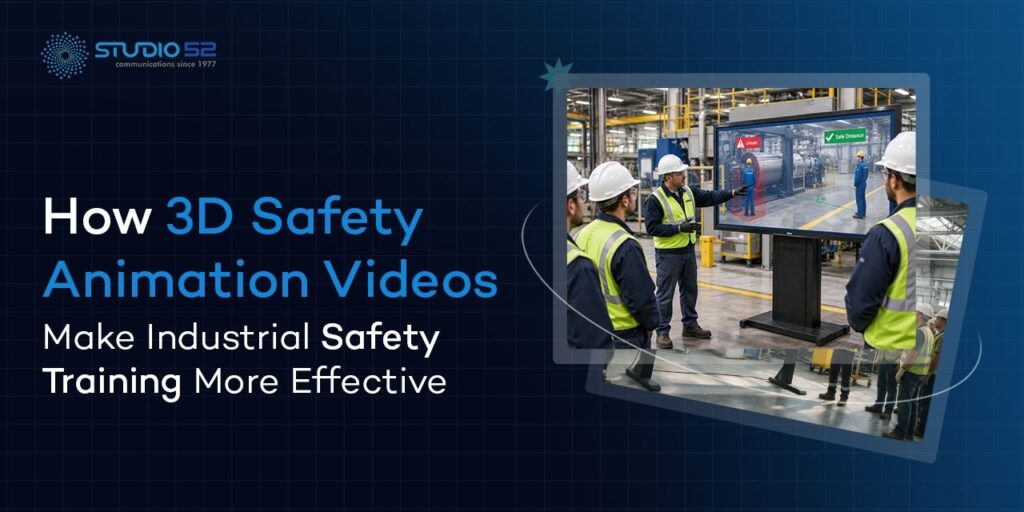
3D industrial safety animation videos change this completely. They show hazards in motion. They place employees in the situation before they encounter it on the job site. Safety experts make real work safer with real-time 3D visual communications.
Stronger safety measures can stop these costly mishaps. This blog explains how 3D safety animation works, why it outperforms older methods, and how your HSE team can use it in an active training program.
Table of Content
What Are 3D Safety Animation Videos?
3D safety animation videos are computer-generated training films. Artists recreate real industrial environments in a 3D visual space. They build digital refineries and construction zones. They model complex manufacturing floors.
Cameras cannot capture views that 3D animation shows in detail. The animation moves inside a pressurised pipeline. It reveals electrical arc flash in slow motion. It shows hidden gas leaks dispersing before any human eye spots them. This is what makes 3D animation so powerful for high-risk industries. It removes the physical danger of demonstrating a hazard live.
The safety videos train workers in multiple GCC industries. They target oil and gas operations. They focus on construction safety. They also address heavy manufacturing risks.
These videos demonstrate proper lockout or tagout procedures. They teach safe confined space entry. They explain rules for working at heights safely. Workers learn secure chemical handling methods. The training also prepares teams for fire emergency responses.
Workers see the exact scenario. They watch the correct action. They know what happens if they don’t get it right.
Why Traditional Industrial Safety Training Can Fall Short
Most HSE teams know this problem well.
A new batch of contractors arrives at a site in Riyadh or Abu Dhabi. The induction runs for three hours. It covers fifty procedures. Everyone signs the attendance sheet. Three days later, a near-miss happens on the floor.
Traditional training methods carry specific weaknesses:
| Training Method | Common Weakness |
| Printed manuals | Low readability on-site
Easily misplaced |
| Classroom lectures | No visual memory
Attention fades fast |
| Static slide presentations | Passive format
No engagement |
| Live demonstrations | Limited to safe
Low-risk scenarios only |
| Generic online modules | Not site-specific
low relevance |
Employees don’t flunk safety training because they do not care. They fail because the format does not help them retain information under real conditions.
Industrial safety training videos built in 3D solve this at the format level not the content level alone.
How 3D Safety Animation Makes Complex Hazards Easy to Understand
Industrial hazards are clear mechanical dangers and hidden chemical risks. Conventional cameras are also unable to record variations in gas pressure within sealed pipelines or electrical discharges within transformers. A 3D animated bespoke safety training video penetrates objects to expose hazards
Internal pressure spikes before explosion threats take place are zoomed in to the molecular real estate cracks of material by animators. Well-trained workers view precise cause-and-effect sequences in high-def visual detail. Operators can see these clear signs of when something is going wrong long before failure occurs.
This boosts retention of key safety steps in the midst of high-pressure emergency calls. Operators have a visual record of precisely what they did because they watched the mechanical process take place. Achieving simplicity in technical hazard points is possible because of visual learning, which tells a core story and simplifies into memorable, actionable tasks.
What Makes a 3D Safety Video Actually Effective?
Safety media doesn’t come from simple engineering specs to a pretty decorative screen. Designers must follow not only real equipment layouts, but also pipe color codes and the design standards for personal protective clothing. Lessons taught through digital means help field technicians translate their learning into what they actually do again and again on site.
Best practice factors of animated safety videos stories are straight to the point, pragmatic, and focus on main hazards. Short content modules mitigate mental fatigue and reinforce only one key procedure at a time. Using clear voiceover narration in local languages helps increase learner engagement as learners go through different regional crews.
Good safety animations should have these key features:
- Engineering models that match up with real site equipment
- Emergency action plans with clear visual cues and step-by-step instructions.
- Short voiceovers in various languages.
- Adding defined color overlays on high-risk areas.
From Watching to Doing: How to Integrate 3D Videos Into Safety Programs
Making a good video is only half of the work. The other half is using it well inside your training program. This is how 3D safety videos will be incorporated into live programs for HSE teams covering all of the UAE and Saudi Arabia:
Preparatory briefings: Play a short 3D safety clip before workers start a high-risk task in the morning. It triggers recent memory at the precise moment it matters.
Inductions for new workers: Rather than a static slide deck, create a series of 3D animations. GCC newcomers nearly always come from diverse safety training backgrounds. This encourages a swift grasp via visual induction.
Toolbox consistency: Full library broken into two min clips. Each toolbox briefing opens with a topical scenario. Workers connect more when they see the hazard with their own eyes than if they only hear about it.
LMS integration: Play 3D safety video inside your LMS. Managers assign general categories based on job role, department, or risk level. Track completions automatically.
Refresher training: Regulatory changes. Equipment changes. But for 3D Animation no reshooting, easy to update. Update the scene, re-render, and re-upload.
Pro tip to HSE Managers: Follow up each 3D safety video immediately afterward with a brief quiz of three questions or less. Recall within X sessions. Retention skyrocketed when recall occurred in the same session.
Inside a 3D Safety Animation: From Hazard to Final Video
Breaking down an industrial safety animation involves forming technical collaboration. Visual artists collaborate with safety managers to ensure full regulatory compliance. Six straightforward development steps form the safety animation video production process to ensure operational accuracy.
Start with safety engineers who provide site manuals and hazard assessments, as well as technical computer-aided design CAD drawings. Scriptwriters build a scenario using real site hazards and safety measures. From there, storyboard artists illustrate every scene to chart camera angles and visual highlights.
3D artists then create realistic digital replicas of the tools, buildings around the site, and safety equipment. The animators then decide physical movements, hazard lighting, and mechanical motion sequences. The final step is when sound engineers record the professional voiceovers and sound effects to complete the asset.
This is the entire flow from a hazardous workplace site to a 3D animated safety training video!
| Stage | Phase | Core Activity | Deliverable |
| 1 | Technical Scoping | Review site risk assessments and CAD files | Technical outline |
| 2 | Script & Storyboard | Draft action dialogue and camera angles | Approved visual script |
| 3 | 3D Modeling | Build accurate digital machinery assets | Digital 3D models |
| 4 | Animation & FX | Simulate motion, gas leaks, and explosions | Dynamic video draft |
| 5 | Audio Integration | Record multilingual audio and sound effects | Master audio track |
| 6 | Final Rendering | Export high-resolution video formats | Ready-to-use safety asset |
Safety experts review every visual rendering before final deployment across company facilities. This strict quality review guarantees that video instructions follow exact site safety protocols.
Safety experts review every visual rendering before final deployment across company facilities. This strict quality review guarantees that video instructions follow exact site safety protocols.
The Future of Industrial Safety Training Is More Visual, Interactive, and Immersive
The pace of industrial safety technology development is fast in the GCC. Progressive energy and manufacturing companies are combining 3D animation assets with interactive digital environments. Modern industrial 3D workplace safety training videos are utilised as the base optics in virtual reality simulations.
They move beyond passive viewing to manipulate virtual control panels and safety valves. Artificial intelligence software adjusts individual worker choices and predicts the evolution of the safety scenarios in real time. Learners have simulated equipment malfunctions to take and practice response procedures with no risk to operations.
Safety messages can be sent to mobile learning applications so beginners receive instant safety alerts on their mobile device at the worksite. Operators watch site-specific safety videos, then have a refresher before performing intricate maintenance jobs. Interactive visual aids foster a proactive safety mentality in everyday industrial workforces.
Conclusion
3D safety animation transforms standard industrial training into an engaging visual learning experience. Clear digital models eliminate communication barriers, improve hazard retention, and prevent costly site accidents.
Safety directors rely on industrial safety moment videos to create more habitual safe behaviours throughout their field operations. The purchase of state-of-the-art visual safety tools is a health protection for the workforce rather than a disruption of site operations.
Ready to take your site safety compliance to the next level?
Discover the impact of bespoke 3D industrial safety animation videos on workforce training across GCC industrial locations. Head over to Studio52 and check out our production reel. Read the full guide on animated safety training videos today.
UAE: +971 44541054
Saudi Arabia: +966 12 4220506
Email: askus@studio52.tv