
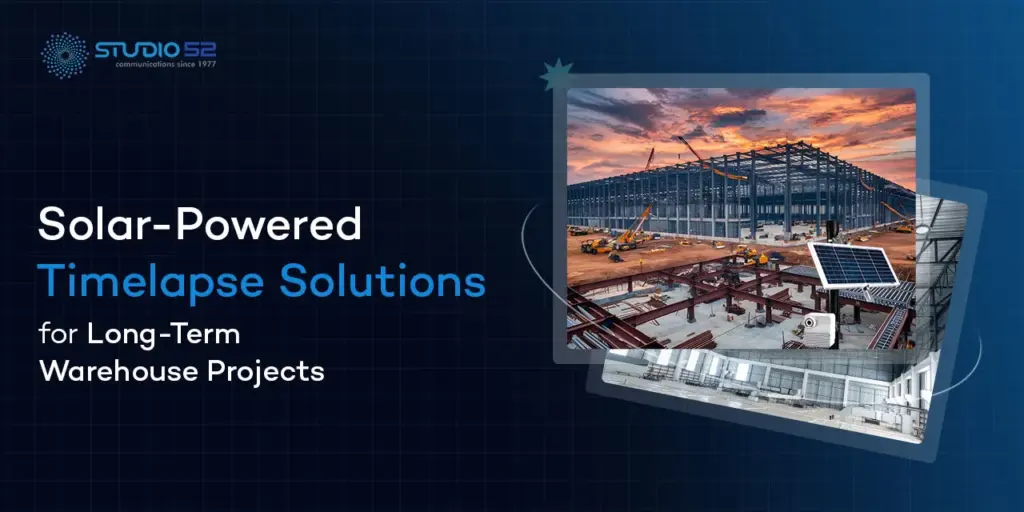

Solar-powered timelapse solutions are transforming long-term warehouse construction monitoring. It covers the technology behind solar timelapse cameras, key benefits like cost savings and remote access, real-world use cases, and how to choose the right provider for your industrial project.
Warehouse and logistics construction projects are getting bigger, longer, and more complex. Whether you are developing a large distribution hub or a multi-facility industrial park, keeping a close eye on every phase is not optional anymore. It is essential. That is where professional timelapse video production comes in. Designed for remote, large-scale sites, these systems give project managers, investors, and clients a clear visual record of progress from day one to the final handover.
But here is the challenge. Most warehouse sites sit far from reliable power grids, run for months or even years, and cover areas too large to monitor manually. Traditional camera setups simply do not hold up under those conditions. Solar-powered timelapse cameras do.
Table of Content
What Are Solar-Powered Timelapse Solutions?
Solar-powered timelapse solutions are self-contained camera systems that run entirely on solar energy. They capture images of a construction site at set intervals throughout the day, then stitch those images together into a compressed video that shows the full project timeline in just a few minutes.
Unlike hardwired setups, these cameras do not need access to mains power. They carry built-in solar panels and battery backups that keep them running through overcast days, monsoon seasons, and everything in between. Once installed, they operate independently, sending footage to cloud storage for remote access at any time.
For warehouse projects that run 12 to 36 months, this kind of reliability is not a nice-to-have. It is the foundation of serious project documentation — which starts with picking the Best Timelapse Camera for the site conditions you’re working with.
Why Warehouse Projects Need Long-Term Timelapse Monitoring
Warehouse construction is not a two-week job. These are long-haul projects with dozens of contractors, overlapping work phases, and high financial stakes. A lot can go wrong, and a lot needs to be proven right.
Here is why long-term construction monitoring matters for warehouse and logistics developments.
Extended timelines mean more opportunities for disputes about progress, delays, or site conditions. Visual records provide an objective, timestamped account of what happened and when. Large site areas with simultaneous activities are difficult to capture through traditional reporting. Timelapse Cameras Construction Industry Best Way Monitor Share Growth Projects shows exactly how a camera placed at a strategic angle captures the full picture in a single frame.
Stakeholders, including clients, investors, and contractors, expect regular progress updates. High-quality warehouse project timelapse videos make those updates compelling and easy to understand. Regulatory and insurance documentation also benefits greatly from a continuous visual record of the build.
In short, if you are managing a warehouse project and you are not recording it, you are leaving a critical gap in your project management process.
Key Benefits of Solar-Powered Timelapse Solutions
Continuous Monitoring Without Power Constraints
One of the most practical advantages of solar timelapse cameras is that they work where power infrastructure does not exist yet. Remote logistics hubs, greenfield industrial parks, and edge-of-city warehouses are all fair game.
With battery backup systems designed to sustain the cameras through low-light periods, you get 24/7 monitoring without laying a single power cable. The system keeps capturing regardless of what is happening on site.
Cost-Effective for the Long Run
Installing wired power to a construction site just to run cameras is expensive and time-consuming. Solar timelapse systems eliminate that cost entirely. Once installed, their operational costs are minimal. No wiring, no generator fuel, no electrician visits.
Over a 24-month project, the savings in infrastructure alone can be significant, and that is before you factor in the time saved by having automated documentation running in the background.
Remote Access and Real-Time Monitoring
Modern remote site monitoring systems connect directly to cloud platforms, giving project managers instant access to live and archived footage from any device. Whether you are in a site office, a boardroom, or halfway across the world, the project is always a few clicks away.
This level of access improves decision-making, speeds up reporting, and keeps everyone aligned without requiring physical site visits for routine checks.
Better Documentation and Milestone Reporting
Client presentations, progress reports, and milestone reviews become significantly easier when you have a high-quality timelapse video to share. Instead of pages of written updates, you show a crisp visual record that tells the story in seconds.
For project managers juggling multiple sites, this kind of automated documentation is a genuine time-saver.
Marketing and Stakeholder Engagement
Beyond project management, warehouse timelapse footage is powerful marketing material. A well-produced timelapse video demonstrates capability, scale, and professionalism. It works in pitch decks, on websites, and at industry events.
For construction companies and developers building their brand in the logistics and industrial sector, this is content with real commercial value.
The Technology Behind Solar Timelapse Cameras
Modern solar timelapse cameras are not simple gadgets. They are purpose-built for the demands of outdoor, long-duration deployment, and today’s Construction Timelapse Cameras are engineered specifically for jobsite conditions rather than adapted from general-purpose security equipment.
The camera units are fully weatherproof, built to handle heat, dust, rain, and high winds without losing image quality or connectivity. Solar panels are sized to handle the energy demands of the system, with battery storage calculated for several days of autonomous operation without sunlight.
Image quality has advanced rapidly. Today’s systems capture in HD, 4K, and even 8K resolution, ensuring that the final time-lapse video is sharp enough for large-format presentations and broadcast-quality output.
All footage is stored in encrypted cloud systems, with role-based access controls that let you manage who sees what. Project managers, clients, and contractors can all have appropriate access levels without compromising security.
Use Cases for Warehouse and Industrial Projects
Solar-powered timelapse systems are well suited to a wide range of industrial and logistics developments.
Logistics hubs and distribution centers benefit from documenting complex, multi-phase builds that involve structural work, fit-out, and infrastructure development happening simultaneously. Storage warehouses in remote or peri-urban locations need off-grid monitoring capabilities that only solar systems can reliably provide.
Industrial parks with multiple building plots require multiple camera placements across wide areas, making solar setups the only practical option. Infrastructure projects like road access, drainage, and utility installations that happen in parallel with the main build are also easily captured.
How Solar-Powered Timelapse Solutions Work
The process from setup to final video is straightforward.
It starts with a site survey to identify the best camera positions for maximum site coverage. The solar-powered camera systems are then installed on poles or mounts, pointed at the key areas of the build. Capture intervals are programmed based on the project type: every few minutes for fast-moving phases, every hour for slower structural work.
From there, the system runs autonomously. Footage uploads automatically to the cloud, where it is accessible through a web dashboard. At project completion, the captured frames are professionally edited into a polished Timelapse Building Construction video ready for client delivery, marketing, or archival purposes.
Choosing the Right Timelapse Solution Provider
Not all timelapse providers are built for the demands of long-term industrial projects. When evaluating your options, look for a provider with a proven track record in warehouse and construction environments, not just short-term events or commercial shoots — our guide on Longterm Construction Timelapse covers what separates a reliable long-haul setup from a short-term one.
The quality of the hardware matters. Cameras should be weatherproofed to industrial standards, solar systems should be correctly sized for the deployment location, and cloud infrastructure should offer secure, reliable storage throughout the project duration.
Support is equally important. Look for providers who offer installation, maintenance, and technical support for the full project lifecycle. A system that fails at month six of an 18-month project is not a solution; it is a problem.
Monitor Every Phase, Miss Nothing
Long-term warehouse construction is too significant an investment to document poorly. Solar-powered timelapse solutions give you eyes on the site from day one, independent of power infrastructure, accessible from anywhere, and running reliably for as long as the project demands.
The footage you capture is not just a record. It is a project management tool, a client communication asset, and a marketing resource all in one.
Ready to document your next warehouse project the right way? Contact Studio52 today to explore our solar-powered timelapse solutions tailored for long-term construction and industrial projects. Let’s make sure every milestone is captured.