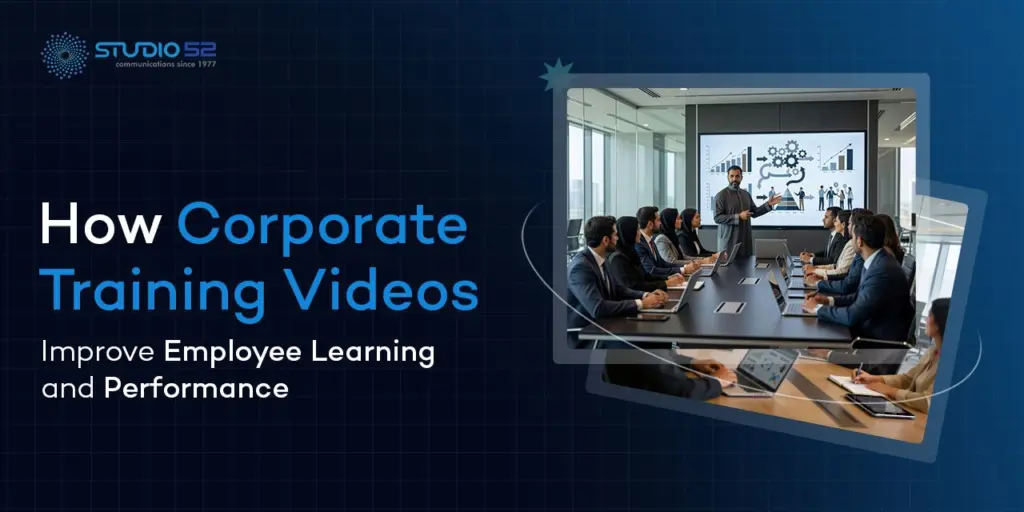

Corporate training videos help businesses in Dubai train employees faster and more consistently than traditional classroom methods. This blog covers how video-based learning improves knowledge retention, onboarding speed, compliance, and overall employee performance. It outlines the main types of training videos, the industries that benefit most, current trends shaping workplace learning in Dubai, and what to look for when choosing a production partner. It also explains why businesses across the UAE trust Studio52 for corporate training video production.
Table of Content
Why Effective Employee Training Matters More Than Ever
Most companies’ training hasn’t kept pace with how fast the job is changing. New tools show up every quarter, rules get updated, standards tighten, and the training material is often the same PDF from two years ago. A classroom session works fine for a handful of people in one room, but it falls apart once you need the same lesson delivered the same way across ten sites or three countries. That gap is why so many businesses now invest in corporate training video Dubai production instead of slides and binders. Video doesn’t get tired halfway through, and it doesn’t change depending on who’s presenting.
The Growing Importance of Corporate Training in Modern Businesses
Roles shift faster than job descriptions keep up with. A process that worked for a five-person team can fall apart once operations span multiple branches. The real issue usually isn’t effort; it’s inconsistency. When one manager trains a certain way and another trains differently, employees end up with different versions of the same job. Tighten that up and the payoff shows quickly: fewer mistakes, safer sites, and teams moving at the same speed.
What Are Corporate Training Videos?
Strip away the jargon, and a corporate training video is simply visual content built to teach something specific, a process, a skill, or a policy. The big difference from a classroom is availability. A trainer can only be in one place at a time, while a video can run on a laptop in Dubai and a tablet in Abu Dhabi at the same hour, replayed as often as someone needs. Some companies keep it simple with short explainer clips; others lean into animation or full filmed walkthroughs. Either way, people remember what they see longer than what they read in a manual nobody finishes.
How Corporate Training Videos Improve Employee Learning
There’s a reason training video Dubai content keeps showing up in onboarding plans; it changes how much information sticks.
Better knowledge retention comes first, since watching a task performed gives the brain something concrete to hold on to. Consistency sits right alongside that, because the same video plays out the same way no matter who presses play. Complicated topics get easier too, as animation and screen demonstrations break a messy process into steps that make sense. Add in the fact that employees can watch on their own schedule from any device, and you get flexibility a fixed classroom slot cannot match. Engagement tends to climb on its own too, since a well-shot video with decent narration holds attention longer than a wall of bullet points.
Ready to Transform Employee Learning?
Create impactful training videos tailored to your business goals and help employees learn faster with professional visual content.
How Training Videos Improve Employee Performance
Learning is only half the story, though. None of it matters if it doesn’t show up in day-to-day performance, and this is where employee training videos Dubai earn their place in the budget.
New hires settle in faster when onboarding runs through structured video modules instead of a stack of handouts on day one. Productivity tends to climb too, simply because people aren’t guessing what to do next. Compliance and safety awareness get a real boost from seeing the correct procedure demonstrated rather than just reading a rule about it, and that clarity usually brings the error rate down. There’s also a quieter benefit, confidence. An employee who has watched a process done correctly walks into the job feeling far less unsure than one who’s just been told what to do.
Types of Corporate Training Videos Businesses Use
Not every training need looks the same, which is why corporate learning videos Dubai teams produce tend to fall into a handful of categories. For a broader look at the full landscape, Types of Corporate Videos and Their Uses covers the wider range beyond training alone.
Onboarding videos introduce new hires to the company and what’s expected of them. Compliance training covers the legal side consistently, no matter who’s watching. Health and safety videos show the correct procedure instead of just describing it on paper. Technical skills videos walk employees through equipment or specialized processes step by step. Product knowledge videos help sales and support teams understand what they’re selling or supporting. And leadership videos focus on the softer side, communication, and decision-making.
Industries That Benefit Most from Corporate Training Videos
Some industries simply can’t afford training that’s inconsistent, and that’s where video-based learning earns its keep.
Oil and gas sites run on strict safety protocols that benefit from visual instruction over a written checklist. Manufacturing floors are equipment-heavy and need training that repeats accurately. Construction carries on-site risks that call for safety messaging everyone genuinely understands. Healthcare can’t tolerate shortcuts, since procedures need to be followed precisely. Logistics and transportation teams are spread out, so training has to travel with them. And corporate or professional services still need compliance and soft skills training that keeps a scattered team aligned.
Best Practices for Creating Effective Corporate Training Videos
Good results rarely come from just pointing a camera at someone; planning goes a long way.
Start with a clear learning objective, since a video without one tends to wander. Keep it concise, because attention drops fast once a video runs long. Real-world scenarios help more than abstract examples, and visual demonstrations beat narration alone almost every time. Production quality matters too, since a shaky, poorly lit video signals it isn’t worth taking seriously. And don’t let training go stale, content untouched for two years rarely reflects how the job works now.
Corporate Training Video Trends in Dubai
Workplace learning in the region keeps shifting, and a few trends are shaping where corporate training video Dubai production is heading next.
Microlearning is one of the biggest trends, short videos that fit a ten minute gap instead of a full hour. Mobile friendly formats matter just as much, since plenty of employees will only watch training on a phone. Interactive elements, letting someone click through choices, are pushing engagement higher. AI is starting to personalise the experience too, suggesting the right module instead of a one-size-fits-all playlist. And multilingual videos are becoming close to essential given how diverse regional workforces tend to be.
How to Choose the Right Corporate Training Video Production Company in Dubai
Picking a partner for corporate video production Dubai work is easy to get wrong on price alone.
Industry experience matters first, since a partner who understands your sector asks better questions from the start. Strong instructional design is just as important as the visuals, because a beautifully shot video with weak structure won’t teach anything. Creative and production capability shows in the finished product, and multilingual support is worth checking early if your workforce doesn’t all speak the same first language. Ideally, one partner manages the whole process end to end, rather than juggling separate vendors.
Why Businesses Trust Studio52 for Corporate Training Video Production
Studio52 has been in media production for more than 40 years, and that history shows in the small details, the pacing of a script, and how a safety demonstration is framed. The team has worked across oil and gas, healthcare, logistics, and other industries, so they’re rarely starting from zero. Scripting, filming, animation, and multilingual voiceover all happen under one roof, so corporate video Dubai production doesn’t need to be pieced together across different vendors. That consistency, paired with a track record across the UAE and wider Middle East, is why businesses keep coming back to Studio52 for training and internal communication video Dubai needs.
Conclusion: Better Training Creates Better Business Results
A well-planned corporate training video Dubai strategy doesn’t just look good on paper; it shows up in faster onboarding, fewer mistakes, and stronger compliance numbers. As workplaces keep changing, video-based learning offers something traditional training struggles to deliver: consistency and content people actually pay attention to.
Looking to improve employee learning and workplace performance? Partner with Studio52 to create professional corporate training videos tailored to your organization’s needs.