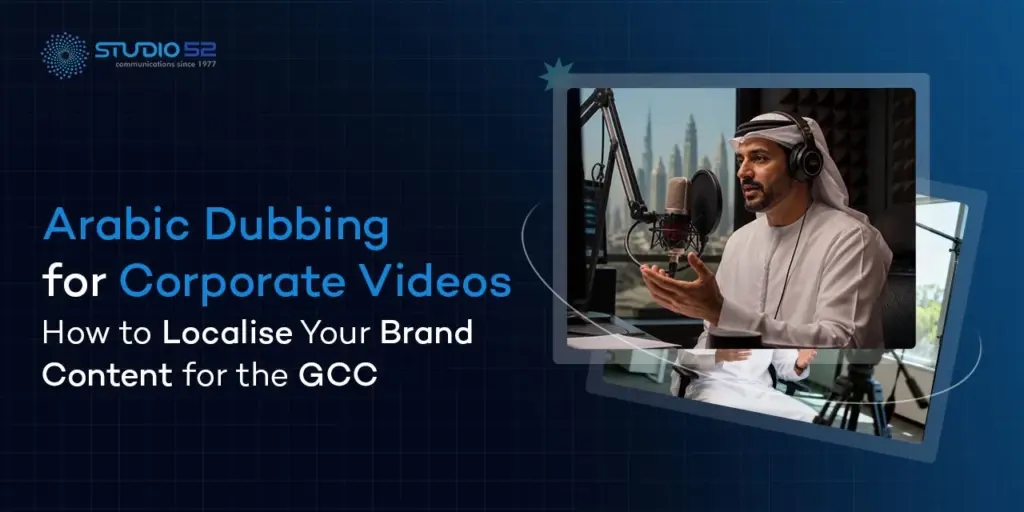

Businesses expanding into the GCC often assume that translating a corporate video is enough to connect with local audiences. In reality, language alone does not build trust; tone, delivery, and cultural nuance matter just as much as the words themselves. As more companies invest in video content to reach Saudi Arabia, the UAE, and neighboring markets, the demand for professionally localised Arabic corporate video content has grown sharply. Arabic dubbing for corporate videos has become one of the most effective ways to close that gap, allowing brands to speak to Gulf audiences in a natural, native voice rather than through subtitles or a foreign accent. When done well, it does more than translate a message; it strengthens engagement, reinforces credibility, and makes a brand feel like it truly belongs in the region. This guide walks through what Arabic dubbing involves, why it matters for corporate video strategy, and how to approach the process the right way.
Table of Content
What Is Arabic Dubbing?
Understanding Arabic Dubbing
Arabic dubbing is the process of replacing a video’s original audio with a newly recorded Arabic voice track, timed to match the speaker’s pace, tone, and, where possible, lip movement. Unlike subtitling, which layers translated text over the original audio, dubbing replaces the voice entirely, giving viewers a fully native-language viewing experience. It differs from a simple voice over as well: a voice over is often narrated independently of the visuals, while dubbing is built around matching delivery to the on-screen speaker moment by moment.
Why Businesses Use Arabic Dubbing
Companies turn to Arabic dubbing services for practical reasons. It improves accessibility for viewers who prefer or require Arabic-language content, removes the friction of reading subtitles while watching, and creates a viewing experience that feels designed for the audience rather than translated for them after the fact. For corporate communication in particular, this matters a great deal, since a dubbed company video signals that a business has invested in reaching its audience properly rather than treating localisation as an afterthought.
Why Localize Corporate Videos for the GCC?
Expanding Into GCC Markets
Companies entering Saudi Arabia, the UAE, Qatar, Kuwait, Bahrain, and Oman face a shared expectation: content should speak the language of the market, not just be translated into it. Each of these markets represents a distinct audience with its own business culture, but Arabic remains the common thread connecting them. A dubbed corporate video signals that a brand understands this and has made the effort to communicate on local terms, rather than repurposing global content with minimal adaptation.
Build Trust With Local Audiences
Native-language communication builds a different kind of trust than subtitled or foreign-language content. When a video sounds natural rather than translated, it feels culturally relevant, and that relevance carries directly into brand credibility. Audiences across the GCC are simply more receptive to messaging delivered in a voice that matches their own everyday language, which is why GCC video localization has become a standard consideration in regional marketing and communications planning.
Benefits of Arabic Dubbing for Corporate Videos
Better Audience Engagement
Viewers stay engaged longer when they can listen naturally instead of splitting their attention between visuals and subtitles, which is especially important for longer corporate or training content.
Improved Brand Recall
A brand message delivered in a clear, native voice is easier to remember than one filtered through translated on-screen text that competes for attention with the visuals.
Higher Viewer Retention
Removing the friction of subtitles keeps viewers watching through to the end of a video rather than dropping off partway through, particularly on mobile devices where small text is harder to read.
Consistent Brand Messaging
Professional corporate video dubbing preserves tone and intent across markets, so the brand voice stays consistent whether a video is viewed in English, Arabic, or another regional language.
Greater ROI on Video Marketing
A single well-produced video can be localised for multiple GCC markets through dubbing, extending its reach and value without the cost of reshooting content from scratch for every audience.
Types of Corporate Videos That Benefit From Arabic Dubbing
Company Profile Videos
A dubbed company profile video helps prospective clients and partners across the region understand a business’s story and capabilities in their own language from the very first impression.
Product Demonstrations
Product videos rely on precise, clear explanation, and Arabic dubbing ensures technical details are communicated accurately rather than lost in subtitle translation.
Training Videos
Employee training content is far more effective when delivered in a language trainees are fully comfortable with, reducing the risk of missed or misunderstood instructions.
Safety and Compliance Videos
For safety-critical content, native-language delivery through Arabic dubbing removes any ambiguity that subtitles or a second language might otherwise introduce.
HR and Onboarding Videos
New employees form early impressions of a company culture through onboarding content, and Arabic dubbing helps that experience feel personal and locally relevant.
Marketing and Promotional Videos
Promotional content depends heavily on tone and emotional delivery, both of which come through far more naturally with a professionally dubbed Arabic voice track than with subtitles alone.
Arabic Dubbing vs Arabic Voice Over
Key Differences
Dubbing replaces the original audio entirely and matches the pacing and delivery of the on-screen speaker. Voice over is typically narrated independently of lip movement and works well for documentary-style or B-roll-driven content. Subtitles keep the original audio in place while displaying translated text on screen, offering a lighter-touch localisation option.
Which Option Is Best for Your Business?
For talking-head company profile or training videos, dubbing usually delivers the strongest, most natural viewing experience. For narration-heavy explainer or marketing content without close-up speakers, a professional voice over may be sufficient. Subtitles remain a useful lightweight option when budget or turnaround time is limited, though they rarely match the engagement of full Arabic dubbing.
Key Steps in the Arabic Dubbing Process
Script Translation and Localization
The original script is translated and adapted, not just word for word, but with attention to tone, idiom, and cultural context so it reads naturally in Arabic.
Voice Casting
Voice artists are selected based on tone, accent, and suitability for the brand and target audience, ensuring the voice matches the personality of the video.
Studio Recording
Recording takes place in a professional studio environment to capture clean, broadcast-quality audio free of background noise or inconsistency.
Lip-Sync and Timing
Where the original speaker is visible on screen, the Arabic recording is carefully timed to match mouth movement and pacing as closely as possible.
Audio Mixing and Quality Control
The final Arabic track is mixed with existing sound effects and music, then reviewed for consistency, clarity, and accuracy before delivery.
Choosing the Right Arabic Dialect
Modern Standard Arabic (MSA)
MSA is widely understood across the Arab world and works well for formal corporate content aimed at a broad, multi-country GCC audience.
Gulf Arabic
Gulf Arabic carries a more regional, familiar tone that resonates strongly with audiences across the wider Gulf region.
Emirati Arabic
For content specifically targeting UAE audiences, Emirati Arabic dubbing adds a layer of local familiarity that generic Gulf Arabic may not fully capture.
Saudi Arabic
Given the scale of the Saudi market, Saudi Arabic dialect choices are often selected specifically for campaigns and corporate content focused on that country.
Why Professional Arabic Dubbing Matters
Native Voice Artists
Native speakers bring authentic pronunciation, rhythm, and cultural nuance that non-native voice talent simply cannot replicate convincingly.
Cultural Accuracy
Professional Arabic dubbing companies understand regional sensitivities and adapt scripts appropriately, avoiding phrasing that could read as awkward or out of place.
Broadcast-Quality Audio
Studio-grade recording and mixing ensure the final product sounds polished across every platform, from corporate websites to broadcast media.
Professional Editing and Mixing
Careful post-production work blends the new Arabic track seamlessly with existing visuals, music, and sound effects for a finished, professional result.
Common Mistakes to Avoid
Direct Word-for-Word Translation
Literal translation often produces phrasing that sounds unnatural in Arabic, undermining the credibility the dubbing was meant to build.
Choosing the Wrong Dialect
Using a generic or mismatched dialect for a specific market can make content feel disconnected from the audience it’s meant to reach.
Poor Audio Synchronization
Audio that doesn’t match on-screen timing distracts viewers and can make even well-translated content feel unprofessional.
Using AI Voices Without Human Review
Fully automated voice generation without native review often misses cultural context, tone, and natural rhythm, risking a final product that feels artificial.
Industries Using Arabic Dubbing Services
Corporate & Business
Company profile videos, investor communications, and internal announcements all benefit from consistent, professional Arabic dubbing.
Manufacturing
Technical and safety content in manufacturing environments relies on precise, native-language delivery to avoid costly misunderstandings.
Healthcare
Patient education and staff training videos in healthcare settings depend on clear, culturally sensitive Arabic communication.
Banking & Finance
Financial institutions use Arabic dubbing for client communications and compliance training where clarity and trust are essential.
Oil & Gas
Safety briefings and operational training across oil and gas sites are often delivered in Arabic to ensure full comprehension across diverse workforces.
Retail & E-commerce
Marketing and product content localized through Arabic dubbing helps retail and e-commerce brands connect more naturally with GCC shoppers.
Future Trends in Arabic Video Localization
AI-Assisted Dubbing
AI tools are increasingly used to speed up translation and initial voice generation, though human review remains essential for quality and cultural accuracy.
Personalized Multilingual Content
Brands are moving toward producing multiple localized versions of the same video, tailored to specific dialects and regional audiences.
Increased Demand for GCC Localization
As more international companies target Gulf markets, demand for professional Arabic dubbing companies continues to grow across nearly every sector.
Growth of Corporate Video Marketing
With video remaining a dominant marketing format, the need for high-quality Arabic localization will keep expanding alongside it.
Conclusion
Arabic dubbing enables businesses to communicate more effectively with GCC audiences by delivering localized, culturally relevant corporate videos. Investing in professional dubbing services improves audience engagement, strengthens brand credibility, and supports successful market expansion across the Middle East.
CTA
Localise Your Corporate Videos for GCC Success
Looking to reach Arabic-speaking audiences across the GCC? Professional Arabic dubbing helps your corporate videos sound natural, engaging, and culturally relevant.
Contact Studio52 today to discuss your Arabic dubbing project and create impactful corporate videos for the GCC market.