
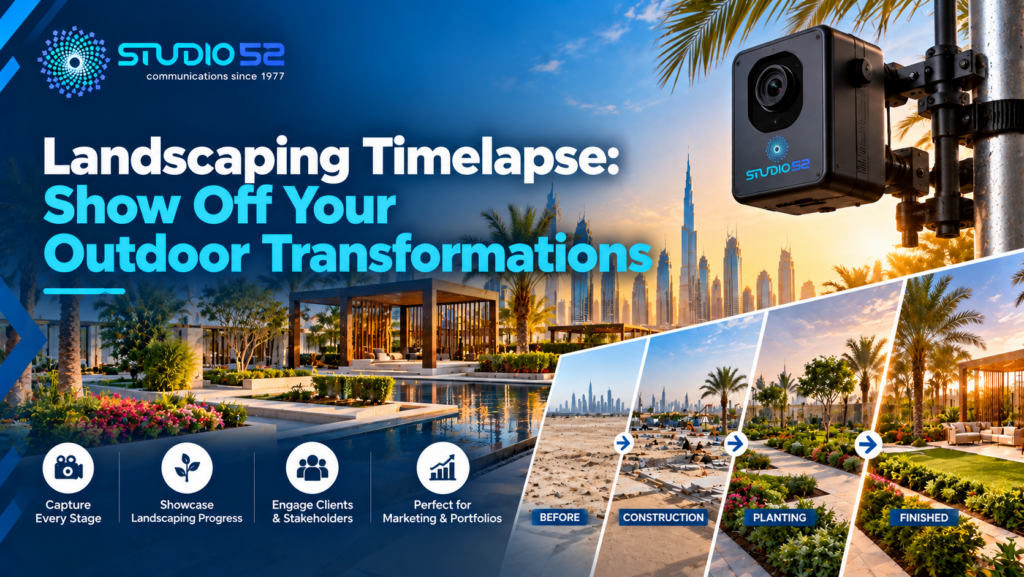

The UAE landscaping market was estimated at USD 1.8 billion in 2025 and is projected to reach USD 3.5 billion by 2032, growing close to 10% a year, while Saudi Arabia’s market is estimated at around USD 3 billion and heading toward USD 5 billion. Villas, resorts, parks, and mixed-use developments across the Gulf are investing heavily in outdoor space, and the companies that design and build it have a problem: a finished garden looks good in a photo, but it hides everything that went into it. Landscaping timelapse solves that by showing the transformation itself.
This guide explains why timelapse suits landscaping, what it costs, and how to capture and use outdoor transformations in the UAE and Saudi Arabia.
Table of Content
What Is a Landscaping Timelapse?
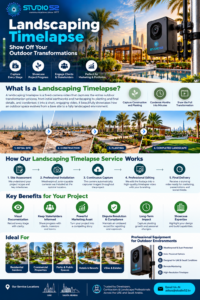
A landscaping timelapse is fixed-camera, interval-based capture of an outdoor space as it is designed, built, and planted. The camera records from site clearing and grading through hardscape, irrigation, planting, lighting, and finishing touches, and the frames are edited into a short video.
It can also show growth. Unlike most construction, landscaping continues to change after handover. A second, longer timelapse can show planting maturing over months, which is a powerful proof of quality for clients who want lush, established outdoor spaces. Studio52’s guide to timelapse cameras for residential and villa interiors covers equipment principles that apply outdoors too.
The UAE and Saudi Landscaping Market by the Numbers
The UAE market is growing close to 10% a year. Growth is driven by urban development, tourism and hospitality investment, smart city initiatives, and demand for climate-resilient and eco-friendly outdoor spaces.
Installation leads. Roughly 55% of the UAE market comes from installation work, tied to ongoing real estate and infrastructure development, while softscape (planting and gardening) accounts for about 60% of services.
Saudi Arabia is scaling up. The Kingdom’s landscaping market is estimated at around USD 3 billion, growing at a projected 7.57% annually to 2032, supported by giga-projects, urban greening programmes, and residential development.
Competition is fragmented. The top five UAE players hold only around 40% of the market, which leaves room for smaller firms to stand out through quality content.
Why Landscaping Is Made for Timelapse
The transformation is dramatic. Bare sand or levelled ground becomes a green, lit, finished garden. The contrast is exactly what timelapse is best at showing.
Effort is invisible in the final photo. Irrigation, drainage, soil preparation, and structural hardscape disappear beneath the surface, yet they define quality and longevity.
Clients are often absent. Villa owners, developers, and hotel groups frequently live or work elsewhere. A timelapse gives them peace of mind.
It differentiates in a crowded market. Most competitors share only the finished result. Process footage shows craft and project control. Studio52’s overview of villa renovation construction timelapse in the UAE shows how this works for residential projects.
The Data: Video and Before-and-After Content
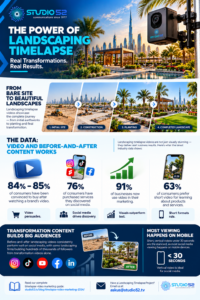
Video persuades. Industry surveys report that 84% to 85% of consumers have been convinced to buy after watching a brand’s video, and 63% prefer short video for learning about products and services.
Social media drives discovery. One landscaping marketing report notes that 76% of consumers have purchased services they discovered on social media, and that before-and-after transformation content consistently performs well, with some landscaping firms building hundreds of thousands of followers from transformation videos alone.
Visuals outperform text. Visual content earns far higher engagement than text-only posts, and 91% of businesses now use video in their marketing.
Short formats rule. Most social viewing happens on mobile, so vertical cuts under 30 seconds are standard. Studio52’s timelapse video marketing guide explains how to repurpose footage across channels.
What a Landscaping Timelapse Captures
The empty site. Bare ground, existing structures, and the before state.
Earthworks and grading. Machinery reshaping the terrain.
Hardscape. Paving, walls, steps, pergolas, and water features taking shape.
Irrigation and drainage. Trenches and pipework, usually hidden after completion.
Planting. Trees, palms, shrubs, turf, and flower beds appearing in sequence, often the most satisfying phase.
Lighting and finishing. Evening lighting and final styling create the reveal.
Golden-hour reveal. A final frame at sunrise or sunset gives marketing-ready footage.
Who Uses Landscaping Timelapse
Landscape contractors and designers use it in portfolios, tenders, and social media.
Villa owners and developers use it to monitor progress and market completed properties. Studio52’s guide to construction timelapse video for UAE developers covers developer use of video.
Hotels and resorts use it to announce new gardens, pool areas, and event lawns.
Municipalities and master developers use it to document parks, corniches, and public realm projects.
Garden centres and nurseries use it to show plant growth and supply capabilities.
Gulf Climate: The Technical Challenge
Heat is relentless. Outdoor temperatures can reach 50°C in summer, so cameras need heat-resistant housings and cooling.
Dust and sand. Landscaping sites are dusty, so dust protection (IP65 or higher) is essential.
Strong sun and shadows. Harsh midday light and long shadows change quickly, which can cause flicker in the final video unless exposure is managed carefully.
Irrigation spray. Sprinklers can wet lenses and housings, so camera position matters.
Power. Many sites have no mains supply, so solar or battery systems are common. Studio52’s long-term construction timelapse 4K-8K solutions describes the weatherproof, solar-powered systems used for extended outdoor projects.
How a Landscaping Timelapse Is Produced
Site assessment. Choose a high or wide vantage point that will remain unobstructed as planting grows and structures rise. Plan for the shadow of future trees and buildings.
Camera selection. Weatherproof 4K cameras suit most projects, with higher resolution for large estates and parks.
Interval and exposure. Intervals follow the pace of work, with fixed exposure strategies to reduce brightness flicker as the sun moves.
Monitoring. Remote access and regular maintenance keep the camera aligned, clean, and powered.
Editing. Footage is stabilized, color graded to show true plant colors, and edited into vertical and widescreen cuts.
For help choosing equipment, see Studio52’s guide to the ideal timelapse camera.
Short Builds vs. Long Growth Timelapses
Short build timelapse. Covers the installation phase, typically a few weeks to a few months, and ends with the finished reveal.
Long growth timelapse. Continues after handover to show planting maturing over six to twelve months or more. This is especially valuable for premium projects where established, lush landscaping is the selling point.
Seasonal timelapse. In regions with seasonal change, such as flowering seasons, the same camera can capture how the garden evolves through the year.
Combined film. The best marketing videos start with the build, cut to the reveal, and close with a growth sequence that shows the project thriving.
Turning Footage Into Marketing

Portfolio and website. Place the timelapse beside final photography on each project page.
Social media. Post vertical clips on Instagram Reels, TikTok, and YouTube Shorts. Use the planting sequence as the hook.
Client pitches. Show prospective clients how you manage complex outdoor projects from earth to finish.
Developer and property marketing. Landscaped communities and villas sell on lifestyle. A transformation video helps buyers picture it. Studio52’s article on renovation timelapse as a UAE real estate secret weapon explains how.
Awards and sustainability reporting. Footage supports landscape awards and green credentials, such as water-efficient irrigation and native planting.
Best Practices
Install before work begins. The bare site is the strongest before frame.
Choose a stable vantage point. Avoid trees, signs, or temporary structures that will grow or move into frame.
Keep the camera fixed. Movement breaks continuity.
Plan for lighting. Shoot final frames at golden hour for the best reveal.
Protect the equipment. Use weatherproof housings, sun shields, and a position that avoids irrigation spray.
Capture the details. Supplement the timelapse with close-ups of planting, stonework, and water features.
Get permissions. Developers and communities may require approvals for equipment and published footage.
Common Mistakes to Avoid
Starting late. Without the before shot, the transformation loses impact.
Obstructed views. Growing trees and new structures can block the camera mid-project.
Ignoring exposure flicker. Poor settings cause distracting brightness changes in outdoor footage.
Neglecting power. Solar panels need clean surfaces and good sun exposure, particularly in dusty conditions.
Forgetting vertical formats. Mobile viewers dominate social media.
Budget and Timelines
Duration follows the project. Garden installations run from a few weeks to several months, and large parks and master-planned landscapes can run much longer.
Cost depends on scope. Pricing varies with cameras, duration, power and connectivity, and editing deliverables. Short-term rigs deploy within 24 to 48 hours, as described in Studio52’s short-term construction timelapse solutions, while long-term systems are quoted individually. Request a quote based on your project schedule.
Studio52’s Landscaping Timelapse Service
Studio52 documents outdoor and construction projects across the UAE and Saudi Arabia with weatherproof, solar-capable cameras, remote monitoring, and professional post-production. Explore our timelapse video production service or our Saudi construction timelapse service.
Ready to show off your next outdoor transformation? Get a customized quote from Studio52’s team.
Conclusion
With landscaping markets growing across the Gulf, the firms that win work are the ones that can show it. A landscaping timelapse turns bare ground into a story of craft, planning, and growth, and gives every project a second life on social media, in pitches, and in your portfolio.
What is a landscaping timelapse?
Can a timelapse show plants growing?
Can cameras handle UAE and Saudi heat?
How long does a landscaping timelapse project last?
Can I use the video on social media?
Why choose Studio52 for landscaping timelapse?
Studio52 provides professional landscaping timelapse solutions across the UAE and Saudi Arabia, with weatherproof and solar-capable camera systems, remote monitoring, and professional video editing.
