
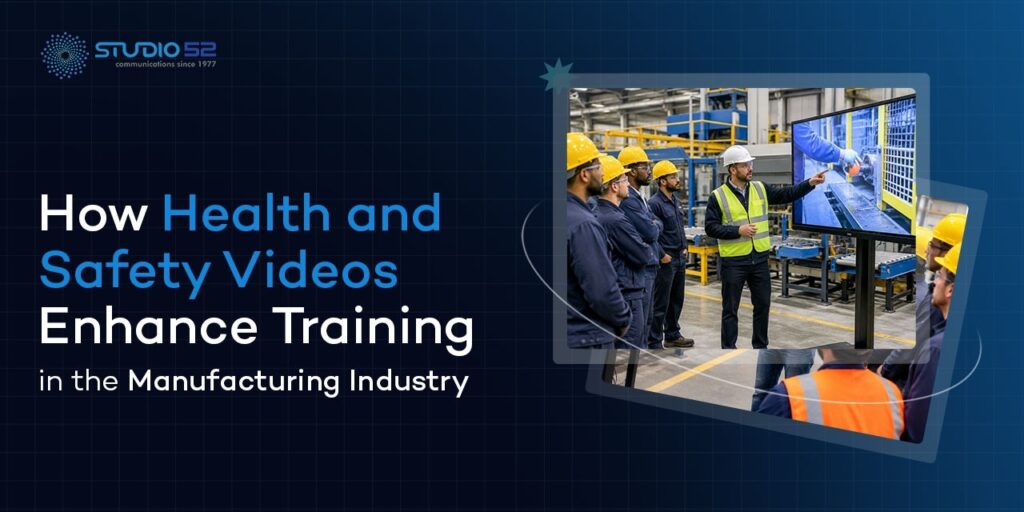

Employees at manufacturing facilities face many hazards every day. Employees are surrounded by large pieces of equipment, exposed to chemicals, and required to complete their jobs in a timely manner; therefore, employees must be provided with additional resources beyond just written safety guidelines.
Manufacturing safety videos provide clear visual demonstrations for handling any situation. The video demonstrates situations engagingly and walks employees through the right way to act.
UAE and GCC companies now explore advanced employee training. They actively test new learning methods. The development of a successful health and safety video production strategy can help businesses to reduce accidents while maintaining compliance with relevant safety regulations.
Table of Content
Why Health and Safety Training Is Essential in Manufacturing
The manufacturing industry is one of the most dangerous industries. Injuries can include burns, crushing, chemical exposure, and electrical shocks when there has been no formal safety training.
Industrial development in the region of GCC is expanding very fast. As the workforce grows and diversifies, new installations are being commissioned across Saudi Arabia and the UAE. Many employees speak several different languages and have different educational levels.
Teaching everyone the same things just isn’t cutting it anymore. Workers require simple and visual guidance that is specific to their workplace. Manufacturing and industrial safety videos fulfil that requirement precisely.
Safety training documentation is a mandatory requirement of all the regulatory bodies throughout the GCC. Video-based, structured programs also enable organisations to stay ahead of compliance. They also prevent expensive plant shutdowns resulting from avoidable injuries.
Why Traditional Manufacturing Safety Training Needs a Modern Approach
Most manufacturing businesses still use printed manuals and classroom training. These traditional approaches fail for obvious reasons. Trainees lose focus quickly. Workers forget the information fast. Language barriers create major safety gaps.
Shift schedules clash with old training methods. Night shift workers miss live sessions entirely. New hires receive inconsistent instructions because different trainers teach different rules.
Safety manufacturing video content directly addresses these issues. Workers have training at their fingertips. The bosses can monitor the rates of completion. The message is the same, whatever the shift or location.
GCC factories are now increasingly embracing digital training systems. Video-based safety training is a natural fit for this migration. It reduces time and cost associated with multiple live sessions.
8 Powerful Ways Health and Safety Videos Transform Manufacturing Training
The role of health and safety videos is not just to impart information. They reshape how workers view risk and react to it.
Turn Complex Machine Operations Into Easy-to-Follow Visual Lessons
Heavy equipment operating procedures are long. Many workers find written directions confusing. Safety videos clearly show the steps you need to take to complete a job safely. Safety videos are easy to understand for workers who may have trouble reading.
Show the Consequences of Unsafe Actions Before They Happen
Workers tend to underestimate potential dangers they haven’t encountered yet. Safety videos simulate those outcomes, but no one actually gets hurt. That visual effect leads people to change behaviour permanently.
Make PPE Training More Practical and Memorable
Demonstrating how to wear gloves and helmets is much more useful than describing it. These examples show the proper use of PPE in actual situations. Workers recalled more of what they saw than what they read.
Prepare Employees to Respond to Emergencies
Emergency drills are necessary but not always feasible in operating plants. The safety videos provide workers the opportunity to be trained on routes for fire evacuation and responses to first aid at any time. They hammer home the right actions before a disaster hits.
Make Safety Training More Engaging Across Every Shift
Text-heavy modules lead to disinterest within seconds. Video content captures attention and preserves momentum. Both animated and live-action formats help keep workers engaged from start to finish on every shift.
Deliver Consistent Safety Messages Across Multiple Facilities
What if a company has three factories? One in the UAE and two others over the border in Saudi Arabia. Are they sacrificing consistency in training due to the inability of the same human instructor to provide training at several locations? Each video at each location delivers the exact same message with the exact same degree of accuracy as often as possible.
Simplify Lockout/Tagout and Other Critical Procedures
The consequences of locking out or tagging out incorrectly are severe. Video instructions provide a step-by-step approach to performing this dangerous task. Employees will have a clear understanding of what needs to happen prior to operating a piece of equipment.
Build a Safety-First Culture Beyond the Training Room
Safety videos train, too. They reinforce values. If workers see safety content frequently, they will start to accept it. Using the same visual presence builds a culture that makes safety second nature.
Essential Topics Every Manufacturing Safety Training Video Should Cover
Strong safety video libraries do not focus on a single subject. All construction sites have something to solve here.
Machine and Equipment Safety
Workers should understand how to use machines properly. They should be aware of machine malfunctions. Make sure the videos emphasise rules for machine guarding. They must recognise the emergency shut-off controls and the daily inspections. Instructors should check for mechanical wear before operating heavy equipment.
PPE and Workplace Conduct
PPE does save lives, but only if used properly. Videos must illustrate correct donning and doffing per PPE type that is related to the hazards of the facility.
Material Handling and Ergonomics
Most workplace injuries in manufacturing are due to manual lifting. Employees should have video instruction for how to properly lift, as well as proper body alignment (posture) to help reduce the risk of developing a chronic muscle or joint condition.
Employers must teach workers correct lifting procedures. They must train staff on proper forklift use in aisles. Companies must instruct operators on the proper use of overhead cranes. It is possible to prevent chronic back problems by having proper body alignment and by limiting the weight you carry.
Chemical and Electrical Safety
This applies to both chemicals and electricity. Workers must be trained on how to use labels, the rules for storing them, and the proper procedure for isolating them before working in areas where either may pose a hazard.
Emergency Response and Incident Reporting
Every employee must understand how to respond during an emergency. The video(s) must feature a map of the evacuation routes; what an employee is expected to do when a fire occurs; and the proper steps to report a spill or accident.
Live Action or 3D Animation? Choosing the Right Format for Manufacturing Safety
A health and safety animation company and a live-action video production team each have unique advantages. Selecting the right format depends on your training objectives.
| Feature | Live Action | 3D Animation |
| Best for | Real workplace walkthroughs | Hazardous or hard-to-film scenarios |
| Visual Realism | High. Shows actual environment | Simulated but highly accurate |
| Flexibility | Limited to what can be filmed safely | Unlimited. Any scenario is possible |
| Cost over time | Reshooting required for updates | Easy to update without new filming |
| Language adaptation | Requires re-filming or dubbing | Simple to add subtitles or voiceovers |
| Risk during production | Workers may be present on set | Entirely safe. No physical set needed |
| GCC workforce suitability | Works well for facility-specific content | Ideal for multilingual diverse teams |
A 3D safety animation company can be a viable alternative to filming a dangerous situation. You can use 3D safety animation to show what could happen if you were exposed to hazardous explosives, became trapped in machinery, or came into contact with toxic chemicals. Live action is also effective for plant tours and real employee demonstrations.
Many GCC producers do some of both. They use animation for demonstrating hazards and live action for specific site walkthroughs. Partnering with a health and safety animation agency that does both provides you with the greatest flexibility.
Behind Every Effective Safety Video: From Workplace Risk to Visual Storytelling
Making an effective safety video does not happen only during the recording. In fact, it all starts with gaining insight into the existing dangers in a particular facility.
An expert health and safety video agency specialising in producing videos does a complete risk assessment even before starting to develop the script. Safety officers and floor supervisors provide valuable input on the most significant dangers. Their knowledge drives each shot.
After that, the storytelling process begins. Not only the information but also its presentation makes people pay more attention. When employees recognise themselves in the video, they will be more interested and/or involved, as the video is related to what he/she does every day.
Another important feature of good videos is the consideration of linguistic diversity. Facilities in the UAE and Saudi Arabia hire workers of various nationalities. In such cases, subtitling in several languages along with visual material helps to get the message through.
The entire video passes a compliance check before being distributed. All the information is checked for relevance.
Conclusion
Manufacturing safety isn’t a checkbox. Safe manufacturing is an ongoing commitment to invest in all the people who work in your plants. Health and safety videos enable you to fulfil that pledge in a real way.
From facility tours to 3D animated scenarios, choose content formats that truly reflect the dangers your employees encounter every day. The right video ensures that you take safety measures beyond talk to action saving lives and improving operations in all of your facilities.
Want to improve safety training at your manufacturing facilities in the UAE or Saudi Arabia? Our Studio52 specialises in health and safety videos designed for industrial settings.
Get in touch with us now to get started!
UAE: +971 44541054
Saudi Arabia: +966 12 4220506
Email: askus@studio52.tv