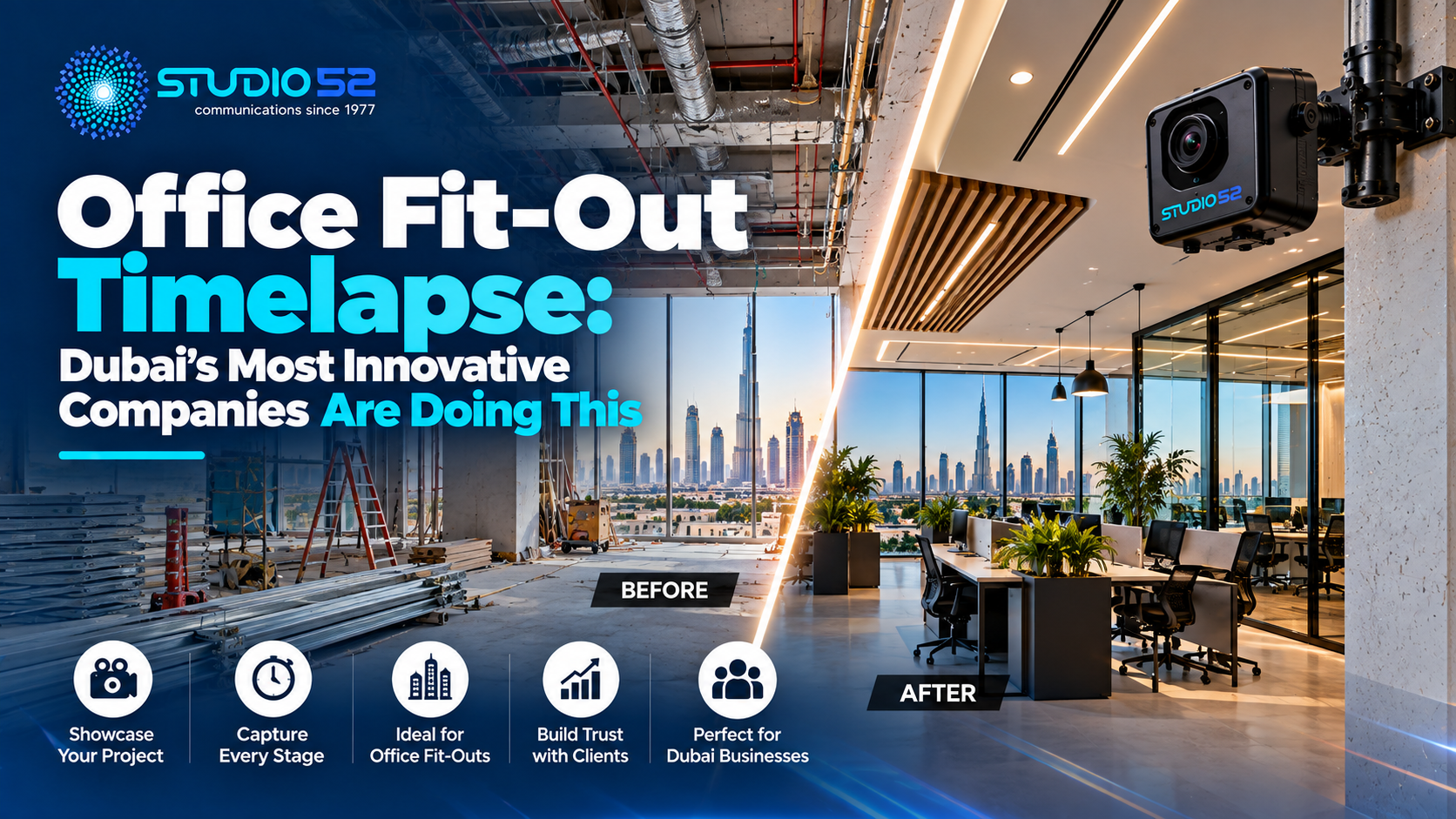
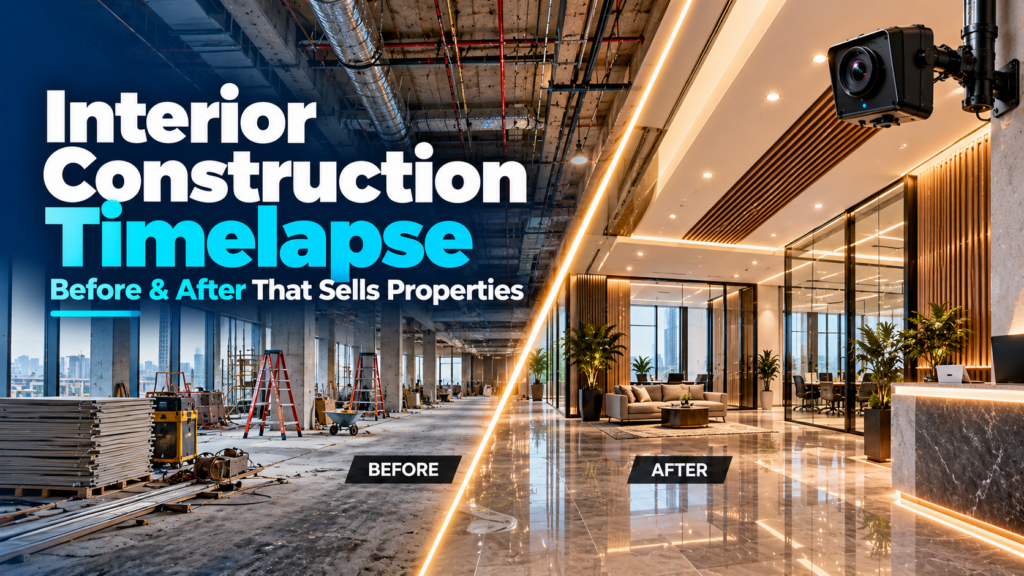

In the first half of 2026, Dubai had 87,800 transactions in the real estate sector, totalling AED 291.7 billion, 71% of which were off-plan transactions. In such a congested market, it is only natural to have a finished room photograph at least.
Buyers and agents want proof of the original room layout. They need to see the exact construction process. They also want to see the final completed space. This is where interior construction timelapse comes into play in less than a minute.
This article details the benefits of before-and-after timelapse in selling and renting properties in the UAE, projects that would benefit from it, and how to create one worth sharing.
Table of Content
What Is Interior Construction Timelapse?
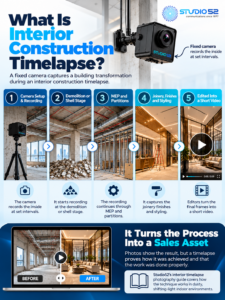
A fixed camera captures a building transformation during an interior construction timelapse.
- The camera records the inside at set intervals.
- It starts recording at the demolition or shell stage.
- The recording continues through MEP and partitions.
- It captures the joinery finishes and styling.
- Editors turn the final frames into a short video.
It turns the process into a sales asset. Photos show the result, but a timelapse proves how it was achieved and that the work was done properly. Studio52’s interior timelapse photography guide covers how the technique works in dusty, shifting-light indoor environments.
Why Before-and-After Sells in the UAE
Buyers want to see their potential. The difference between an old and finished interior is the whole point of a renovated property.
Off-plan buyers want reassurance. With most Dubai transactions off-plan, buyers rely on visible progress to trust that handover will happen as promised. Interior time-lapse extends that proof from facades to finished rooms.
Premium segments expect craftsmanship. In luxury homes and branded residences, the story of materials, joinery, and finishing is part of the price. Studio52’s guide to villa renovation before-and-after timelapse shows how that story is told.
Dubai’s Property Market by the Numbers
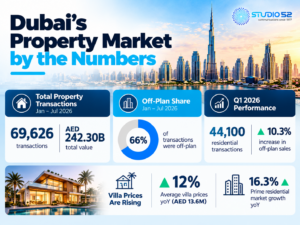
Transaction volumes are high. Between January and July 2026, the city registered 69,626 property transactions worth AED 242.30 billion, 66% of which were off-plan. The first quarter recorded 44,100 residential transactions, with off-plan sales rising by 10.3%.
Ready units hold the highest value. Off-plan constituted 65.4% of transaction volumes but only 46% of total transaction value. Thus, demonstrating that ready and refurbished properties command an excessive amount of spending.
Price appreciation driven by villas. Average villa prices are up by about 12% from last year, averaging AED 13.6 million. The prime residential market has grown by 16.3% from last year. Projections for the remaining part of 2026 are more modest. In a two-tier market, differentiated presentation becomes critical.
The Data: Video and Property Sales

Video sparks inquiry. Video listings generate approximately 403% more inquiries than those without. Homes advertised with video sell for 6 percent higher prices. Virtual tours sell real estate properties 31 percent faster.
Agents are not using it enough. Only 38% of agents use video, and only 9% of agents use listing videos, which means a branded time-lapse instantly gets noticed. 73% of homeowners say they’d rather work with an agent who uses video.
Short clips spread. Property videos under 60 seconds earn roughly 2.5 times more social shares, and a time-lapse reveal fits that length perfectly. Studio52’s own overview of renovation timelapse as a UAE real estate secret weapon goes deeper into the sales logic.
Studio52’s own overview of renovation timelapse as a UAE real estate secret weapon goes deeper into the sales logic.
How Interior Construction Timelapse Supports Sales
Listing hero video
- The 30-60 second before-and-after on the listing page provides a unique centrepiece for portals and social posts.
- Developer marketing
- Developers showing unit fit-out progress give off-plan buyers visible reassurance and agents something to share.
- Flip and investment stories
- Renovators who document the transformation show investors the quality of work and return on investment.
- Interior designers’ client acquisition
- Designers use reveal videos to convert enquiries.
Studio52’s article on timelapse cameras for interior design projects in the UAE explains this portfolio value.
What to Capture in an Interior Construction Timelapse
The “before” state. Start with an honest shot of the existing space, because the contrast is the story. There is demolition and structure. Strip-out and partition changes add drama and scale.
Services and first fix. Ceilings, wiring, and plumbing show hidden quality.
Finishes and joinery provide the visual payoff. Flooring, paint, kitchens and bathrooms deliver this look. Styling and furniture complete the final reveal. The actual space must match the marketing photography. This creates a seamless transition.
Who Uses It
Developers document show units and common areas for off-plan campaigns. Brokerages and agents use it on premium listings to differentiate from competitors.
Contractors and designers use it in tenders and portfolios covered in Studio52’s guide to timelapse video marketing. Homeowners and investors use it to share upgrades and justify asking prices.
How Interior Construction Timelapse Is Produced
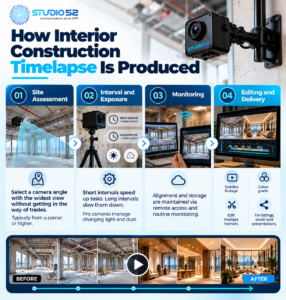
- Site assessment: Select a camera angle with the widest view of the room without getting in the way of trades; the angle is typically from a corner or higher.
- Interval and exposure: Short periods speed up tasks. Long periods slow them down. Pro cameras manage changing light and dust.
- Monitoring: Alignment and storage are maintained via remote access and routine monitoring.
- Editing and delivery: The footage is stabilised, colour-graded, and cut in numerous formats for listing pages, social,s and presentations.
Best Practices for a Before-and-After Reveal
- Lock the camera in place on day one. Any changes in camera placement will ruin the match of before and after photos.
- Shoot a clean “before” photo. Clear all clutter and turn lights on during the initial photo shoot.
- Use matching lighting conditions at the end. Shoot a final photo with the same lighting so the blend seems natural.
- Keep it concise. A shot of 30 to 60 seconds is good for social while allowing longer versions for the website.
- Use very little text.
- Keep information to basic facts: location, area, timeline of completion.
Three Scenarios Where the Reveal Pays Off
- The resale apartment: An individual remodelling an outdated apartment in an existing community has options when showcasing renovations in the kitchen, bathrooms, and flooring to command a higher listing price compared to other unrenovated apartments in the community. Since ready stock represents an unfairly high proportion of transaction value, presentation becomes a tool for pricing.
- The show unit: A developer installing a new sample apartment can launch a series of shots showing the build in progress for an off-the-plan buyer’s eyes.
- The villa upgrade: A homeowner preparing a villa for sale or rental documents structural changes, landscaping, and interiors, creating a story that agents can share across channels.
Studio52’s article on timelapse cameras for residential and villa interiors covers the details of residential capture.
Timeline and Budget
Duration follows the programme. Small interior jobs run one to two weeks. Larger commercial and residential fit-outs run from three to eight weeks, according to Studio52’s published framework.
The price is based on the size of the project. Studio52 publishes a specific fit-out framework for these services. Small projects cost roughly AED 3000 to AED 5000. Mid-size interiors cost between AED 6000 and AED 10000.
The company quotes larger multi-camera work individually. Teams deploy short-term rigs within 24 to 48 hours. Studio52 outlines this timeline in their short-term construction timelapse solutions.
Cost per use is low. The nature of one shoot supports a listing video, social cuts, a portfolio case study, and sales presentations, which further diversifies the investment.
Common Mistakes to Avoid
Begin once demolition is completed. Losing the “before” destroys the story’s most powerful element. Set up the camera before you start working.
- Bad camera placement
It results in holes in the video. Cameras are blocked by scaffolding. Tools or materials stored also obstruct the view. You need to coordinate the positions with the site supervisor to make sure the monitor and the camera angles are routinely cleaned.
- Ignoring power and storage
Long projects need reliable power and enough storage, which is why professional rigs include monitoring and regular visits.
- Over-editing
Heavy effects and long intros bury the transformation. Let the change speak, add concise captions, and end on the finished space.
- Forgetting vertical formats
Most property discovery happens on mobile, so deliver 9:16 versions alongside widescreen.
Where to Publish It
- Portals where videos can be embedded need a high-quality hero video.
- The completion rate is higher for short reveals on Instagram Reels, TikTok, and YouTube Shorts.
- LinkedIn is a great choice for B2B clients, including developers, designers, and contractors.
- Your website will give you an asset that will not change.
Studio52’s Interior Construction Timelapse Service
Studio52 documents interior builds and renovations across the UAE with rapid-deploy rigs, 4K-8K cameras, remote monitoring, and branded post-production.
Ready to turn your next project into a sales asset?
Get a customized quote from Studio52’s team. See our interior time-lapse video service for more.
Conclusion
In a market where competition revolves around presentations, evidence of transformation works well in convincing people. Interior construction time lapse makes the build a before-and-after story that can sell properties, justify pricing, and even build your portfolio at once.
Frequently Asked Questions About Interior Construction Timelapse
What is interior construction timelapse?
Interior construction timelapse is a video created using a fixed camera installed inside a building to capture construction, fit-out, or renovation progress over time. The footage is edited into a concise video showing the transformation from the initial construction stage to the finished interior.
How does interior construction timelapse help sell properties?
Interior construction timelapse gives prospective buyers and investors a visual record of a property’s transformation. It helps demonstrate workmanship, showcase finishing details, and communicate project progress, making property marketing more engaging and transparent.
How long should an interior construction timelapse video be?
The ideal duration depends on the intended use. A 30–60-second edit is a useful starting point for social media and property listings, while a longer version can provide more detail for websites, project presentations, and investor updates.
Can interior construction timelapse be used for off-plan properties?
Yes. Interior construction timelapse can document fit-out progress, show the development of sample apartments, and demonstrate finishing quality. It helps prospective buyers understand how a property is progressing before completion.
Does a timelapse camera disrupt construction work on site?
No, when the system is planned and installed correctly. Compact cameras can be mounted in suitable locations away from active work areas, with remote monitoring used to check camera operation. Installation should follow site safety requirements.
Why choose Studio52 for interior construction timelapse in the UAE?
Studio52 offers interior construction timelapse solutions for property developers, contractors, and real estate marketers. Services can include camera deployment, indoor-suitable equipment, remote monitoring, and professional video editing to showcase construction progress and finished properties.