
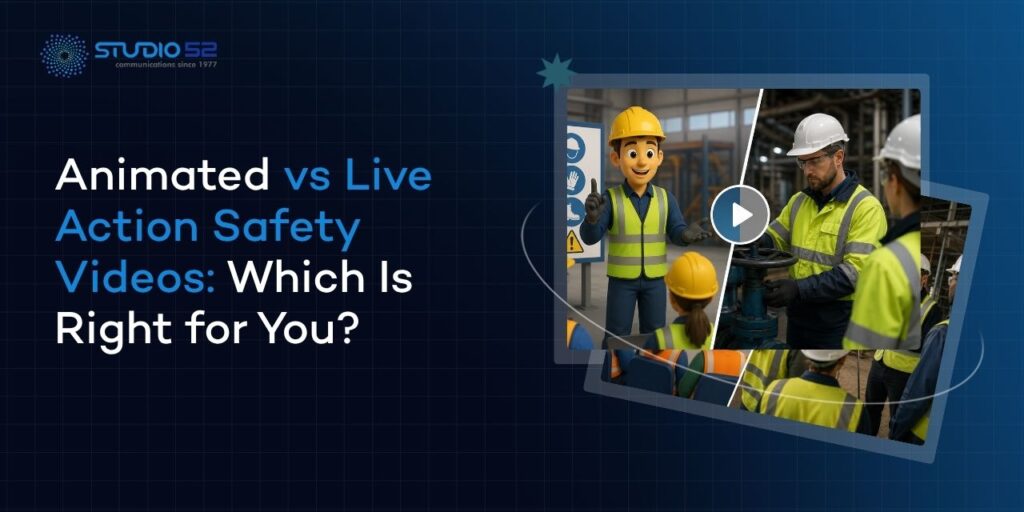

Choosing between animated and live-action safety videos is a real decision that affects training quality, compliance, and budget. Animated safety videos work well for complex hazards, invisible risks, and multilingual teams. Live-action safety videos are stronger for site-specific induction and real equipment demonstrations. Many industrial companies use a hybrid of both. This guide breaks down the key differences, costs, use cases, and common mistakes so you can choose the right format with confidence.
Table of Content
Key Takeaways
Animated safety videos work best for complex, dangerous, or hard-to-film hazards.
Live-action safety videos are stronger for site-specific induction and real equipment procedures.
A hybrid format combines both for large-scale HSE training.
Animation is easier to update when procedures change.
Your choice should depend on the safety topic, workforce type, and training goal, not just budget.
Introduction
Every year, workplace accidents happen, and most of them were preventable. The right safety video does not just tick a compliance box. It genuinely changes how workers understand risk and respond to it.
But here is where most HSE teams get stuck. Do you go with animated safety videos or live-action safety videos? One format is not universally better. The wrong choice can result in a video that workers ignore, a budget wasted, or a safety message that simply does not land.
This guide walks you through both formats clearly so you can make the right call.
What Are Animated Safety Videos?
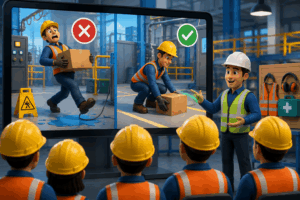
Animated safety videos use 2D animation, 3D animation, motion graphics, and visual storytelling to explain safety topics. Instead of filming real people on a real site, animators build environments, characters, and scenarios from scratch.
This approach makes it possible to show things that are impossible, dangerous, or impractical to film. Think internal equipment failures, chemical reactions, or a gas leak spreading through a facility.
What Are Live-Action Safety Videos?
Live-action safety videos use real people, real locations, and actual equipment to demonstrate safety procedures. A camera crew films on-site or in a controlled environment, capturing authentic workplace conditions.
These videos are effective when you want workers to recognize exactly where they will be working, what they will be handling, and what the real safety rules look like in practice.
Animated Safety Videos: Key Benefits
Animation handles complexity well. When a hazard is invisible (like carbon monoxide), or when showing it in real life would put a film crew at risk, animation steps in.
Here are the strongest reasons to choose animated safety videos:
They make it easy to explain complex hazards in a way that workers can actually follow. An explosion sequence or a confined space atmosphere can be shown in full detail without any real danger.
They are excellent for incident recreation. When you need to reconstruct what went wrong in a past accident, animation lets you do this accurately and clearly.
They work well for multilingual workforces. Adding different voiceovers or subtitles to an animated video is straightforward. No reshooting is needed.
They are flexible. When your SOP changes, updating an animated video is far simpler than organizing a new film crew.
They are widely used across oil and gas, construction, manufacturing, logistics, and industrial training sectors for exactly these reasons.
Live-Action Safety Videos: Key Benefits
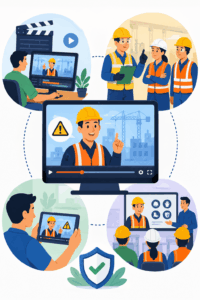
Real footage builds trust in a way that animation sometimes cannot. When workers see their actual workplace on screen, it makes the training feel relevant to them personally.
Live-action safety videos are most effective when you need to show site entry rules, PPE requirements, real emergency exits, assembly points, and equipment handling procedures.
They are also useful for supervisor messages. A real manager speaking directly to the camera carries more weight than a voiceover on an animated character. Company-specific HSE rules and SOPs are easier to communicate when the visuals match what workers see every day.
Animated vs Live-Action Safety Videos: Main Differences
The table below gives you a quick comparison across the factors that matter most to HSE and training teams.
| Factor | Animated Safety Videos | Live-Action Safety Videos |
| Best For | Complex hazards, incident recreation, abstract risks | Real site procedures, induction, equipment use |
| Flexibility | Easier to update | May require reshooting |
| Realism | Visual and simplified | Highly realistic |
| Production Needs | Script, storyboard, design, animation | Crew, location, actors, permits |
| Safety | No risky filming required | Requires safe filming setup |
| Languages | Easy to adapt with voiceover or subtitles | Possible but visuals stay fixed |
When Should You Choose Animated Safety Videos?
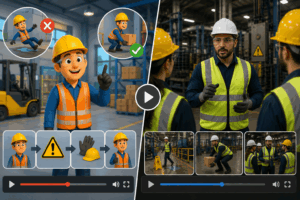
Go with animation when you need to explain unsafe acts and their consequences, fire or explosion risks, gas leaks, chemical hazards, working at height, confined space dangers, or internal equipment processes.
Animation is also the right call when your safety rules apply to a multilingual workforce or when the physical risk involved makes live filming impractical or unsafe.
When Should You Choose Live-Action Safety Videos?
Choose live-action when the training is site-specific. If you need to show actual entry points, real PPE, equipment handling, supervisor guidance, or company procedures, live-action delivers the authenticity that workers respond to.
Safety induction videos in particular benefit from real footage. Workers need to recognize the environment before they arrive on site.
When a Hybrid Safety Video Works Best
Many industrial companies find that combining both formats produces the strongest results. Real footage handles site authenticity while animation explains the technical or hazardous parts that would be difficult or dangerous to film.
For large HSE training programs, oil and gas safety videos, and industrial safety induction content, hybrid production is often the most practical and effective approach. Motion graphics can highlight key safety points, and voiceover keeps everything clear across different languages.
Cost, Time, and Update Considerations
Cost depends on several factors, including video length, animation style, number of filming locations, shoot days, safety complexity, voiceover languages, revision rounds, and required output formats.
There is no fixed answer on which format costs more. Animation costs are driven by complexity and style. Live-action costs are driven by location access, crew size, and the number of shoot days required.
Where animation has a clear advantage is updates. When a procedure changes, an animated video can often be revised without starting over. A live-action video may need a new shoot if the site or process has visually changed.
How to Decide Which Format Is Right for You
Use this as your quick decision guide. Choose animation if the topic is complex, dangerous, technical, or difficult to film safely. Choose live-action if the topic is site-specific, practical, and requires real workplace visuals to be credible. Choose a hybrid format if you want both realism and clear technical explanation in the same video.
Common Mistakes to Avoid
Choosing format based only on cost is one of the most common errors. A cheaper video that workers ignore solves nothing.
Other mistakes include making videos too long, using generic stock visuals that bear no resemblance to the actual workplace, ignoring the specific HSE risks relevant to your site, not involving the safety team in the production brief, skipping subtitles or multilingual versions, and failing to update videos after SOPs change.
Conclusion
The right format comes down to your safety topic, your audience, site conditions, budget, and training goal. Neither format wins outright. Both serve specific purposes well, and many of the best industrial safety programs use both.
Need help choosing between animated and live-action safety videos? Studio52 creates professional safety videos for industrial training, HSE compliance, safety induction, and high-risk workplaces. Talk to our team to find the right format for your next project.
FAQs
Are animated safety videos better than live-action safety videos?
Are animated safety videos useful for industrial safety?
When should companies use live-action safety videos?
Can we combine animation and live-action in one safety video?
Which safety video format is more cost-effective?