
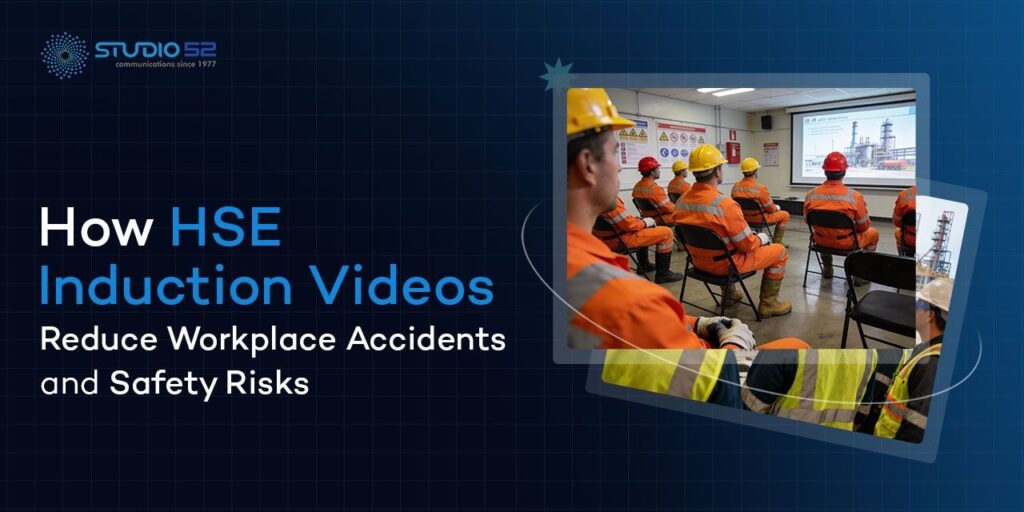

Workplace induction is usually the earliest and least consistent form of safety training. This blog explores how HSE induction videos improve workplace safety. They deliver simple, consistent messages across sites in the UAE, Saudi Arabia, and Oman. It explains why traditional induction methods often fail. It shows how video training reduces injuries and fatalities. You will learn which industries benefit the most. The blog also covers essential video content and implementation best practices.
New workers often arrive on site, attend a brief induction meeting, and sign the required documents. After completing the induction, new workers officially join the workplace. Many workplaces across the UAE, Saudi Arabia, and Oman still rely on this basic approach to safety induction. However, this method creates a weak foundation for accident prevention, where every safety decision can mean the difference between life and death.
Here, a safety induction video replaces that experience with to-the-point clarity in which every worker has the same clear and consistent introduction to site hazards and procedures regardless of who delivers it or how busy the day is.
With the burden on construction, manufacturing, and industrial sites to reduce incidents and demonstrate compliance growing steadily tougher, more safety teams are embracing HSE induction videos as a practical and repeatable way to deliver your safety message from day one.
In this article, you will learn what is wrong with induction as it exists today, how video-based training bridges the gap and what to look for in a great HSE training video.
Table of Content
What Are HSE Induction Videos?

An HSE induction video is a formal video content created to educate new workers, visitors or contractors with a site’s health, safety and environmental requirements prior to the commencement of work.
Unlike listening to a supervisor read off some bullet points or watching someone else look at handouts, a health and safety induction video offers information on hazards, PPE requirements for the job, emergency procedures and site rules in one consistent visual format – everyone who watches it gets the same version.
Improve workplace safety standards through Professional Health and Safety Video Production designed to educate employees and reinforce safe working practices.
They are normally delivered as a screen, tablet or company platform training, normally during onboarding and almost always come with an associated knowledge check to show comprehension.
The Red Flags of Traditional Safety Induction
So verbal briefings very much depend on the person doing it. Skimming over the details in a hurried supervisor, an overwhelming site office or even a language barrier might leave workers with only half of the risks they are going to encounter.
And neither have printed booklets done much better, since dense text lends itself to skimming and memory is often poor, especially for workers whose first language is not English or Arabic.
Much of this can be solved with site induction videos that standardise delivery — same message, same visuals, and the same level of information EVERY TIME regardless of who is running the induction that day.
How HSE Induction Videos Reduce Workplace Accidents
Unlike spoken instructions and paper documents, video content tends to stick more.
Watching a hazard being demonstrated — trailing cable, unguarded edge, improper lifting technique — creates that sense of admiration which verbal warnings never alone accomplish.
Workplace Safety Videos also enable the safety teams to depict exactly that they want in a manner that they want to show, leaving no critical point out due to time constraints or lack of remembrance.
Safety messaging is replicated across shifts, contractors and sites as the video is replayed, referenced and repeated at every induction which closes the gaps where accidents most frequently begin.
Industries That Benefit Most from HSE Induction Videos
Construction sites, with the constant turnover of subcontractors and daily hire also lend itself to a repeatable induction process that works regardless of who may have been on-site on the day.
HSE training videos are employed in oil, gas and manufacturing facilities to address the intricate machinery and procedures that take time to explain verbally in one briefing.
They are utilised by logistics and warehousing operations to standardise safety on forklift, loading docks and manual handling among a large, high turnover workforce.
Also, as a part of the safety induction process that its facilities management and hospitality teams play for staff and visitors, they can use safety induction videos to complete coverage on fire safety, what to do in an emergency evacuation and basic site hazards.
Essential Features of a Good HSE Induction Video
An effective safety induction training video is not long but short enough to hold attention and detailed enough to describe the real hazards, usually presented as focused topics rather than one lengthy briefing.
Site content doesn’t use stock generic visuals – workers have seen the actual site footage so they know what environment they’ll be walking into.
A multilingual workforce needs clear narration, subtitles and easy language to understand everything, and at the end a short quiz or sign-off that ensures that the message has reached – not just been played in the background.
Some of the Common Workplace Accidents Induction Videos Help Prevent
Forcing a good induction video to directly address common incidents such as slips, trips and falls due to inadequate site housekeeping or lack of knowledge of a sites layout.
Gaps in initial induction, not absence of rules, are often associated with wrong PPE use, manual handling injuries and accidents from moving vehicles or machinery.
Induction videos work by visually guiding new workers through such specific scenarios before they even hit the ground on site, thereby avoiding incidents that traditional briefings often fail to avoid.
Beyond Preventing Accidents: Business Benefits
HSE induction videos not only reduce incidents.
They also save supervisors from repeating the same briefing session every time a new hire starts.
They provide a documented, consistent training record for audits and compliance reviews. This is valuable for contractors bidding on future regional projects.
A professional induction process demonstrates a strong commitment to workplace safety. It reassures clients, auditors, and workers that safety is an operational priority.
Best Practices for Implementing HSE Induction Videos
Videos should support your new hire induction process, not replace it. Combine them with verbal Q&A sessions or site walk-throughs. This approach reinforces learning and improves understanding.
Review and update your induction content regularly to keep it aligned with current site conditions, equipment, and safety procedures.
Organize videos by topic or risk area so workers can quickly revisit specific training segments later. Track completion to ensure workers actively watch the induction instead of letting it play in the background.
How Professional Safety Video Production Makes a Difference
A phone camera won’t deliver the clarity or credibility a site safety programme needs when producing an induction video in-house.
Professional filming and concise editing improve training effectiveness. A safety video production company creates videos workers remember instead of long rule lists.
Having a professional safety video production company provides you with quicker changes in procedures as well as a degree of visual quality perfect for all audits, client visits, and inductions.
Conclusion
A single dramatic failure rarely causes workplace accidents.
Increasingly, they reflect an incomplete foundational knowledge that a rushed onboarding process never remedied.
HSE induction videos give safety teams a standardized training method. They ensure every worker understands workplace hazards from the start.
If your site operates in the UAE, Saudi Arabia, or Oman, improve your safety culture with induction videos. Professional safety induction video production is a smart investment.
Want to improve your sites safety induction process?
Partner with an experienced safety video production team. Create engaging HSE induction videos tailored to your actual work environment.
Talk to us about your safety induction video today.
FAQs
Why are HSE inductions needed?
What is the purpose of HSE Induction Videos for Workplace Safety?
Health and Safety Induction Videos and Workplace Accidents
For which industries should HSE induction videos be used?
What goes into a well-made safety induction video?