
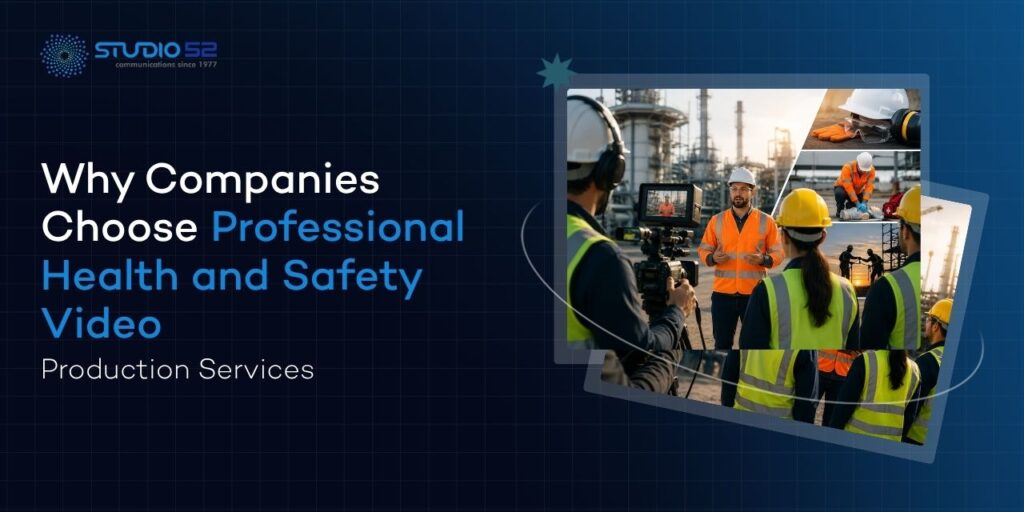

Walk into any large construction site in Dubai, a petrochemical plant in Jubail, or a logistics hub in Muscat, and you will find one thing in common. Safety is the conversation that never stops. But here is where many companies quietly struggle: the way they communicate safety to their people has not kept pace with how their workforce actually learns.
Printed manuals get forgotten. Classroom sessions feel disconnected from real site conditions. And in workplaces where your team speaks five different languages, a single-format approach leaves people exposed. That gap is exactly why safety video production has moved from a nice-to-have to a genuine operational priority across the Gulf region.
Table of Content
The Growing Importance of Workplace Safety Communication
Safety regulations across the UAE, Saudi Arabia, and Oman have tightened considerably over the past decade. Regulators are asking harder questions during audits, and the penalties for poor compliance have real teeth. Beyond the legal pressure, there is a cultural shift happening inside organisations. Safety managers no longer want to simply tell employees what the rules are. They want people to genuinely understand why those rules exist.
A well-made health and safety video answers both demands. It delivers information in a format that feels immediate and credible. And because it can be replayed, subtitled, and shared across departments, it scales in ways that a one-day workshop simply cannot match.
Why Professional Health and Safety Video Production Matters
There are several reasons companies choose to work with a specialist production house rather than handle training content internally. Here is a closer look at what actually drives that decision.
Improved Employee Engagement
Sit someone down with a 40-page safety document and their attention will drift before they reach page three. Put the same information into a professionally produced health and safety training video and the story changes entirely. Motion, sound, and a clear narrative pull people in, and engagement directly affects whether safety messages actually land.
Better Knowledge Retention
Visual learning is more effective, full stop. People retain information delivered through video far better than through text alone. For safety-critical content, that difference is not academic. An employee who cannot recall the correct lockout procedure because they skim-read a manual is a real liability on site.
Consistent Training Across Multiple Locations
Many companies operating across the Gulf run multiple sites at the same time. Getting the same quality of safety briefing to every team member at every location is genuinely difficult with instructor-led sessions. A standardised health and safety video removes that inconsistency completely, delivering the same content, to the same standard, regardless of where a team is based.
Enhanced Compliance with Safety Regulations
Regulators want evidence. They want to see that training has been delivered, understood, and documented. Professional health and safety videos in the workplace create a clear audit trail. When paired with digital completion tracking, they become a serious compliance asset that protects companies during inspections.
Demonstrating Real-Life Workplace Scenarios
One of the strongest arguments for video over text is the ability to show rather than tell. Employees can see what a near-miss looks like. They can watch how a correct fire evacuation unfolds. That experiential quality is something no printed safety guide can replicate.
Increased Safety Awareness Among Employees
A structured health and safety induction video shown on day one does something that internal memos cannot. It signals, from the very first hour, that safety is a core company value. That framing shapes how new hires think about their responsibilities before bad habits have a chance to form.
Cost-Effective Long-Term Training Solution
The upfront investment in professional production looks very different when you calculate it per use. Unlike instructor-led sessions that cost money each time they run, a video is produced once and deployed hundreds of times across departments, sites, and years.
Faster Employee Onboarding
Getting new people up to speed quickly matters, especially on time-sensitive projects. A professional health and safety induction video condenses essential information into a format employees can complete at their own pace, without pulling a supervisor away from active work.
Multilingual Safety Communication
In the Gulf, it is normal for a single site to include workers from India, Pakistan, the Philippines, and Egypt. Delivering safety content in only one language is not adequate training. A professional health and safety video agency can produce content in multiple languages with accurate voiceovers, making sure nothing critical is lost in translation.
Use of Animation for Complex Safety Topics
Some hazards simply cannot be filmed safely. The internal mechanics of a gas leak, the spread of airborne chemicals, or the chain reaction inside an electrical fault all need a different approach. Working with a health and safety animation company allows you to visualise what a camera never could, with complete technical accuracy. A skilled health and safety animation agency brings that credibility and visual storytelling together in a way that makes even the most complex hazards understandable to a non-specialist audience.
Reducing Workplace Accidents and Incidents
The bottom line of any safety training program is fewer incidents. When employees clearly understand risks and know the correct response, accident rates fall. That translates to lower insurance costs, less downtime, fewer project delays, and most importantly, fewer people getting hurt.
Features of Effective Health and Safety Training Videos
The best health and safety training videos share a few defining qualities. These videos are tailored to the specific industry and site environment rather than using generic content. Real-world examples help workers recognize familiar hazards and understand the correct safety practices. A clear, logical structure guides viewers from hazard identification to the appropriate response. Technical accuracy, professional voiceovers, and easy updates ensure the content remains effective as regulations and workplace requirements evolve. When you partner with a professional health and safety video agency, these qualities are built into the process, not hoped for.
The Future of Health and Safety Video Production
The sector is evolving quickly. Interactive modules, VR-based safety simulations, and mobile-first content are already moving from pilot projects to mainstream adoption across the Middle East. Microlearning formats that deliver focused training in under five minutes are gaining traction in organisations that need to reach workers on site rather than in a classroom.
Conclusion
Companies choosing professional health and safety video production are not following a trend. They are responding to real operational pressure. It works for compliance. It works for engagement. And it works for the multilingual, multi-site realities of running operations across the UAE, Saudi Arabia, and Oman. Whether you need a first-day health and safety induction video, animated content for complex hazard scenarios, or a full library of health and safety videos in the workplace, the quality of your production partner determines the outcome.
Studio 52 is one of the region’s most trusted names in health and safety video production. With producers, animators, safety content specialists, and multilingual voice artists on the team, Studio 52 builds training content that meets the highest compliance standards and genuinely connects with the people watching it.
Contact Studio 52 today and build something that truly protects your workforce.
UAE: +971 44541054
Saudi: +966 12 4220506
Email: askus@studio52.tv