
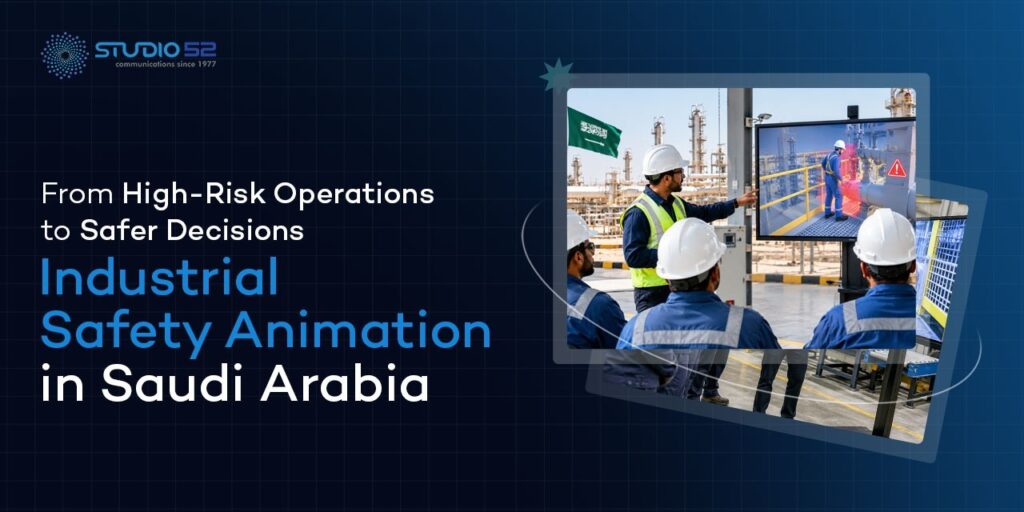

Workplace accidents cost businesses millions every year. In Saudi Arabia, oil and gas, construction, and manufacturing have some of the highest safety risks worldwide.
Conventional safety training can be boring and is often not retained by workers. Printed manuals and traditional classroom training don’t always convey that danger effectively.
Industrial safety animation videos are a complete game changer. They tell workers precisely what to do and what not to do with detailed, visual scenarios.
Animated training modules offer obvious visual signals. Employees keep critical information in real-life scenarios. Saudi companies invest in focused visual solutions. They now employ animation to instil stronger safety cultures. This blog discusses how industrial safety animation can turn high-risk processes into smarter decisions.
Table of Content
Understanding the Challenges of Industrial Safety in Saudi Arabia
Saudi Arabia’s industrial base is rapidly expanding. Vision 2030 is leading to huge projects in energy, construction, and manufacturing.
There is risk with growth. Work sites grow rapidly. Workforces are increasingly diverse in the field. Language barriers contribute to gaps in safety communication among employees.
Numerous Saudi industries rely on large international workforces. They speak different languages and have different training.
Standard safety briefings may not have the same impact. Written instruction or explanation given is not enough to the workers. And high-risk environments such as refineries, construction sites, etc., need to be adhered to religiously. A single miscommunication may cause a disastrous incident.
They are finding that the training tools they need to be clear, consistent, and readily available. Industrial Safety Animation meets these genuine, day-to-day challenges in industry.
What Is Industrial Safety Animation and Why Does It Matter?
Animation in the industrial sector employs motion graphics as well as 3D visuals to demonstrate safety practices. It makes complicated machinery and processes come alive on screen.
They can teach equipment use, emergency procedures, and how to recognise dangers. They make invisible dangers visible and intelligible.
Animation can show inside a machine or gas line without physical access. This is a very effective teaching tool for the trainer.
Safety animation means there is no need to conduct live demonstrations again and again. They are all the same content no matter what.
For those Saudi industries tightly regulated by HSE, consistency is needed. It assists companies in compliance and in lowering the number of incidents.
So whether you’re running a plant, refinery, or a logistics hub, industrial safety animation helps you create a stronger understanding across your workforce.
How Industrial Safety Animation Transforms High-Risk Operations into Safer Decisions
Workers must spot danger fast. They have to choose safe actions immediately. They must react correctly during high stress.
Animation trains that muscle memory. It allows workers to be exposed to actual visual experiences before being on-site.
A 3D industrial safety animation video can show how workers should react during an incident such as a gas leak, a crane malfunction, or a chemical spill. Workers will be shown the proper reaction to each situation sequentially.
The use of this visual rehearsal will provide the worker with increased self-assurance and improved response time when they arrive at the job site. At that point, workers will not have to deal with the unknown on-site for the first time.
Animations simplify technical processes. They make complex valve operations and specific shutdown sequences easy for employees to understand.
Saudi Arabian companies use these videos for onboarding. They also use them for refresher training. Managers even present them during toolbox talks. This material can be applied throughout all shifts, locations, and in various languages.
Teams retain safety knowledge longer when they view and read information. Research shows that visual learning increases knowledge retention. Animation eliminates doubt.
All employees must watch the same video. This practice ensures each one receives identical training about job responsibilities. Standardising these processes protects both employees and companies.
Key Applications of Industrial Safety Animation Across Saudi Industries
Industrial safety animation is catered to many sectors in Saudi Arabia. Here is how each industry uses it on the ground.
| Industry | Common Hazards | How Animation Helps |
| Oil and Gas | High-pressure systems and flammable materials | Shows safe handling of pipelines and emergency shutdown procedures |
| Manufacturing and Factories | Moving machinery and chemical exposure | Demonstrates lockout/tagout steps and correct PPE usage |
| Construction and Infrastructure | Working at heights and heavy lifting | Trains workers on scaffolding safety and crane operation boundaries |
| Petrochemical and Energy | Toxic chemicals and high-voltage equipment | Visualises confined space entry and electrical isolation procedures |
| Warehousing and Logistics | Forklift movement and fire hazards | Guides workers through pedestrian zones and emergency evacuation routes |
| Water and Utilities | Pressurised systems and electrical panels | Covers safe isolation steps and maintenance protocols for field teams |
| Mining and Quarrying | Explosives and unstable ground conditions | Demonstrates blast zone safety and slope monitoring procedures |
Saudi organisations in these industries lean on videos to develop uniform and impactful HSE training.
Benefits of Industrial Safety Animation for Saudi Businesses
Safety animations provide huge advantages to Saudi businesses. Visual training changes the whole landscape of corporate safety. Companies gain operational advantages on a daily basis.
Improved Knowledge Retention
Graphics on screen increase how much employees remember. Your brain stores pictures better than words. Visual training helps employees remember safety procedures during an emergency. They will retain this information for a long period of time.
Consistent Training Across Worksites
Multisite organisations have a challenge providing consistent training. Animated videos provide the same instruction to each site. All locations receive the same safety message. Standardisation removes any differences in training that may exist between regions.
Safer Demonstrations of Dangerous Scenarios
Hazardous testing in the real world puts human life at risk. Animated simulations provide a safe environment for presenting catastrophic failures as they would appear in three dimensions. Workers can experience an explosion with no danger of being injured physically. Virtual environments offer a means to develop critical survival skills safely.
Flexible and Multilingual Learning
Multilingual training support is needed for diverse workforces. Animations are compatible with Arabic and English voiceovers. The employees are trained in their own native languages. Video flexibility accommodates demanding shift schedules.
Supporting a Stronger Safety Culture
An effective workplace safety video culture begins with communication and personal responsibility when it comes to identifying risks. If management decides to provide its employees with advanced training, it demonstrates true dedication to securing employees. Gradually, these precautions will become a normal routine practice.
2D vs. 3D Industrial Safety Animation: Choosing the Right Approach
Choosing the right animation type is important for training. Every industrial safety animation studio includes 2D and 3D services. Each technique meets a particular corporate training requirement. Decision-makers assess the project’s needs before production begins.
2D Animation can also be referred to as motion graphics. Great for abstract ideas and compliance rules. 2D videos are also a good fit for simple procedural training. 2D projects are also cheaper to produce.
3D modeling and animation can be used to create high-quality spatial scenes and objects. It is excellent for complex machinery and internal mechanics work. 3D videos take your viewers inside dangerous plant scenarios. Companies prefer 3D in high-risk industrial sectors.
| Feature | 2D Industrial Animation Video | 3D Industrial Animation Video |
| Best For | Process flows and simple procedures | Complex machinery and spatial awareness |
| Visual Depth | Flat and illustrative | Realistic and immersive |
| Production Time | Faster | Longer but more detailed |
| Worker Engagement | Good | Very high |
| Technical Detail | Limited | Excellent for intricate systems |
| Multilingual, Adaptation | Easy | Easy |
| Recommended Sectors | Logistics, Light Manufacturing | Oil and gas, Petrochemical, Construction |
| Complexity | Moderate concepts | High technical depth |
| Cost | More budget-friendly | Higher investment for greater impact |
How to Choose an Industrial Safety Animation Company in Saudi Arabia
Not all studios have expertise in industrial settings. Selecting a partner counts.
Find out whether the studio has worked in your industry before. Animation for oil and gas safety differs from logistics training. The studio should know the industrial processes well.
Request examples of the industrial 3D animation safety videos they’ve produced previously. The studio must boast an excellent track record of providing absolute accuracy. They should also offer exceptionally clear visuals with highly engaging content.
Confirm that it can create material in both Arabic and English. Multilingualism is essential when dealing with different Saudi public sectors.
Inquire about the production process. An industrial animation studio should work hand-in-hand with your HSE team during script revisions and checks.
Lastly, consider post-production services. Safety procedures evolve, so you may need to keep your content up to date.
The Future of Industrial Safety Animation in Saudi Arabia
Saudi Arabia continuously expands its industrial development with no sign of stopping. Plans for 2030 will provide plenty of opportunities to develop increasingly large and complicated sites for many years to come.
As worksites become larger and more complex, their training needs also increase. This means businesses require adaptable methods that will help train all employees at speed and at scale.
Industrial safety animation becomes an essential component of HSE strategy for leading companies in Saudi Arabia that view it as a basic element of training.
Technology changes, too. Such things as virtual reality and interactive animations will become commonplace in safety training as employees will learn how to respond to emergencies in a simulated environment.
It also means safety requirements in Saudi Arabia become stricter. Companies have to be ready for SASO’s new regulations. Investing in top-quality training tools today will be better prepared to comply with future regulations. The demand for professional animation services in Saudi Arabia will continue to rise.
Conclusion
Animation training videos are an effective means of ensuring safety in the Saudi Arabian industry. The language barrier and diverse labour force are not a hindrance to clear communication.
No matter what, workplace animation helps bring safety protocols to life. Workers are better educated on the dangers and therefore take precautions.
From oil rigs to factories, Saudi Arabia is building its industrial sector. This growth drives a higher demand for quality HSE training. Animation meets this training need with accuracy, consistency, and real impact.
Creating industrial safety animation now is an investment in a stronger, safer workforce of the future. Read more about how video production agencies are transforming workplace safety training here.
Eager to take your industrial safety training to the next level?
Studio52 offers high-quality industrial safety videos in KSA for the toughest industries. Speak to our team today, and let’s make your workplace safer.
Saudi Arabia: +966 12 4220506
Email: askus@studio52.tv
FAQs
How can industrial safety animation improve workplace training in Saudi Arabia?
What is the difference between 2D and 3D safety animation?
How much does industrial safety animation cost in Saudi Arabia?
Can safety animation videos be produced in Arabic and English?
Can animated safety videos support HSE induction and toolbox talks?