

The GCC interior design market is estimated at USD 14.79 billion in 2026 and is projected to reach USD 21.18 billion by 2031, with renovation and remodeling already accounting for more than half of all revenue. For design firms competing for that work, the final reveal photo is no longer enough: clients want to see the transformation, and interior renovation timelapse is how the best studios across the UAE and Saudi Arabia are showing it.
An interior renovation timelapse compresses weeks of demolition, joinery, finishing, and styling into a short video that proves craftsmanship and project management in one watch. This guide covers why it has become a core portfolio tool for GCC designers, how it performs against static marketing, and how to get footage worth publishing.
Table of Content
What Is Interior Renovation Timelapse?
Interior renovation timelapse is fixed-camera, interval-based capture of an indoor space as it is renovated, edited into a short transformation video. The camera stays in one position and records at set intervals through demolition, electrical and MEP work, carpentry, painting, and furnishing, so the finished video shows the whole journey without anyone filming manually.
It differs from construction timelapse in scale and conditions. Interior sets are controlled environments with dust, changing artificial lighting, and tight camera positions, which is why Studio52’s guide to interior timelapse photography for design projects in the UAE emphasizes stable mounting, consistent exposure, and unobtrusive placement.
The GCC Interior Design Market by the Numbers
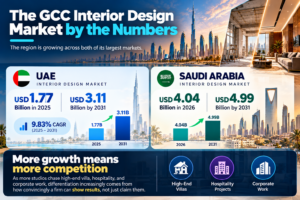
The region is growing across both of its largest markets. The UAE interior design market is valued at USD 1.77 billion in 2025 and projected to reach USD 3.11 billion by 2031 at a 9.83% CAGR, while Saudi Arabia’s market is estimated at USD 4.04 billion in 2026, heading toward USD 4.99 billion by 2031.
More growth means more competition for the same clients. As more studios chase high-end villa, hospitality, and corporate work, differentiation increasingly comes from how convincingly a firm can show results, not just claim them.
Why Renovation Is the Biggest Opportunity for Design Firms
Renovation already dominates revenue. Renovation and remodeling hold 51.36% of GCC interior design revenue, and in the UAE the share reaches 68.05%, reflecting a mature built environment where upgrade cycles drive demand.
Office churn keeps the pipeline full. Tenant churn in prime UAE offices exceeds 20% annually, producing frequent fit-outs, and the UAE renovation sub-segment is forecast to grow at 7.92% CAGR through 2031. Saudi renovation and remodel work, though smaller today, is projected to rise at 4.94% CAGR, supported by relaxed foreign ownership and repositioning of aging commercial property.
The firms winning this work are the ones that can document it. A renovation timelapse is proof of delivery on exactly the type of project that now makes up most of the market.
The Data: Why Transformation Video Wins

Video is now the default in marketing. 91% of businesses use video as a marketing tool in 2026, up from 86% in 2024, and around 70% of interior designers are using short-form video specifically to demonstrate transformations.
Platforms reward the transformation format. Algorithms in 2026 favor short, demonstrative content: before-and-after reveals, single-design-choice explainers, and room walkthroughs under 60 seconds. A renovation timelapse is naturally cut to that shape, and a 30%+ retention rate at 15 seconds is the benchmark for strong content-product fit.
Video also builds trust before the first call. Prospective clients increasingly vet designers by watching them before they ever speak. A portfolio proves you can design a room; a timelapse proves you can run a project, which is the part clients worry about most.
Where Interior Renovation Timelapse Gets Used
Portfolio and website case studies. A timelapse beside the final photos turns a static project page into a story, and Studio52’s short-term construction timelapse solutions show how rapid-deploy rigs deliver edited footage within days of handover.
Social media reveals. Reels, Shorts, and LinkedIn posts built from the same footage keep a studio visible long after the project ends.
Client updates and approvals. Studio52’s interior timelapse clients, including Art Jameel, Igloo, INC Interiors, and Eighty Eight Design House, describe it as a way to give clients clear progress visibility and cut repetitive update requests.
Tender and pitch decks. Visual proof of past execution is persuasive evidence in competitive pitches, particularly for hospitality and corporate fit-outs.
Office vs. Residential Renovation Timelapse
Office renovation timelapse emphasizes speed and disruption control. Corporate refits run on tight deadlines, often around live operations, and the footage doubles as a record for facilities teams and a showcase of workplace transformation. Studio52’s guide to commercial interior project timelapse covers how visibility plays out on commercial fit-outs.
Residential renovation timelapse emphasizes craftsmanship and story. Villa and apartment projects involve custom joinery, premium materials, and homeowners who want to share the journey. Studio52’s overview of timelapse cameras for residential and villa renovation notes that kitchen and bathroom makeovers are especially popular subjects because of their dramatic visual change, and the villa renovation before-and-after timelapse approach shows how those stories are built.
How Interior Renovation Timelapse Is Produced
Site assessment and camera placement. Cameras are mounted in corners or elevated positions that capture the widest view of the work area without obstructing crews or being blocked by temporary partitions.
Interval and exposure setup. Short intervals suit fast tasks; longer intervals suit extended projects. Professional cameras handle low-light conditions and shifting artificial lighting automatically.
Monitoring and data security. Footage is stored locally or in the cloud, with remote access so designers and clients can check progress without visiting, and regular checks keep alignment and coverage consistent.
Editing and delivery. Raw frames become a stabilized, color-corrected, branded video, usually with multiple cuts for web, social, and presentations.
Best Practices for Interior Renovation Timelapse
Choose the camera angle before work starts. The best position captures the main work area while avoiding obstructions such as temporary partitions or stored materials. Once demolition begins, moving the camera breaks continuity in the final video, so agree the angle with the site team on day one.
Match the interval to the pace of work. Short intervals work well for fast-moving tasks like installation and finishing, while longer intervals suit extended projects where change is gradual. Setting this too slowly makes the video look like a slideshow, and too fast produces more footage than anyone can edit.
Plan for dust, power, and safety. Active renovation sites are messy, so cameras need protection from dust, a reliable power source, and a position where they will not be knocked or blocked by trades moving through the space.
Monitor throughout. Regular checks keep the camera aligned and working. A single missed week caused by a dead battery or a shifted tripod is the most common reason interior footage ends up with an unusable gap, and professional oversight prevents it.
Brief the editor on the story. Decide early whether the video is meant for clients, social media, or pitch decks, because that determines pacing, music, text overlays, and length.
Turning Timelapse Into a Portfolio Asset
Cut for every channel. One shoot can produce a full-project film for the website, a 30-second reveal for social, and a short clip for email or pitch decks.
Pair it with the final photography. The timelapse sets up the reveal, so the finished images land harder.
Build a library. Studios that capture every significant project end up with a growing archive of visual case studies, a compounding marketing asset rather than a one-off video.
How to Choose a Timelapse Provider
Look for interior experience specifically. Indoor capture is a different discipline from outdoor construction: dust, lighting changes, and tight spaces all affect results.
Ask about turnaround. Fast edits matter when a project’s launch or handover date is fixed.
Check GCC coverage. If your studio works across the UAE and Saudi Arabia, a provider with teams in both markets simplifies logistics and keeps quality consistent.
Studio52’s Interior Renovation Timelapse Service
Studio52 provides interior timelapse for offices, villas, retail, hospitality, and exhibitions across the UAE, Saudi Arabia, and the wider GCC. Every project includes site assessment, 4K-8K cameras, remote monitoring, regular checks, and professional editing with stabilization, color correction, and branding. See our interior timelapse video service for how it works.
Ready to turn your next renovation into a portfolio piece? Get a customized quote from Studio52’s team.
Conclusion
With renovation making up the majority of GCC interior design revenue and video now the standard way clients vet designers, interior renovation timelapse has moved from nice-to-have to core portfolio infrastructure. The studios that document their transformations consistently will be the ones clients remember when the next project comes up.
What is interior renovation timelapse used for?
How long does an interior renovation timelapse project run?
Does timelapse work in dusty, low-light interiors?
Can timelapse footage be used on social media?
Is timelapse suitable for both offices and homes?
Why choose Studio52 for interior renovation timelapse across the GCC?
Studio52 offers end-to-end interior timelapse production with professional equipment, remote monitoring, and branded editing, with teams serving the UAE, Saudi Arabia, and other GCC markets.
Sources: Mordor Intelligence – GCC Interior Design Services Market, Mordor Intelligence – UAE Interior Design Market, Mordor Intelligence – Saudi Arabia Interior Design Market, Averi – Content Marketing for Interior Designers 2026, Interior Design Community – Video Marketing for Interior Designers