
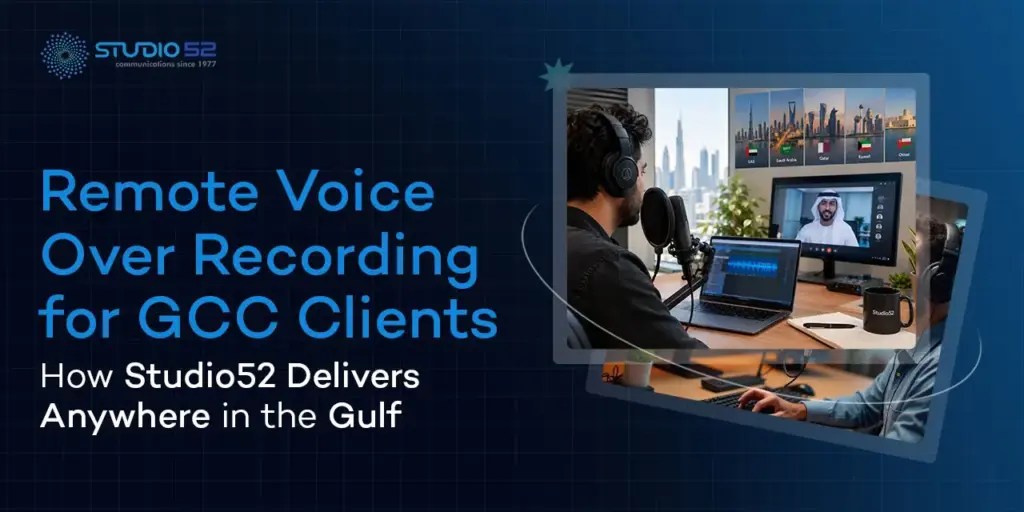

Businesses across the GCC region require full-time professional voice-overs. However, going to a studio is not always logistically wise. That solves that problem with remote voice-over recording in the GCC. Companies realize they no longer need physical studio visits.
Studio52 manages your entire project through digital channels. The experts handle talent selection, recording, and final delivery remotely. Your team saves valuable time while getting exceptional audio output.
Table of Content
What Is Remote Voice Over Recording?
A professional remote studio is where the voice artist records. The producer sends the audio sample online to the client for review and approval. Revisions take place in the form of a few simple rounds of feedback. The client shares a script. The studio handles the rest.
Remote recording connects clients with studios digitally. Artists record in professional booths miles away from your office. Traditional sessions required you to sit inside the physical studio. That required some time, travel, and scheduling. Remote production lets you manage everything online from your desk. You listen live and give feedback instantly without travelling.
Why GCC Businesses Choose Remote Voice Over Services
More GCC companies are moving to online voice-over recording. The reasons are practical and straightforward.
- No studio travel required. Save time and logistics.
- Faster project coordination. Approvals happen through email or shared files.
- Access to more voice artists. You are not limited to local talent only.
- Flexible scheduling. Recording fits around your timeline.
- Easy feedback process. Share comments without attending a session.
- Same studio-quality output. Remote does not mean reduced quality.
For businesses managing IVR systems, corporate videos, or training content, these advantages matter.
Languages & Voice Styles for GCC Audiences
Audiences across the region connect with native speakers. Professional voice-over for GCC projects often involves multiple languages. Studio52 provides complete support.
One of the most requested is Arabic voice-over. Modern Standard Arabic (MSA) is for formal content, and regional dialects are for targeted campaigns.
For the Kingdom market, Saudi Arabic is appropriate. Gulf Arabic is used for audiences in the UAE, Qatar, Kuwait, Bahrain, and Oman. You can choose between male and female voice artists easily.
English voice-over is just as popular. Many GCC companies require bilingual content for internal teams, expatriate audiences, or international clients.
Different projects require different voice styles in the market. Corporate narration requires a confident, clear tone. In terms of delivery, commercials are best when they are fun and spirited.
On the other hand, E-learning is best served by a soothing pedagogical voice. A calm, instructional voice is most effective for e-learning content.
What Types of Projects Can Be Recorded Remotely?
Remote voice-over recording works across nearly every content type.
- IVR and phone systems deliver on-hold messages, menu prompts, and call routing.
- Corporate videos sound polished with company profiles, presentations, and brand films.
- E-learning and training content have modules, courses, and compliance materials.
- Advertisements include TV, radio, digital, and social media.
- Product videos capture consumer attention through demos, explainers, and launch content.
- Social media content such as podcasts and narration is mainly long-form audio and serialised content.
- Arabic dubbing and localization are exceptional in adapting international content for GCC audiences.
Each of these projects follows the same remote workflow. The client provides the brief. Studio52 handles the production. If your business needs IVR voice-over recording, remote audio production makes the process fast and straightforward.
How Studio52 Manages a Remote Voice-Over Project
The process has 6 steps from start to finish. Every step is clear and manageable.
Step 1: Client shares the script and project brief.
The client sends the script, language requirements, tone direction, and intended use.
Step 2: The team must discuss voice requirements and suitable artists.
Studio52 recommends voice artists based on the brief. The client selects based on samples.
Step 3: Clients shortlist the voice samples.
A small selection of artists is presented. The client can pick the best fit according to the project.
Step 4: Recording takes place in a professional studio.
The remote studio uses high-end microphones and acoustic recording equipment. The chosen artist records in a fully equipped studio. No home studio, no background noise.
Step 5: Client feedback and revisions are managed remotely.
The client listens to the recording. Any changes are communicated and addressed quickly.
Step 6: Experts mix and master audio to ensure broadcast-ready standards.
The final file is prepared, processed, and sent in the required format.
Maintaining Studio-Quality Audio Remotely
Some clients worry that remote production affects quality. It does not. Remote workflows never compromise your final audio quality. A remote voice-over service GCC partners with experienced voice artists. Expert mixing and mastering ensure broadcast-ready standards.
Every file passes strict final quality checks. The team records every project inside a professional sound booth. Voice artists are experienced and trained. Microphones and recording equipment meet broadcast standards.
After recording, audio engineers handle editing and noise control. Mixing and mastering follow. A final quality check confirms the file is ready for use.
The client receives studio-grade audio. The fact that they were not physically present makes no difference to the output.
Remote Voice Over for Different GCC Markets
The voice-over company GCC is not a single market. Each country has its own audience expectations.
For UAE, the demand is strong for corporate, hospitality, retail, and real estate content. Both Arabic and English recordings are common among GCC clients.
For Saudi Arabia, an Arabic localisation is a priority. IVR systems, corporate communications, and commercial projects drive most work.
The differences in local cultures can tilt the preference toward Gulf Arabic for content that has a consumer focus.
In Qatar, Kuwait, Bahrain, and Oman, you will find corporate communication requirements as well as E-learning and ads projects.
In different GCC markets, adapting voice, language, and tone for the right audience is a must. You see, it is the audience who ultimately decides how your message will be received.
How to Choose the Right Voice Over Artist for a GCC Project
The right voice artist makes a real difference. Here is what to consider.
Target audience: Who will hear this recording? Identify your target audience before picking a voice. A consumer campaign needs a different voice than an internal training module.
Language and dialect: MSA, Gulf Arabic, Saudi Arabic, or English? Match the voice to local preferences.
Brand personality: Your voice artist should reflect your brand. A bank sounds different from a retail brand.
Male or female voice: This particularly depends on audience research and brand guidelines.
Tone and delivery format: What kind of tone should it be? Formal, friendly, energetic, or calm? Define this before selection.
Industry experience: Artists with IVR or corporate experience understand pacing and clarity.
Previous samples: Always review real recordings before finalising the artist.
Common Challenges in Remote Voice Over Recording
Remote production comes with specific challenges. Most have simple solutions.
Last-minute script changes happen in fast-paced campaigns. Clients often update scripts mid-project. A clear revision process keeps this manageable.
Pronunciation requirements such as brand names, product terms, and Arabic transliterations need phonetic guides. Share them upfront.
Feedback across locations is another challenge for remote voice-over. Use timestamped comments to flag specific sections. This removes ambiguity.
Multiple revisions are a difficult factor. Set a revision limit in the brief. This keeps timelines realistic.
Large IVR file sets require file naming. IVR projects often involve dozens of prompts. Numbered scripts and file naming conventions keep delivery organised.
Tight deadlines never stop our team from delivering on time. Communicate deadlines clearly at the start. Realistic timelines lead to better results.
Lastly, consistent voice across projects needs to be maintained. Record the same artist for follow-up projects. This maintains audio consistency.
Why Choose Studio52 for Remote Voice Over Recording?
Studio52 has been producing professional voice-overs for GCC clients for years.
The roster includes experienced Arabic and English voice artists. Projects cover IVR, dubbing, corporate content, and e-learning.
Every recording takes place in a professional studio. Remote project coordination is a standard part of the service. GCC clients in Saudi Arabia, the UAE, Qatar, Kuwait, Bahrain, and Oman are treated with the same attention no matter where they are.
The team handles overall production, from artist selection to editing, mastering, and delivering final audio. No need for clients to manage multiple vendors across different stages!
Explore professional voice-over services for GCC businesses to see what Studio52 offers.
Conclusion
Remote voice-over recording in GCC makes professional audio accessible. Businesses across the Gulf enjoy ultimate flexibility and speed. You get top-tier sound without stepping outside your office.
Need Professional Voice Over Recording for Your GCC Project?
Studio52 helps businesses across the GCC produce professional voice-overs remotely—from artist selection and studio recording to editing and final delivery.
Contact Studio52 to discuss your project requirements.