
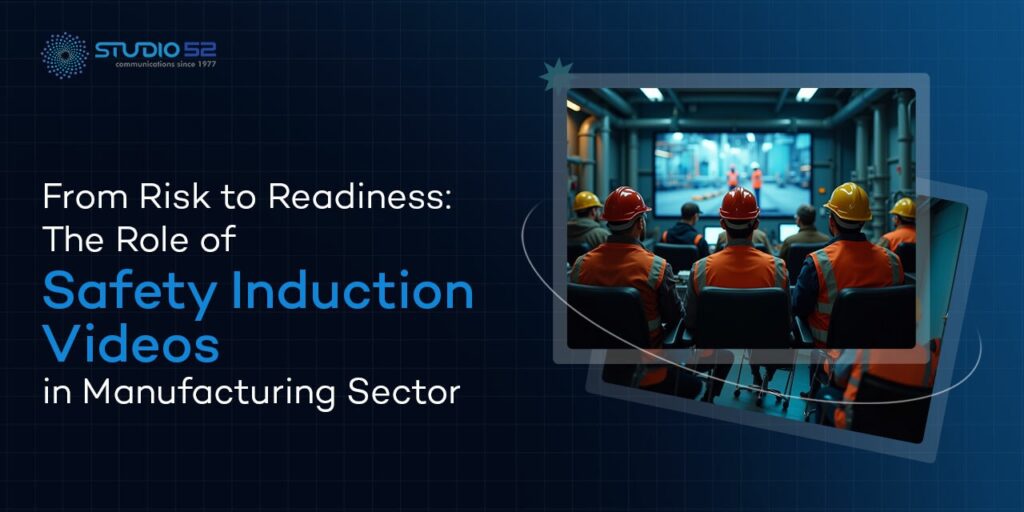

Manufacturing sites are busy, high energy environments where new people can feel lost in minutes. Safety induction videos reduce that risk by giving clear, repeatable guidance before anyone steps into active zones. Across UAE, Saudi Arabia, and Oman, manufacturers rely on video induction to keep safety training consistent, improve understanding, and support compliance. This blog explores why manufacturing needs specialized induction, what to include in an effective video, the role of animation, and how to choose the right production partner.
If you’ve ever visited a manufacturing plant, you know it is not the kind of place where you can “settle in slowly.” Everything is moving. Everything is timed. Everything is happening at once. There is a rhythm to it, and the people who work there understand that rhythm so well that it looks normal. But for someone new, it can feel like walking into a different universe.
A new employee steps onto the floor and instantly has to make sense of the noise, the movement, the warning signs, the walkways, the machinery, and the pace. They might be trying to focus on their job, but their mind is also trying to answer a hundred small questions. Where do I stand? Where do I walk? Who do I ask? What if I do something wrong? And in manufacturing, doing something wrong does not always mean a small mistake. Sometimes it means a serious incident.
That is why safety induction videos have become so important in the manufacturing sector. They are not there to “look professional.” They are there because manufacturing does not forgive confusion. These videos help turn a person’s first day from uncertainty into readiness. They show people how to enter the workplace safely, how to move safely, and how to respond safely. Across UAE, Saudi Arabia, and Oman, companies are using video induction because it gives consistency, clarity, and control over the most risky part of onboarding.
Table of Content
Understanding Safety Induction in Manufacturing
Safety induction is the first safety foundation you give someone before they start work. It is basically the moment you tell them, “This is how we do things here, and this is how you stay safe while doing it.” In manufacturing, this matters more than most industries because hazards are not always obvious to a new person.
A machine might look harmless when it is idle. A production line might seem predictable until it suddenly speeds up. A marked zone on the floor might look like a simple boundary, but it could be there because of moving loads or automated equipment that can’t stop instantly.
This is where workplace safety training videos become valuable. A video can show the environment and explain it in a way that a quick verbal briefing often cannot. It does not rely on memory, mood, or time. It delivers the same message every time. Many manufacturers also use health and safety induction videos as part of their HSE compliance approach, because they cover not only safety rules but also reporting culture, responsibilities, and basic workplace discipline.
Why Manufacturing Requires Specialized Safety Induction
Manufacturing sites are not one risk. They are many risks happening together. That is why manufacturing safety induction cannot be generic. It needs to be specific to the environment.
A person might be safe in one area and unsafe in another within seconds. The warehouse may have forklifts and loading bays. The production area may have moving parts and high temperature processes. The maintenance zone may involve electrical systems, lockout procedures, and restricted access. Even something as simple as cleaning can become risky if chemicals are involved.
This is why safety induction videos for manufacturing must be built around real life. They should reflect the site’s actual layout, its rules, its hazards, and its culture. When training feels real, people take it seriously. When training feels generic, people treat it like background noise.
This is also where site safety induction videos become critical, especially for plants that deal with contractors. Contractors are often skilled, but they bring habits from other sites. If your site rules are different, those habits can become dangerous. A clear induction video removes assumptions and sets one standard for everyone entering the facility.
Common Safety Risks in the Manufacturing Sector
Manufacturing is full of hazards that can be grouped into two types. The obvious ones and the sneaky ones.
The obvious ones are things like moving machinery, sharp edges, rotating parts, conveyor systems, and heavy equipment. These risks are visible, but they are still dangerous because people can underestimate them. One moment of distraction, one wrong movement, one shortcut, and an injury can happen.
Then there are the sneaky hazards. These are the ones that do not feel dangerous until they become a problem. Repetitive tasks that slowly strain the body. Manual handling that causes injuries over time. Noise exposure that affects hearing gradually. Dust, fumes, or chemicals that do not cause pain immediately but create health issues later.
Vehicle movement is also a huge risk. Forklifts, pallet jacks, and internal logistics traffic create danger in shared spaces. Many incidents happen because someone assumes the driver saw them or because they step into a route without thinking.
This is why the best workplace safety videos don’t just talk about hazards. They show how quickly things can go wrong and what safe behavior looks like in real situations.
Key Components of an Effective Manufacturing Safety Induction Video
Here is what makes a manufacturing induction video actually useful. It must feel like it was made for real people, not for paperwork.
First, it needs to speak clearly. No complicated words. No overly formal tone. A person watching it should feel like someone is explaining things to them in a calm, direct way. Manufacturing workers don’t need motivation speeches. They need clarity.
Second, it should show the environment. People learn faster when they recognize what they will see in real life. Show the correct walkways. Show restricted areas. Show the PPE requirements. Show what “safe distance” looks like near equipment.
Third, it must cover emergency response properly. In a real emergency, nobody has time to remember long explanations. They need simple instructions. What does the alarm mean? Where do you go? What do you do first?
Fourth, it must include reporting culture. A lot of incidents happen because people see something unsafe and stay quiet. A good induction video should make it normal to report hazards, near misses, and unsafe conditions.
This is why many manufacturers prefer custom safety training videos. They can include the exact machines, the real processes, and the correct procedures so the training feels personal and believable.
Types of Safety Induction Videos Used in Manufacturing
One video for everyone sounds simple, but in manufacturing it is not always the best approach. Different people need different levels of training.
General safety induction videos are usually the starting point. They cover the core rules that apply to everyone, such as PPE, access rules, emergency response, and reporting.
Then there are role specific videos. A person working on a production line needs different safety focus compared to a person in maintenance or warehouse operations. This is where workplace safety training videos become more targeted and more effective.
Visitor induction videos are shorter and focus on safe movement, restricted zones, and emergency actions. Contractor induction videos often include permit requirements, supervision expectations, and site discipline.
The point is simple. The right training for the right audience creates better behavior.
Role of Animation and Filming in Safety Induction Videos
Some things are best shown in real footage. Others are best explained through animation. And manufacturing safety training benefits from both.
Live filming is powerful because it builds familiarity. Employees see the actual environment, and that reduces confusion. It shows them what the site looks like, how people move, and what safe behavior looks like.
But animation has its own strength. It can explain things that are difficult or unsafe to film. Pinch points inside machines. Stored energy hazards. How injuries happen in seconds. Invisible hazards like fumes or dust. Animated safety videos make these concepts clear without putting anyone at risk.
Many manufacturers use a mix of both because it creates training that feels realistic and easy to understand. This is one reason safety video production in Dubai is growing, because manufacturers want modern training that is clear, practical, and visually strong.
Benefits of Safety Induction Videos for Manufacturing Organizations
The first benefit is consistency. Every person receives the same training message, every time. That reduces gaps and misunderstandings.
The second benefit is speed. Not rushed speed, but efficient onboarding. Supervisors don’t need to repeat the same induction briefing again and again. The video covers the standard training, and supervisors can focus on site walkthroughs and real questions.
The third benefit is retention. People remember visuals. They remember real examples. A video makes safety easier to absorb compared to a long lecture.
The fourth benefit is compliance. Health and safety induction videos support audits and internal documentation because the training is structured and repeatable.
And honestly, the biggest benefit is fewer incidents. Fewer injuries. Fewer disruptions. That is why safety induction videos are becoming normal in manufacturing, not optional.
Safety Induction Videos for New Employees, Contractors, and Visitors
New employees need full induction because they will be exposed daily. Contractors need site specific rules because assumptions can lead to risk. Visitors need short guidance because even a brief tour can become unsafe if they enter the wrong zone.
This is why site safety induction videos are useful. They create one clear standard that everyone follows, no matter who they are.
Measuring the Effectiveness of Safety Induction Videos
A good safety video should change behavior. The easiest way to measure that is by tracking incidents involving new joiners. If those numbers drop, your induction is working.
Quizzes after the video can confirm understanding. Supervisors can also observe early behavior, like PPE compliance, safe movement, and hazard reporting.
Feedback helps too. If employees say a part was unclear, improve it. Induction videos should evolve with the workplace.
Choosing the Right Safety Video Production Partner
Safety training is not marketing. It demands accuracy, clarity, and the right tone. A reliable safety video production partner understands manufacturing hazards, real processes, and compliance requirements.
They write scripts that sound natural and relatable, and they film visuals that reflect actual site conditions, not staged scenarios. Most importantly, they make the content engaging enough that employees genuinely pay attention. This is why many manufacturers turn to specialized safety and training video production services. They need professionals who understand safety communication, not just cameras and editing software. Companies like Studio52 bring industry knowledge and production expertise together, ensuring safety messages are delivered correctly and responsibly.
The right partner creates custom safety training videos your workforce respects, understands, and remembers.
Wrapping Up
Manufacturing is fast, powerful, and high energy. That is what makes it productive, but it is also what makes it risky for anyone new. Induction is your chance to protect people before they face real hazards.
Safety induction videos help turn risk into readiness. They deliver consistent training, improve retention, support compliance, and build safer habits from the start. Across UAE, Saudi Arabia, and Oman, manufacturers are choosing video induction because it works.
When people know what to do, they work with confidence. And confident workers make safer decisions.
If you want induction training that feels clear, practical, and easy for people to follow, Studio52 can help. Studio52 delivers safety and training video production services across UAE, Saudi Arabia, and Oman, including live filming, animated safety videos, and tailored induction modules for manufacturing sites.
Whether you need training for employees, contractors, or visitors, Studio52 can create safety induction videos that match your real environment and help your workforce start safe. Contact Studio52 today and build a stronger, safer onboarding experience.
FAQs
What is the purpose of a safety induction?
Why is safety important in the manufacturing industry?
What topics should be covered in a manufacturing safety induction video?
Should manufacturing safety induction videos be animated, live-action, or both?
Can safety induction videos be customized for specific machines or processes?