
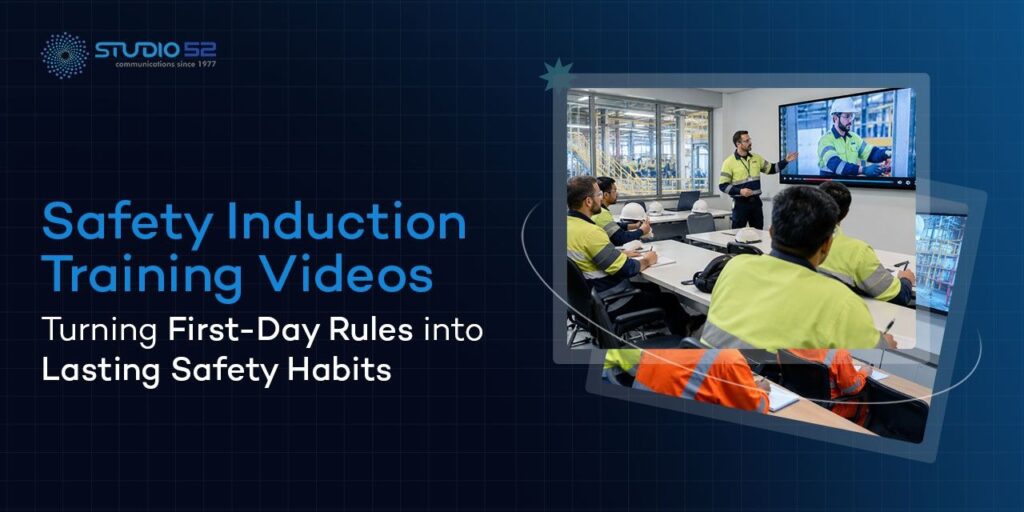

Every new employee comes in on Day One with one question: “How do I not get hurt here?”
Most organisations give a printed policy manual. Others hold a class session. A handful still read slides in a conference room. None of those methodologies stick.
A safety orientation video makes a difference. It uses simple visual storytelling, clear and structured messaging, real workplace scenarios- all this in a single, impactful tool. Workers learn faster. They remember more. And those habits follow them to the shop floor, the site, or the warehouse — from Day One and beyond.
Across the UAE, Saudi Arabia, Oman, and Kuwait, companies have come to regard safety video production as a core, not peripheral, investment. The results are there in the incident reports.
Table of Content
What Is a Safety Induction Training Video?
A safety induction video introduces new staff to essential workplace protocols. It presents site hazards, emergency plans, and core company policies. Employers play this visual guide before employees enter operational areas.
Unlike printed handbooks, videos show actual physical environments. Viewers watch proper equipment handling and real hazard responses. This format suits multinational teams in Kuwait and Oman.
Visual training standardises messaging across different office locations. It delivers identical safety instructions to every new worker. Companies reduce training time while improving safety compliance rates significantly. Managers can track worker understanding more easily and confidently.
Why First-Day Safety Training Matters
The day of the hire carries the highest risk.
New workers are unfamiliar with the layout. They haven’t caught the blind spots. They don’t know the unwritten rules of the floor yet. This ignorance leads to crashes.
Studies have shown that many industries have proven time and time again that new hires are the most likely to get injured on the job during their first couple of weeks. In high-stakes industries like oil and gas or construction — prevalent throughout the Gulf — it’s even more severe.
A good induction video for new employees fills this gap nicely, before they even get to the shop floor. It lets the employee know what to wear and how to behave in an emergency.
Especially in the UAE and Saudi Arabia, customers and regulators are now expecting that safety induction will be demonstrated. A video delivery ensures a consistent, documented training session. Same message for every employee. Nothing is missed because an instructor ran out of time.
Quality first-day training does all that and more, ensuring the employee is protected and protecting the company from having to defend itself. And from a corporate standpoint.
From Rules to Habits: How Safety Videos Influence Everyday Behavior
Rules on paper rarely translate into daily action.
Employees forget written instructions quickly after reading long manuals. Visual storytelling bridges the gap between site knowledge and daily routines effectively.
Engaging safety videos trigger powerful visual memory in risk environments. Workers remember visual scenarios when they encounter actual job site hazards. This instant mental link encourages correct safety choices without hesitation.
Consistency forms solid safety habits over time. When companies show visual scenarios regularly, workers adopt safe practices naturally. They wear protective gear correctly and follow equipment protocols automatically.
Peer behavior on screen reinforces positive cultural norms. Seeing colleagues demonstrate safe choices inspires new hires to mirror those actions. Visual media transforms basic compliance into a lasting safety mindset across all departments. Daily visual reinforcement keeps workers alert every shift.
Key Elements of an Effective Safety Induction Training Video
High-quality video production depends on a few key things. Let’s look into the elements that contribute to better viewer retention and training performance.
A Clear and Structured Script
A good script logically arranges complex subject matter. Writers employ straightforward language to describe processes. This avoids confusion and maintains the viewer’s concentration on the safety basics.
Engaging Visuals
HD video depicts job sites realistically. The clear animations show hidden hazards and machinery functions. Colourful visual cues instantly bring attention to important safety warnings.
Realistic Safety Scenarios
Workers can see real site conditions and risk examples. Most of them identify with traditional work environments and day-to-day operations. The rules of safety turn into common sense once you visualize practical situations.
Professional Voiceover
Clear voice talent delivers instruction with confidence. Multi-Language voiceovers assist a diverse workforce across the Gulf Region. Consistent audio tone keeps employees fully engaged
Appropriate Pacing
The timing is balanced so the audience can digest the information. The video steers clear of hurrying through complicated technical processes. Speed control enhances critical-step memory retention.
Strong Audio and Subtitles
Clean sound design penetrates the noise floor. Multilingual subtitles enable the non native speakers to receive all the information. Subtitles let you make sure you get everything, even on a loud factory shop floor.
What Should a Workplace Safety Induction Video Include?
A good safety induction video for uk workplace must cover these core areas without exception:
Company Safety Policies
Explain the company’s commitment to safety. State the rules clearly. Workers must know the standards the company holds before anything else.
Workplace Hazards
Define the risk areas. Show how you measure to find where they lie. A hazard-aware worker is saved if they know how to get out of the risk by noticing it in time.
PPE Requirements
Show the appropriate personal protective equipment for each work area or task. Give an idea of the correct way to wear it. Visual demonstration reduces PPE errors dramatically.
Emergency Procedures
Cover fire exits, muster points, first aid locations, and emergency contacts. Show the evacuation route on screen. Workers must know this on day one without exception.
Safe Work Procedures
Guide the workers through your SOPs for everyday activities. Demonstrate the correct procedure step by step.
Workplace Conduct
Address behaviour expectations and report hazards. Don’t bypass safety controls and site rules. Keep your fellow workers safe. Status-related respect is the foundation for the whole safety framework.
How Different Industries Use Safety Induction Training Videos
Different sectors require different safety messaging. Non-specific videos are not adapted to operation-specific risks. Manufacturing companies use custom HSE training videos to address the customized risks found within their facilities.
As an example, offshore installations are based on marine safety and gas detection. With warehouse and distribution centers, the focus is on forklift traffic and ergonomic lifts. Tailored content ensures that it is relevant, at the present moment, for all team members.
The following chart shows how leading industries use safety videos to raise employee awareness:
| Industry | Key Focus Areas | Primary Safety Goals | Common Video Format |
| Oil and Gas | Gas leaks, fire hazards, offshore safety | Prevent catastrophic industrial incidents | Live-action & animated overlays |
| Warehousing & Logistics | Forklift traffic, ergonomics, safe stacking | Prevent collisions and material spills | Scenario-based live action |
| Manufacturing | Machine guarding, lockout/tagout rules | Lower operational machinery hazards | Step-by-step procedure videos |
| Healthcare | Infection control, hazardous waste, patient transfer | Maintain sanitary and safe care zones | Role-specific training modules |
| Construction | Fall protection, heavy equipment, site PPE | Reduce site injuries and fatalities | Site-filmed with narration |
| Hospitality & Retail | Slip prevention, fire exits, kitchen safety | Protect guest safety and employee welfare | Short-form videos per department |
How to Make Safety Induction Videos More Engaging
Safety training is not a luxury experience. It is a requirement.
A worker who zones out during induction misses critical information. That gap can cost a life.
Independent videos are genuinely more intriguing. Here are the approaches:
- Use real locations. If possible, shoot the scenes on the actual jobsite. Workers become more vigilant and aware of the exact environment.
- Cast relatable characters. Feature people who resemble the real workforce. Diverse casting increases identification.
- Keep each segment in short form. Disassemble a twenty-minute induction into five-minute modules. Shorter modules reduce cognitive load.
- Add knowledge checks. Stop the video at significant moments, and include an easy query. This tool makes a huge difference in retention.
- Use native-language voiceovers. Safety info is absorbed better by workers in their native tongue. Multilingual service in the Gulf workforce includes versions in Arabic, Hindi, Tagalog, and Urdu.
- Show consequences. Illustrate the consequences of a procedure done wrong — responsibly and without graphic content. It becomes too hard to land the lesson when contrasting safe and unsafe behaviour.
- The commonality is engaging health and safety video production use adult learning principles treating the worker like an adult learner not a compliance tick box.
Engaging health and safety video production treats the worker as an adult learner, not a compliance checkbox.
The Role of Safety Videos in Building a Long-Term Safety Culture
An induction video alone can only go so far. It does not finish.
Safety culture develops through repetition of the right messages throughout an employee’s career. In weekly toolbox talks, monthly refreshers, and as part of incident reviews, videos help to keep the original lessons fresh.
Workers start to speak the same safety language. They share the same terminology. They invoke the same procedures. That shared vocabulary creates a system of accountability between teams.
Ready-made HSE induction videos instantly onboard new hires to maintain safety standards in high-turnover Gulf industries such as construction and hospitality. Regular video refresher courses keep site safety standards high. The message remains the same. The standard remains high.
A site manager or country director directly addressing the camera on safety expectations makes an impact on the workers. The top-down commitment influences all of the levels under it to behave accordingly.
The Future of Safety Induction Training
The way safety training is delivered is evolving. New technologies are changing the way induction content is delivered to workers.
- Virtual Reality or VR: Immersive VR scenarios take workers into simulated hazardous situations even before they visit a site in real life. The construction and oil and gas sectors in the Gulf are already running VR-based inductions for major projects.
- Mobile-first delivery: Remote site or multi-site operation employees view safety induction videos on their mobile devices phones and tablets. Teachers can also show mobile-friendly, bite-size lessons live in class for students who are unable to attend.
- Multilingual AI Subtitling: AI auto-subtitles in 30+ languages bring existing safety videos to the diverse Gulf workforce instantly and without expensive reshoots.
- Analytics and tracking: Learning management systems (LMS) record which learners finished the induction. The results streamline compliance audits and reveal knowledge deficits.
- Microlearning formats: Quick videos for five minutes on a single subject topic outperform longer sessions lasting an hour in tests of retention. They are turning full induction programmes into microlearning libraries that staff can dip into whenever they like.
The companies producing safety videos for the workplace add modern elements to their recordings. They create scalable training infrastructure that can grow for the next decade.
Why a Professional Safety Video Production Company Matters
A video recorded on a smartphone and a professional safety induction video are two very different things.
Unclear audio with poor visuals or a script that’s hard to follow all detract from the training message. Workers disengage. Critical things do not stick. If something does go wrong, the company still is liable.
Studio52 is a leading provider of safety video production services for businesses in the UAE and the Gulf Region. The full-service team watches everything — scripting, filming, animation, voiceover in multiple languages, and delivery in final format for LMS integration.
The safety video production company has created induction material for oil and gas operators, construction contractors, healthcare networks, and hospitality providers. Every video is tailored to the client’s brand, site environment, and workforce language needs.
The team has the knowledge to achieve maximum ROI and long-term workplace safety success. For all your regional needs, get in touch with the professionals for expert assistance.
Conclusion
The first day of safety training influences everything else.
A professionally produced safety induction video provides a strong foundation for new staff that is clear, consistent, and memorable for them. The program integrates safety rules into daily employee routines. It safeguards the workers. It secures operations. And it fosters a safety culture that organisations in the UAE, Saudi Arabia, Oman, and Kuwait can rely on.
The video format has no sequel. It is simply the most effective tool available. Improve your safety materials today. Choose high-quality visuals that help protect employees and promote a strong safety culture across the GCC markets.
Your workforce deserves a safety induction that actually works.
Partner with Studio52 a leading safety video production company in the UAE to create induction content that engages, educates, and protects. From scripting to final delivery, the team handles it all.
Contact Studio52 and turn your safety rules into lasting workplace habits.
UAE: +971 44541054
Saudi Arabia: +966 12 4220506
Email: askus@studio52.tv
FAQs
Why is safety induction important for new employees?
Can safety induction videos be used for specific industries?
Can animated videos be used for workplace safety induction?
How can video help you create a long-lasting safety culture?