
82% of marketers say video marketing has given them a good return on investment, and 85% say it has directly helped them generate leads. For construction companies sitting on a project timelapse camera that only ever produces an internal progress report, that’s a wide gap between what the footage could be doing and what it’s actually doing.
A project timelapse camera was built to document construction. What’s changed is how contractors, developers, and architects are using that same footage: not as an archive, but as a working marketing asset that feeds tenders, social channels, investor decks, and lead generation — all from equipment that was already on site anyway.
Table of Content
What Is a Project Timelapse Camera?
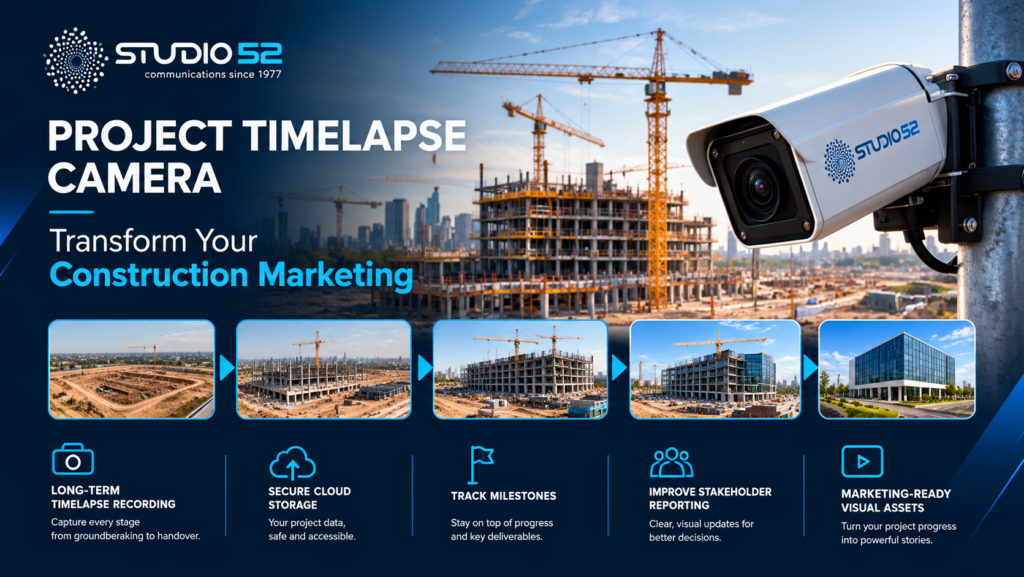
A project timelapse camera is a fixed, interval-shooting system installed on a construction site to capture the full lifecycle of a build. Unlike a handheld camera used for occasional site photos, a project timelapse camera runs continuously — often for months or years — capturing frames at set intervals that compress into a single video showing groundbreaking through handover in a few minutes.
The distinction that matters for marketing is intent. A camera installed purely for internal monitoring gets treated as infrastructure: something that runs in the background and rarely gets touched until someone needs to check a specific date. A camera installed with marketing in mind gets positioned, framed, and edited the same way a brand would approach any other piece of content — which is exactly why Studio52’s guide to choosing the ideal construction timelapse camera treats camera selection and marketing use as connected decisions, not separate ones.
Why Timelapse Has Become a Marketing Tool, Not Just Documentation
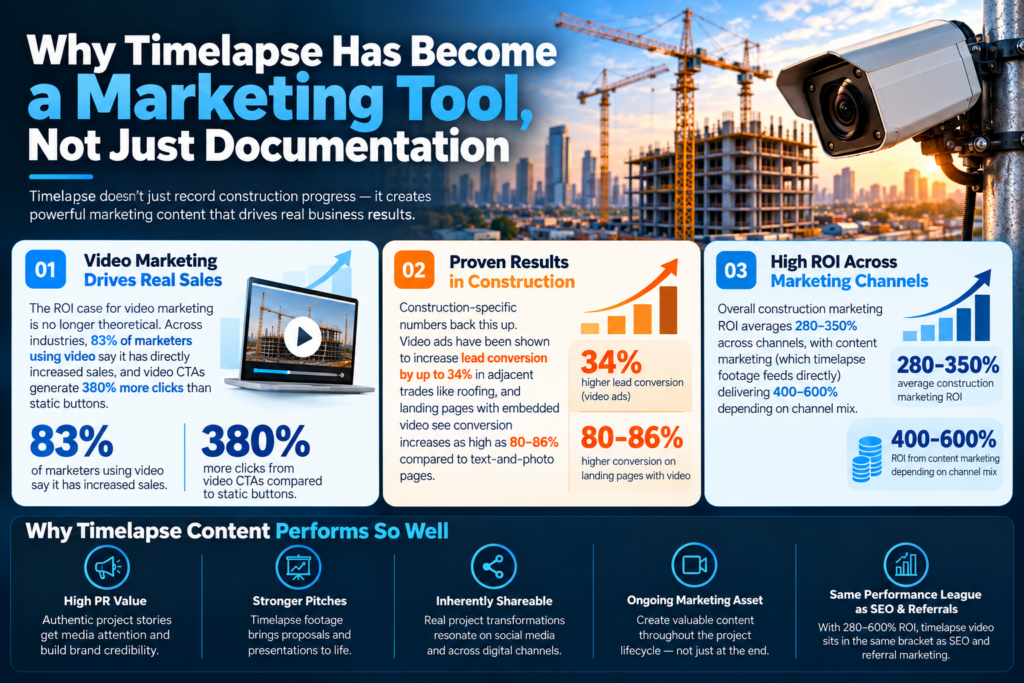
- The ROI case for video marketing is no longer theoretical. Across industries, 83% of marketers using video say it has directly increased sales, and video CTAs generate 380% more clicks than static buttons. For a category like construction, where the actual product — a finished building — literally cannot be shown until the project is complete, timelapse footage is one of the only ways to market the process itself while it’s still happening.
- Construction-specific numbers back this up. Video ads have been shown to increase lead conversion by up to 34% in adjacent trades like roofing, and landing pages with embedded video see conversion increases as high as 80–86% compared to text-and-photo pages. A project timelapse camera produces exactly the kind of native, authentic video content that performs in those placements — it isn’t stock footage or a staged shoot, it’s the actual project.
- Overall construction marketing ROI averages 280–350% across channels, with content marketing (which timelapse footage feeds directly) delivering 400–600% depending on channel mix. That puts project timelapse video in the same performance bracket as SEO and referral marketing — channels most construction firms already treat as priorities. It’s the same logic behind Studio52’s rundown of the benefits of construction timelapse video: high PR value, strong pitch-presentation impact, and content that’s inherently shareable because it documents something real.
The Data: How Video Actually Moves Construction Marketing
- Short-form is winning, and timelapse is naturally suited to it. The average B2B video length has compressed from 168 seconds in 2024 to just 76 seconds in 2026, and 71% of marketers say videos between 30 seconds and 2 minutes perform best. A project timelapse camera’s raw output can be cut to almost any length without losing its core value — a 45-second social clip works just as well as a 3-minute investor cut, because the underlying footage is the same continuous record.
- Platform-specific engagement backs the format choice. LinkedIn native video achieves 5.1–6% engagement compared to 2–3% for static image posts — a meaningful gap for B2B construction marketing, where LinkedIn is often the primary channel for reaching developers, EPC contractors, and investors. Emails containing video previews see up to 300% higher click-through rates, which matters directly for firms sending project updates to stakeholder lists.
- None of this requires new production infrastructure. The camera is already mounted on site for documentation purposes; what changes is treating the output as a content asset with a distribution plan, rather than a file that sits unused until someone asks for it.
What a Project Timelapse Camera Actually Captures
- Groundbreaking to structural completion. The earliest phases — site clearance, excavation, foundation work — are often the least visually interesting in isolation, but they matter enormously in the final compressed video, establishing scale and giving the transformation its full weight.
- Milestone moments that would otherwise go undocumented. Topping-out ceremonies, façade completion, MEP fit-out — a fixed camera captures all of it automatically, without needing anyone to remember to bring a camera to site on the right day.
- The daily grind that makes the final video credible. Crews moving, cranes swinging, materials arriving — this is the texture that separates an authentic project timelapse from a polished but generic stock construction clip, and it’s precisely the kind of unscripted, native content that outperforms staged marketing footage. Studio52’s work with UAE developers is a useful reference point for how continuous coverage looks across a full project lifecycle.
Where Project Timelapse Footage Gets Used
Tender and bid proposals. A visual record of how efficiently a past project moved from start to finish is harder to dismiss than a written case study, and it’s increasingly expected as supporting material in competitive bids.
Social media and website content. Short cuts optimized for LinkedIn, Instagram, or a homepage hero section turn a single continuous shoot into weeks of distributable content without any additional filming.
Investor and stakeholder updates. International investors who can’t visit the site regularly get a visual progress report that’s more convincing than a status email, aligning with what Studio52 covers in its guide to showcasing a project’s progress story.
Portfolio and business development material. Completed projects become permanent assets that keep generating value long after handover — a point Studio52 explores in depth in its breakdown of construction progress documentaries combining timelapse, drone, and on-site footage for firms that want to go beyond a single continuous timelapse shot.
Choosing a Camera Built for Marketing-Grade Footage
Not every documentation camera produces footage worth marketing with. A camera chosen purely for reliability might capture the project accurately but lack the resolution, dynamic range, or framing control needed for content that looks credible next to a firm’s other marketing material.
An outdoor timelapse camera built for GCC conditions needs to survive the climate without sacrificing image quality. That means weatherproof housing rated for heat, dust, and humidity, paired with 4K-or-higher resolution so footage can be cropped, zoomed, and repurposed across formats — vertical for social, widescreen for a website banner, and a longer cut for an investor presentation, all from one original capture.
Placement matters as much as specification. A camera aimed only at the building itself misses the cranes, the crew, and the skyline shifting around the site — the context that makes a timelapse video feel alive rather than clinical. Getting that right from day one avoids having to reposition equipment mid-project and losing continuity in the footage.
For multi-year projects, long-term equipment reliability becomes its own marketing consideration — a camera that fails midway through a build leaves a visible gap in the final footage. Studio52’s long-term 4K–8K construction timelapse solutions are built specifically around solar power and remote diagnostics so continuous coverage survives the full project timeline.
Turning Raw Footage Into Marketing Content
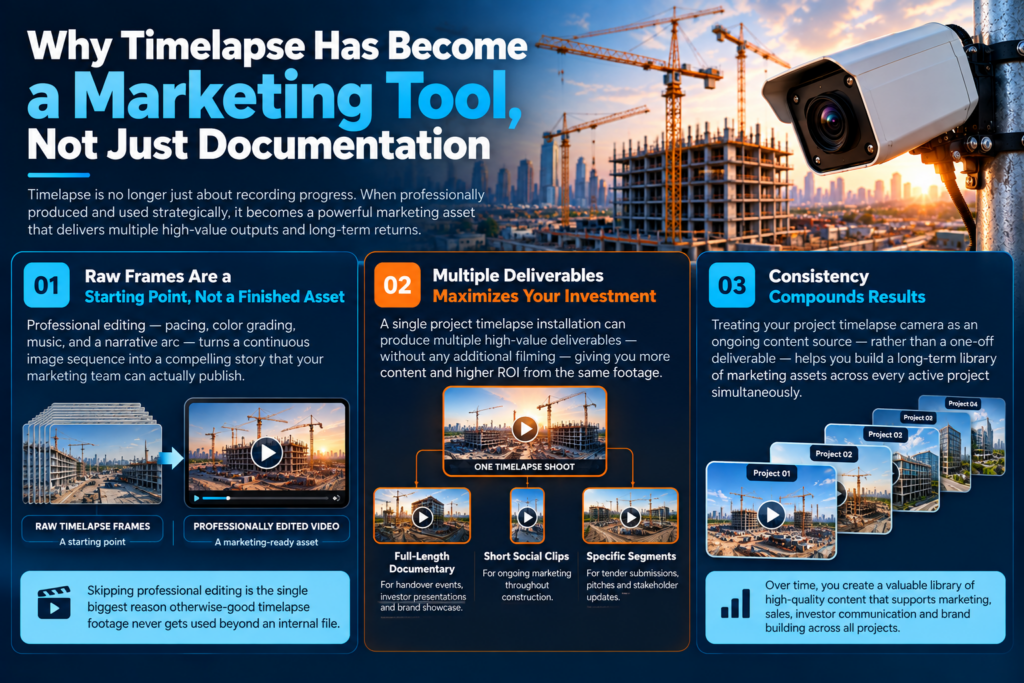
- Raw timelapse frames are a starting point, not a finished asset. Professional editing — pacing, color grading, music, and a narrative arc — is what turns a continuous image sequence into something a marketing team would actually publish. Skipping this step is the single biggest reason otherwise-good timelapse footage never gets used for anything beyond an internal file.
- Multiple deliverables from one shoot maximizes the return on the camera investment. A single project timelapse installation can realistically produce a full-length documentary cut for handover events, a series of short social clips released throughout construction, and specific segments pulled for tender submissions — all without additional filming.
- Consistency compounds. A firm that treats its project timelapse camera as an ongoing content source, rather than a one-off deliverable at project completion, builds a library of marketing assets across every active project simultaneously.
Studio52’s Approach to Project Timelapse Marketing
Studio52 installs and manages project timelapse cameras across the UAE with marketing outcomes built into the process from day one, not added afterward. Every installation includes site assessment for optimal framing, weatherproof 4K–8K equipment engineered for the region’s climate, remote cloud access for stakeholders, and professional post-production that produces multiple deliverables from a single continuous shoot — full-length documentary cuts, short-form social content, and tender-ready segments.
Our teams have documented projects for major UAE developers and EPC contractors, turning site cameras that would otherwise sit unused into an active part of each client’s marketing output.
Want your project timelapse footage working as hard as the rest of your marketing?
Get a customized quote from Studio52’s team.
Conclusion
A project timelapse camera earns its place on site through documentation value alone — but treating it purely as a record-keeping tool leaves real marketing value on the table. With video already delivering some of the strongest ROI of any construction marketing channel, and with the camera and footage already paid for as part of standard project monitoring, turning that output into tender material, social content, and investor updates is one of the lowest-cost upgrades available to a construction marketing plan.
FAQs
What’s the difference between a project timelapse camera and a standard construction monitoring camera?
Can timelapse footage really be used for marketing, or is it just for internal records?
How long should marketing-focused timelapse clips be?
Do I need a different camera if I want to use timelapse footage for marketing, not just documentation?
What can a construction company actually do with one project’s timelapse footage?
Why choose Studio52 for project timelapse camera installation in the UAE?
Sources: Vidico – 70+ Video Marketing Statistics for 2026, Web Tonic – Construction Materials Digital Marketing Stats 2026, Siana Marketing – Construction Marketing ROI 2026 Report, Levitate Media – B2B Video Marketing Statistics 2026