Saudi Arabia’s real estate market is on track to grow from roughly USD 84.1 billion in 2026 to USD 141.6 billion by 2034, and residential construction alone already accounts for 42.5% of the sector. Every one of those projects needs to convince someone — an investor, an off-plan buyer, a government body releasing funding — that construction is actually happening on schedule. A construction progress video is how developers prove it.
This isn’t a niche production request anymore. As Vision 2030 giga-projects and off-plan sales models reshape how Saudi property gets marketed and financed, construction progress video has moved from “nice to have” to a standard part of how developers sell, report, and build trust before a single unit is handed over.
Table of Content
What Is a Real Estate Construction Progress Video?
A real estate construction progress video is a compiled visual record of a development’s construction, built from images captured at regular intervals and compressed into a short, watchable sequence. Unlike a one-off site photo or a single drone flyover, it shows continuous, dated progress — foundation to façade to handover — giving stakeholders an unbroken visual timeline rather than a snapshot.
For Saudi real estate specifically, this serves two audiences at once. Government bodies and joint-venture partners use it for compliance and milestone verification, while sales and marketing teams use the same footage, edited differently, to sell units before the building exists. Studio52’s guide on construction project documentation in Saudi Arabia covers exactly this dual role in more depth.
Saudi Arabia’s Real Estate Boom by the Numbers
The scale of development underway makes documentation a necessity, not an option. The Saudi construction market reached USD 101.4 billion in 2025 and is projected to grow at a 3.6% CAGR through 2034, with the sector expected to expand 3% in real terms in 2026 alone, driven by government infrastructure allocations and renewable energy investment.
Vision 2030 giga-projects are pulling enormous capital into the pipeline. NEOM alone secured $24 billion in contracts in October 2025, and Saudi Arabia’s new property law — effective January 2026 — now allows foreign ownership in major cities while reducing transaction taxes, opening the market to a wider pool of international buyers who often can’t visit a site in person before committing.
That combination — more projects, more foreign capital, less ability to physically inspect a site — is exactly what makes construction progress video a structural need rather than a marketing add-on. Investors based abroad need a reliable way to see their money translating into physical progress, and a dated, continuous video record is the clearest way to provide that.
Why Video Sells Property Faster
The performance gap between video and static marketing in real estate is large and well documented. Listings that include video receive about 403% more inquiries than those without, and properties with virtual tours sell around 31% faster. On Zillow, listings with a 3D home tour are saved 75% more and viewed 65% more than listings without one.
Video also affects final sale price, not just interest. Homes marketed with video sell for an average of 6% more than comparable homes without it — on a SAR 1.7 million (roughly $450,000) property, that’s on the order of $27,000 in additional value from video alone.
Yet adoption remains low, which is itself an opportunity. Only around 38% of real estate agents use video at all, and just 9% actually produce dedicated listing videos, even though 73% of homeowners say they’re more likely to list with an agent who uses it. For Saudi developers marketing off-plan units, a professionally produced construction progress video is a way to stand out in a market where most competitors still rely on static renders and photos.
The Data: How Progress Video Performs for Developers
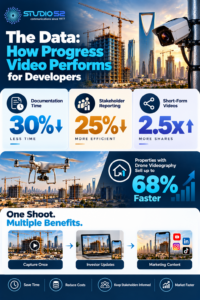 Beyond real estate marketing generally, timelapse and progress documentation carry specific operational benefits. Integrating time-lapse video production into construction workflows has been shown to reduce project documentation time by up to 30% and streamline stakeholder reporting by as much as 25%, according to Studio52’s own analysis of time-lapse solutions for Saudi construction projects — meaning the same footage that markets a project to buyers also cuts the internal cost of keeping stakeholders updated.
Short-form performs best for distribution. Property videos under 60 seconds generate 2.5x more social shares than longer-form content, which matters for developers looking to turn a single continuous timelapse shoot into an ongoing stream of shareable milestone clips rather than one long video released at handover.
Aerial and immersive formats amplify the effect further. Research cited in Studio52’s coverage of FPV videos for property sales in Saudi Arabia found that properties marketed with drone videography sell up to 68% faster than those relying on static images alone — a stat that applies just as directly to a finished progress video used at handover as it does to a completed unit walkthrough.
What a Construction Progress Video Actually Shows Buyers and Investors
Foundation and structural milestones that establish credibility. Early-phase footage — site clearance, piling, foundation pours — rarely looks exciting on its own, but it’s what gives the final compressed video its weight, proving the project started on schedule and giving the full transformation its scale.
Façade, MEP, and interior fit-out progress that off-plan buyers specifically want to see. For buyers purchasing before completion, visual proof that a unit is genuinely progressing — not just that a sales office exists — is often the single biggest factor in maintaining confidence through a multi-year build.
The handover-ready final sequence that becomes a permanent marketing and portfolio asset. Once complete, the video doesn’t get retired — it becomes case-study material for the next project’s investor deck and sales presentations.
Weatherproof Requirements for Saudi Job Sites
Saudi Arabia is an unforgiving environment for unprotected camera equipment. Daytime temperatures regularly cross 45°C, sandstorms can coat exposed electronics in fine dust within hours, and coastal sites near Jeddah or NEOM face salt-laden humidity that standard consumer cameras were never built to survive.
A weatherproof timelapse camera needs sealed housing, solar power, and 4K-or-higher resolution as standard. Properly sealed enclosures protect the lens and internal electronics from dust ingress and heat damage, while solar power removes dependence on unreliable site electricity — and higher resolution matters because the same footage often gets repurposed across formats, from a vertical social clip to a widescreen investor presentation.
Gaps in coverage are the biggest risk to the final product. A camera that fails mid-project during the harshest summer months leaves a visible hole in the final video exactly when the site is changing fastest — which is why continuous monitoring and maintenance matter as much as the camera hardware itself.
From Job Site Footage to Sales Asset
Raw timelapse frames need professional editing before they’re worth showing to a buyer or investor. Color grading evens out the lighting differences between a sunrise shoot and midday glare, frame blending removes flicker caused by moving cranes or shifting shadows, and added music, captions, and milestone markers turn a technical record into a narrative someone actually wants to watch.
One shoot, multiple deliverables. The same underlying footage can produce a full-length documentary for investor presentations, short milestone clips for social media released throughout construction, and a handover-ready highlight reel for the sales team — all without additional filming once the camera system is in place.
Combining formats increases impact. Pairing continuous timelapse coverage with periodic drone flights and on-site interviews, as covered in Studio52’s breakdown of construction progress documentaries combining timelapse, drone, and on-site footage, produces a more complete documentation package than a single camera feed alone.
Who Uses Construction Progress Video in Saudi Real Estate
Developers use it to sell off-plan units and satisfy funding milestones simultaneously. The same footage that reassures a bank or government body releasing construction financing doubles as sales material for the marketing team — a rare case of one asset serving two completely different stakeholders.
International investors rely on it because they can’t visit regularly. A dated, continuous visual record gives overseas capital a reliable substitute for physical site visits, particularly relevant now that Saudi Arabia’s 2026 property law changes are opening the market to more foreign buyers.
Real estate agents and marketing teams use it to differentiate listings in a market where video adoption is still low. With only about 9% of agents producing dedicated listing videos, a well-produced construction progress video is a straightforward way to stand out. Studio52’s work with UAE developers on similar continuous-coverage projects shows how this plays out across a full project lifecycle.
Studio52’s Real Estate Construction Progress Video Service
Studio52 provides end-to-end construction progress video production across Saudi Arabia, from Riyadh and Jeddah to NEOM and coastal developments. Every installation includes site assessment, weatherproof 4K–8K camera systems engineered for the Kingdom’s heat and dust, remote cloud monitoring for stakeholders who can’t visit in person, and professional post-production that turns raw footage into deliverables for investor presentations, marketing campaigns, and sales teams alike.
Our teams have supported developers across residential, commercial, and giga-project developments, and Studio52’s coverage of tracking construction progress in Saudi Arabia with time-lapse reflects the same approach we bring to every real estate client in the Kingdom.
Ready to turn your Saudi development’s construction progress into a sales and reporting asset? Get a customized quote from Studio52’s team.
Conclusion
In a market growing as fast as Saudi Arabia’s real estate sector, static renders and occasional site photos are no longer enough to satisfy investors, government bodies, or off-plan buyers who increasingly expect visual proof of progress. A well-produced construction progress video does double duty — cutting internal reporting time while directly improving how fast and how confidently a property sells. For developers already documenting construction anyway, turning that footage into a genuine marketing asset is one of the highest-leverage moves available.
FAQs
What is a real estate construction progress video used for in Saudi Arabia?
It serves two purposes simultaneously: satisfying investor and government reporting requirements with dated, continuous proof of progress, and providing sales and marketing teams with footage to market off-plan units before completion.
Does video really help sell property faster in Saudi Arabia?
Yes. Listings with video see about 403% more inquiries, sell around 31% faster with virtual tours, and typically achieve about 6% higher sale prices than listings relying on static images alone.
Can a single construction progress video work for both investors and marketing?
Yes. The same underlying footage can be edited into different deliverables — a full-length version for investor and stakeholder updates, and shorter, milestone-focused cuts for social media and sales presentations.
How does Saudi Arabia’s climate affect construction progress video equipment?
Extreme heat, sandstorms, and coastal humidity require weatherproof, solar-powered camera systems with sealed housings. Standard consumer cameras typically fail well before a multi-year project reaches completion.
How long does a construction progress video project typically run?
Coverage usually runs for the duration of construction, from a few months for smaller developments to several years for large giga-projects, with the camera and power setup adjusted to match the timeline.
Why choose Studio52 for construction progress video production in Saudi Arabia?
Studio52 combines weatherproof 4K–8K equipment built for the Kingdom’s climate with remote monitoring and professional post-production, delivering footage that satisfies both investor reporting requirements and real estate marketing needs from a single installation.
Sources: IMARC Group – Saudi Arabia Real Estate Market Size & Forecast, IMARC Group – Saudi Arabia Construction Market Size & Forecast, PhotoUp – Real Estate Video Statistics 2026, Amplifiles – Real Estate Video Stats: 403% More Inquiries