
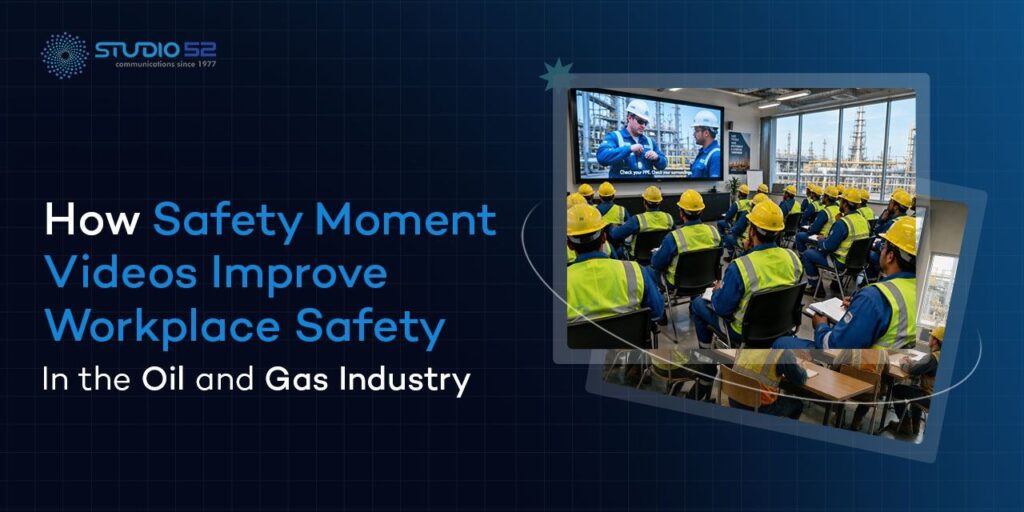

Workplaces deal with serious day-to-day risks on oil and gas sites in the UAE, Saudi Arabia, Oman, and Kuwait. A routine shift can turn into a tragedy with one small mistake at a drilling site or refinery.
Organisations spend a great deal of resources on HSE video, policy, safety signage, and toolbox talks. Yet incidents still happen. Workers sometimes miss key details. Others perish needlessly, overwhelmed by reams of health and safety procedures written in a language that they do not really speak.
With energy production itself, there are certain operational risks associated with it. Every day, offshore platforms, refineries and desert drilling rigs operate under pressure. Working at hot temperatures, exposed to heavy machinery and coming into contact with toxic gas means constant care whilst operating.
This is where an oil and gas safety moment video they can actually watch makes a difference. Concise, tight, and visual there is one clear safety message at a time in these videos. They slot seamlessly into your shift briefings, pre-job checks, and daily toolbox sessions.
In this blog, we will explore how these videos work, the science behind their effectiveness, and why more Gulf-based companies are utilising them to keep their people safe on a daily basis.
Table of Content
What Is a Safety Moment Video
A safety moment video is a short training clip usually two to five minutes long. It focuses on a single workplace hazard or safety rule. Nothing more.
You do not get a long module or a full course. You get one clear message, shown simply. That simplicity is the point.
Workplace safety videos of this format are designed to grab attention fast. They often open with a real-world scenario. A worker approaches a confined space. A valve is about to be opened without a permit. What happens next? The video shows it clearly and then explains how to do it right.
These videos are used in toolbox talks, pre-shift briefings, safety inductions, and refresher sessions. They work for frontline workers, contractors, and new joiners equally well.
In the Gulf region especially, where teams often include workers from multiple countries, a visual video in Arabic or English removes the language barrier that written manuals create.
Why Traditional Safety Communication Sometimes Falls Short
Safety managers are always searching for ways to minimise site incidents. Morning pre-shift safety briefings tend to lose the attention of workers. Text-heavy manuals collect dust on office bookshelves while staff in remote areas work under dangerous conditions.
Most companies follow a standard process print a safety manual, hold a briefing, sign the attendance sheet. That process ticks a compliance box. But it does not always change what happens on site.
- Long manuals are hard to read in a second or third language
- Classroom sessions lose attention quickly in warm outdoor environments
- Repeated briefings on the same topic start to feel routine workers stop listening
- Invisible hazards like gas leaks or pressure build-up cannot be demonstrated live
- Shift workers arriving at different times often miss sessions entirely
- New contractors join with little time for deep safety orientation
None of this means HSE teams are not doing their job. It means the tools being used have real limitations. Written procedures describe what to do. Oil and gas safety videos show it and that difference matters when a worker has to recall a step under pressure.
How Safety Moment Videos Can Strengthen Oil & Gas Workplace Safety
Safety training videos fill the gap that documents leave behind. They work because they combine what people see with what they hear and the combination sticks.
Here are the ways to strengthen safety in the oil and gas industry:
- Workers see the exact sequence of a safe procedure — not a description of it.
- Animated hazards show what cameras cannot film safely, like internal pressure events.
- Short format keeps attention from start to finish — no one zones out at minute two.
- Videos play identically every time — no trainer variation, no missed steps.
- Multilingual voiceovers reach every worker on a mixed-nationality team.
- Digital delivery via LMS or mobile means workers access them before or after a shift.
| Training Retention: What Workers Remember After 24 Hours | |
|---|---|
| Safety Video (visual) | 65% |
| Classroom Session | 32% |
| Printed Manual | 18% |
| Verbal Briefing Only | 10% |
Sample data based on typical results in adult learning research
From Gas Leaks to Confined Spaces: Safety Topics Worth Turning Into Videos
Almost every high-risk task in oil and gas has a topic that would benefit from a short video. Some scenarios are impossible to film safely. Animation makes them visible.
- Confined space entry and permit requirements
- H₂S gas detection and emergency response
- Working at height and fall prevention
- Hot work permits and ignition control
- Fire and explosion emergency procedures
- Crane and lifting operations
- Lockout and tagout (LOTO) procedure
- PPE selection and correct usage
- Chemical spill containment
- Offshore evacuation and muster drills
- Plant vehicle and pedestrian safety
- Pipeline pressure and valve safety
Each of these topics is a focused industrial safety video that a worker watches in under five minutes and remembers long after the briefing ends.
What Makes an Oil & Gas Safety Moment Video Truly Effective?
Not all safety videos work equally well. The ones that change behaviour share a specific set of qualities.
- One clear message per video: no information overload, no distractions
- Realistic scenario opening: workers recognise a situation they face on their own site
- Accurate PPE and procedures shown on screen: every detail must match real site standards
- Plain language throughout: even complex topics use simple words
- Professional voiceover in Arabic or English: for Gulf workforce teams
- A clear do and don’t contrast: workers see the wrong action and the right one
- Short runtime: two to five minutes maximum for toolbox use
Studio52’s safety video production team builds each video in close collaboration with HSE professionals, ensuring that technical accuracy is never compromised for visual appeal.
Why Short, Scenario-Based Safety Videos Can Make a Difference
Short, scenario-based videos show real workers facing recognisable site situations. Rather than dry rules, each video shows a relatable issue and the correct safety resolution. Scenario-based learning captivates employees with real-life stories. Here are the steps:
Step 1: Real Field Scenario
Step 2: Near-Miss Hazard
Step 3: Correct Action Shown
Step 4: Safe Outcome Achieved
A worker watches a peer on screen encounter a pressurised pipe fitting. The video shows the near-miss consequence of skipping a pressure check, followed immediately by the correct isolation procedure.
Reduce workplace safety risks with an effective HSE Induction Video. Improve employee awareness, communicate essential safety procedures, and build safer workplaces with professional video solutions tailored to your organization.
This short narrative format creates an emotional connection. Workers remember the visual story when performing similar tasks on the rig floor later that day. Concise safety training videos deliver these lessons effectively in under two minutes without breaking work momentum.
2D vs. 3D Animation: Which Works for Oil & Gas Safety Videos?
Both safety animation formats for the oil and gas industry deliver strong results. The right choice depends on what the video needs to show. Both formats play valuable roles in site safety communications.
| Feature/Criteria | 2D Animation | 3D Animation |
| Visual Realism | Stylised graphics and character illustrations | Photorealistic equipment and life-like environment rendering |
| Technical Depth | Shows surface actions and simple workflows | Displays internal valve flows, pressure drops, and structural cuts |
| Production Time | Faster delivery turnarounds | Requires detailed CAD asset modelling |
| Cost Efficiency | Lower production investment | Higher investment for complex technical details |
| Equipment detail | Limited with simplified representation | High with replica of valves, rigs, vessels |
| Worker engagement | High. Clear visual storytelling | Very high. Immersive and realistic |
| Best suited | General rules, slip or trip hazards, office safety | Complex machinery, subsurface geology, piping internals |
Using custom safety animation for oil and gas industry applications lets companies reveal dangerous internal processes. For example, 3D graphics can show explosive gas igniting inside a pipe, giving workers a clear view of invisible microscopic hazards.
How Companies Can Measure the Impact of Safety Moment Videos
Investment in workplace safety videos needs to show results. Here are some practical ways to monitor the performance of your safety videos.
| Performance Metrics | What It Tells You | How To Apply |
| Pre- and post-quiz scores | Knowledge gain per worker | Run a 5-question quiz before and after each video session |
| Near-miss trend tracking | Reduction in incidents on a covered topic | Compare monthly incident logs before and after video rollout |
| LMS completion rates | How many workers actually watched | Track via your learning management system dashboard |
| Observation audits | Behavioural changes on site | Supervisors check if correct procedures are now followed |
| Worker feedback surveys | Clarity and usefulness of the video | Short three-question form after each toolbox session |
| Incident cost comparison | Financial impact of safer behavior | Compare incident-related costs year on year |
Companies in Saudi Arabia and the UAE increasingly require documented HSE training for regulatory audits. Video records with LMS completion logs serve as strong compliance evidence.
The Future of Safety Communication in the Oil & Gas Industry
Safety communication in the Gulf is moving fast. Workers are now able to access digital-first approaches on phones, tablets, and site kiosks instead of static posters and paper manuals
- Mobile-ready safety videos for remote desert and offshore locations.
- QR codes on equipment that link directly to the relevant training video.
- Interactive animated safety modules with built-in quizzes.
- AI-assisted scenario generation for faster, lower-cost video production.
- Multilingual delivery in Arabic, Urdu, Hindi, Tagalog, and English for Gulf crews.
- Incident reconstruction videos that turn past near-misses into learning tools.
ADNOC, Saudi Aramco, OQ, and KPC contractors already use digital safety video libraries as part of their HSE management systems. The companies that build these libraries now will have a significant safety culture advantage in the years ahead.
The future of safety training videos in this region is not just about compliance. It’s ensuring that all workers, regardless of their language, experience, or shift, receive the same quality safety training daily.
Conclusion
Oil and gas operations across the UAE, Saudi Arabia, Oman, and Kuwait face hazards that written guidance by itself can’t eliminate. Manufacturing & Industrial safety videos offer energy companies a practical way to protect site workers. It delivers one clear message at a time. It addresses hazards that cameras cannot capture. It reaches multilingual crews without confusion.
The investment is small compared to the cost of one serious incident. The return is a safer site, every shift, for every worker on it.
Ready to Build Your Safety Video Library?
Studio52 produces customised safety moment videos for oil and gas companies across the UAE, Saudi Arabia, Oman, and Kuwait. From 2D and 3D animation to multilingual voiceover and LMS-ready delivery we cover it all.
UAE: +971 44541054
Saudi Arabia: +966 12 4220506
Email: askus@studio52.tv
FAQs
Why are safety moment videos important in the oil and gas industry?
What topics can be covered in an oil and gas safety moment video?
Can safety moment videos be used for toolbox talks?
Can animated safety videos demonstrate dangerous oil and gas scenarios?
Can 3D animation explain complex oil and gas equipment?